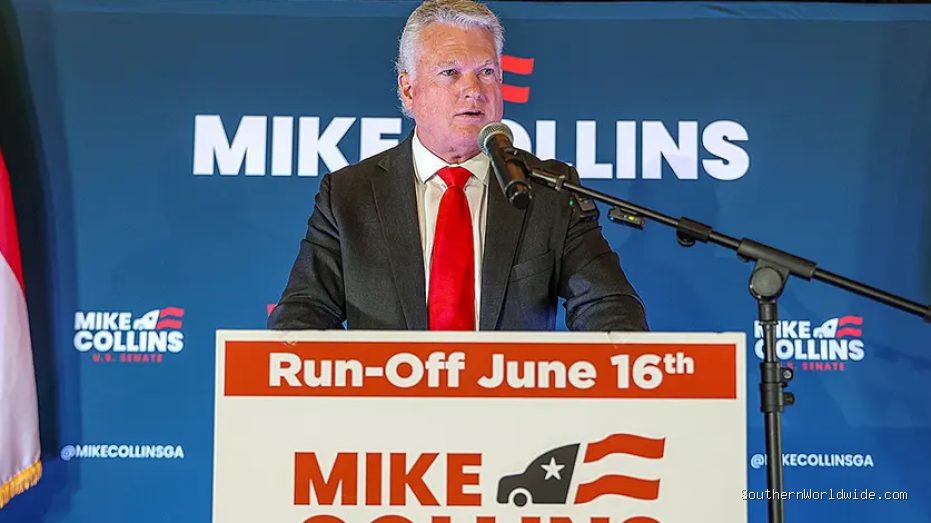
SouthernWorldwide.com – Republican Representative Mike Collins, a vocal supporter of former President Donald Trump and a champion of the MAGA movement, has emerged victorious from a fiercely contested runoff election for the GOP Senate nomination in Georgia. This win propels him into a high-stakes general election race.
The Associated Press reports that Collins defeated former college football coach Derek Dooley in the Republican runoff held on Tuesday. He is now set to face Democratic Senator Jon Ossoff in the November election. This race is considered one of the pivotal contests that could determine whether the Republican Party retains its narrow majority in the Senate following the upcoming midterm elections.
Republicans have identified Ossoff as a particularly vulnerable Democratic incumbent seeking re-election, and he is a primary target for the party’s efforts to regain Senate control.
Collins, a two-term congressman representing Georgia’s 10th Congressional District, located between Atlanta and Augusta, is the son of the late Representative Mac Collins. He also co-owns a trucking company with his wife.
The runoff featured Collins and Dooley, an attorney and former coach at the University of Tennessee, whose father was the legendary head football coach at the University of Georgia. They were the top two vote-getters in a crowded primary field that also included Representative Buddy Carter. However, as no candidate secured over 50% of the vote in the initial primary, a runoff was necessitated.
While Collins actively campaigned on his MAGA credentials and his support for former President Trump, Trump himself maintained a neutral stance in Georgia’s primary and runoff elections for the Senate until the Saturday prior to the runoff.
When asked if Trump’s endorsement in Georgia had come too late to be impactful, Collins expressed confidence, stating, “I don’t think President Trump ever is too late. He has this impeccable ability of putting his thumb right on the scale at the right time with whatever he wants to do.”
Dooley, conversely, received strong backing from his longtime friend and popular conservative Governor Brian Kemp, who is nearing the end of his term. Governor Kemp and his wife, Georgia’s First Lady Marty Kemp, frequently appeared with Dooley on the campaign trail, and the governor’s top political advisor served as a senior consultant for Dooley’s Senate campaign.
“I’m honored to have Governor Kemp’s endorsement. I certainly would have been honored to have the President’s endorsement. But the most important endorsement that I’m fighting for is the people of Georgia,” Dooley emphasized.
Dooley sought to portray himself as an outsider and positioned Collins as a political insider. In contrast, Collins criticized Dooley for his lack of political experience and for having lived outside of Georgia for a significant portion of his adult life.
“Not having a record is not gonna win this thing. But having a records of results will,” Collins told his supporters on the eve of the runoff, highlighting his own legislative achievements.
Both candidates faced scrutiny over past controversies. The House Ethics Committee investigated Collins regarding allegations that he paid an intern in his district office who was in a romantic relationship with his congressional chief of staff, despite the intern reportedly not performing any work. Collins denied any wrongdoing and initially retained the staffer on his Senate campaign.
However, the staffer was later dismissed by Collins after making social media posts on behalf of the campaign that mocked the wife of a Dooley campaign advisor. This advisor had attempted suicide after accusing Matt Lauer of rape. The social media post was subsequently deleted, and Collins issued an apology, describing the tweet as “despicable and unauthorized.”
In Dooley’s case, reports emerged in the week leading up to the runoff accusing him of involvement in a “pay-to-play” scandal with his brother, Daniel Dooley, and the governor. Both Dooley and Kemp have denied any wrongdoing, but Democratic legislators have called for an independent investigation into the matter.
While the Republican primary battle has been intense, Senator Ossoff has been diligently building a substantial campaign fund. This financial advantage is expected to provide him with a significant edge in fundraising as the general election campaign commences.
“I know how to win this race. I look forward to getting the governor’s endorsement. I look forward to getting his help in this thing. I look forward to getting Derrick Dooley’s help in this thing,” Collins stated when asked by Fox Digital about his ability to unite Republican voters for the general election.
Collins stressed the importance of party unity, asserting, “at the end of the day, we’re all Republicans, and we’re on one mission, and that is to put a Republican in that seat and get somebody that represents…the state of Georgia.”
The influence of presidential endorsements has been a significant factor in recent GOP primaries. Over the past six weeks, Trump-backed candidates have successfully ousted incumbents he opposed in high-profile contests across Indiana, Louisiana, Kentucky, and Texas.
However, Trump’s streak of statewide and congressional endorsements faced a setback two weeks prior. His last-minute endorsement of Republican Representative Randy Feenstra in Iowa, who was running to succeed retiring Governor Kim Reynolds, was not enough to secure victory for the three-term congressman.
Feenstra was narrowly defeated by Zach Lahn, a businessman, farmer, and former political strategist. Lahn received support from political groups aligned with the Make America Healthy Again movement, associated with former Trump Health Secretary Robert F. Kennedy Jr., and Turning Point USA, a prominent conservative organization co-founded by the late Charlie Kirk.
Trump saw a return to form the following week. In the South Carolina GOP gubernatorial primary, the candidate he endorsed, Lieutenant Governor Pamela Evette, secured first place in a crowded field, clinching one of the two spots in the race for the nomination.
Separately, Senator Lindsey Graham, a long-time ally of Trump, secured a majority of the vote in the Republican Senate primary, thereby avoiding a runoff. Graham, who was endorsed by Trump, faced primary challenges from five candidates, including conservative businessman Mark Lynch. Lynch had criticized Graham for his support of military action in Iran and was backed by some MAGA figures critical of the former president.