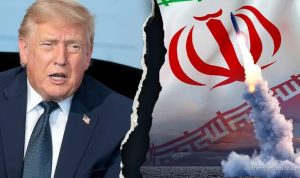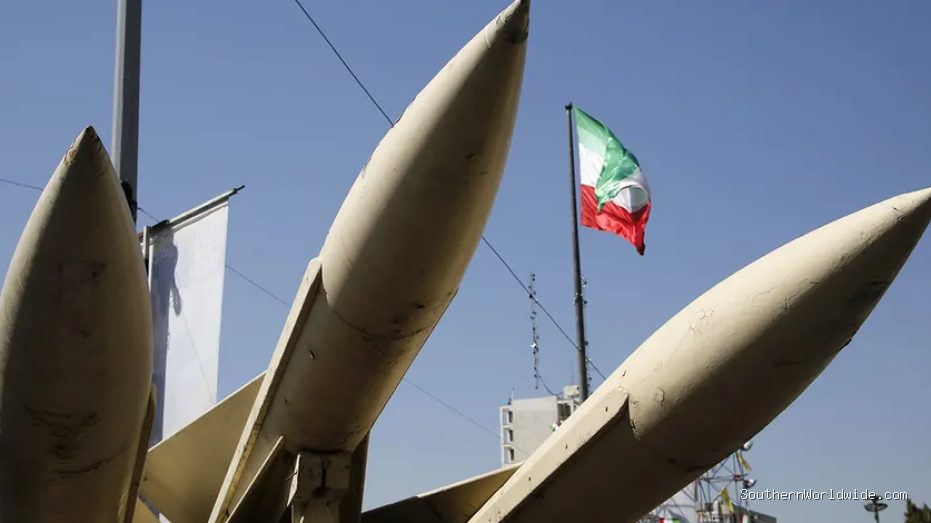
SouthernWorldwide.com – President Donald Trump has recently expressed a shift in his stance regarding Iran’s missile capabilities, stating they “aren’t the problem.” This comes after the White House had previously made Iran’s missile arsenal a central justification for military actions against the country.
For an extended period, high-ranking officials within the Trump administration consistently argued that Iran’s ballistic missiles served as a protective shield for its nuclear ambitions. This assertion was a key reason cited for the initiation of Operation Epic Fury, a series of attacks targeting Iran.
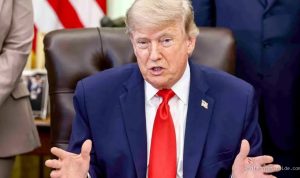
However, during a press conference at the G7 international forum, President Trump suggested that Iran possessing missiles might not be an issue after all. He remarked that if other nations possess similar capabilities, it would be unfair to deny Iran the same. Trump specifically mentioned Saudi Arabia and Qatar as examples of countries with missile arsenals.
“If other countries have them, it’s a little bit unfair for them not to have some. If Saudi Arabia and Qatar, and they all have some, I would say that in relative proportion, I think it’s okay,” Trump stated. He further elaborated, “Am I going to let Saudi Arabia have missiles, but (Iran) can’t have them? It doesn’t work that way.”
He downplayed the threat posed by Iran’s missiles, saying, “Missiles aren’t the problem. They hurt a little location, but they don’t blow up the planet.” Trump indicated that the Gulf nations would be responsible for addressing non-nuclear issues, including ballistic missiles and the “terrorist proxies that they have.”
These statements represent a notable departure from the strong rhetoric previously employed by senior administration officials. In March, Secretary of State Marco Rubio had emphasized that Iran could not be allowed to use its ballistic missile program as a cover for a nuclear weapons program.
“Iran can never have a nuclear weapon, and we will not allow Iran to hide behind the immunity of a massive short-term ballistic missile inventory, or the ability to make them or launch them,” Rubio had told reporters. He characterized Iran’s efforts to build conventional weapons as a deliberate attempt to create a “shield to hide behind.”
Other high-ranking officials had also repeatedly identified degrading Iran’s missile capabilities as a primary objective of Operation Epic Fury. Shortly after the operation began, Trump himself stated, “Our objectives are clear. First, we’re destroying Iran’s missile capabilities… and their capacity to produce brand new ones.”
War Secretary Pete Hegseth further elaborated on March 4, stating that the mission was “laser-focused” on destroying Iran’s missiles and their production facilities. White House Press Secretary Karoline Leavitt echoed this sentiment, noting that a key administration goal was to “destroy the regime’s deadly ballistic missiles and completely raze their missile industry to the ground.”
Senator Rubio consistently reiterated this objective, arguing that diminishing Iran’s missile force was crucial to prevent the country from using its conventional military power as a pretext for developing a nuclear weapons program.
“This is about very specific objectives,” Rubio told reporters on March 30. He outlined four key goals: “the destruction of their air force. Number two, the destruction of their navy. Number three, the severe diminishing of their missile launching capability. And number four, the destruction of their factories so they can’t make more missiles and more drones to threaten us in the future.” Rubio stressed that these actions were intended to prevent Iran from acquiring a nuclear weapon, an objective he stated remained consistent from the outset.
Leavitt, on the same day, made similar remarks, highlighting that Operation Epic Fury aimed at “destroying their ballistic missiles” and dismantling their production infrastructure, while also ensuring Iran did not obtain nuclear weapons.
Trump’s recent comments at the G7 also cast a new light on the administration’s approach to Iran’s nuclear program, an issue that had previously been described with less flexibility.
The administration is currently engaged in negotiations for a memorandum of understanding with Iran, which leaves unresolved a significant point of contention in the nuclear discussions: the future of Tehran’s uranium enrichment program.
Under the preliminary agreement announced this week, the United States and Iran have agreed to a 60-day period to negotiate the fate of Iran’s stockpile of nearly 900 pounds of 60% enriched uranium, which is close to weapons-grade, as well as any future enrichment activities. Administration officials indicated that the minimum acceptable outcome under discussion would involve diluting the material under the supervision of the International Atomic Energy Agency.
Officials described Iran’s willingness to dilute its stockpile as a substantial concession. However, they also acknowledged that the memorandum does not definitively settle whether Iran will ultimately be permitted to maintain any enrichment capability.
Trump also adopted a seemingly more accommodating stance regarding Iran’s access to nuclear power for civilian purposes at the G7 summit.
“It is a little hard, though, when you say that somebody wants it, other people have it, other, adjoining states have it. And you’re not letting them have it for purposes of electricity and things like that,” Trump commented. “It’s always a little tough. You have to use a little common sense.”
Previously, the White House had maintained a much firmer position on Iran’s nuclear program. Special envoy Steve Witkoff had stated that the United States could not permit Iran to retain “even 1 percent” enrichment capability. White House officials had repeatedly characterized the cessation of Iranian enrichment as a critical red line.
When asked for further comment, the White House referred back to Trump’s recent statements on missiles.