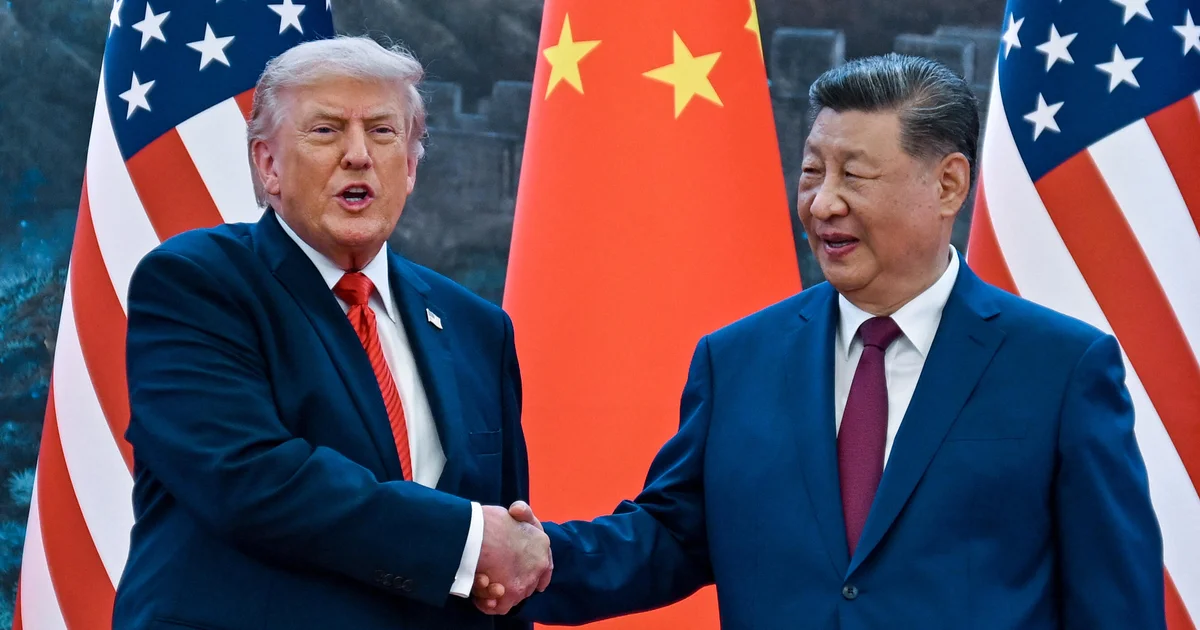
SouthernWorldwide.com – The recent summit between President Trump and Chinese President Xi Jinping aimed to de-escalate economic tensions between the two nations. However, experts suggest that the meeting did not yield any significant breakthroughs in trade deals for the United States.
Wendy Cutler, a former negotiator for the U.S. Trade Representative, expressed her expectation for China to announce substantial purchases of American agriculture, energy, and aircraft. She noted that President Trump and his team appeared to have little to show for the visit.
Despite these observations, President Trump described the meeting in Beijing as an “incredible visit,” highlighting “fantastic trade deals” and suggesting increased cooperation with China. Chinese officials also indicated a willingness for new avenues of collaboration.
David Meale, who leads the China practice at Eurasia Group, a political risk consultancy, commented that both sides claimed progress, but concrete details remain elusive. He believes this doesn’t necessarily signify a failure, but rather that final agreements still require detailed finalization.
A notable potential beneficiary of the talks is Boeing. President Trump announced that China committed to purchasing at least 200 aircraft from the U.S. aviation giant, with a potential to increase to 750 planes. However, this initial order was reportedly smaller than some analysts had anticipated.
Read more : Josh Mauro's Death Ruled Accidental Overdose of Fentanyl, Cocaine, and Ethanol
Boeing’s stock experienced a decline of 3.8% on Friday, suggesting that investors were not entirely impressed by the news of the aircraft deal.
President Trump also stated that China agreed to increase its purchases of U.S. oil and agricultural products, specifically mentioning “billions of dollars of soybeans.” A White House official confirmed that the trip resulted in significant agricultural agreements to boost U.S. farmers’ exports and an aircraft purchase agreement expected to create manufacturing jobs.
The White House further announced the establishment of a “Board of Trade” and a “Board of Investment” to oversee the economic relationship between the U.S. and China. More details regarding these agreements are expected to be released soon.
Non-binding commitments
Energy and trade experts pointed out the scarcity of specific details regarding the announced deals. Erica Downs, an expert on China’s energy policy and a senior research scholar at Columbia University’s Center on Global Energy Policy, noted the lack of confirmation on specific oil purchase volumes.
Downs stated that while China’s willingness to buy more U.S. energy might please President Trump, it does not create a binding commitment for China. Wendy Cutler, now a senior vice president at the Asia Society Policy Institute, had hoped for more concrete details on renewed Chinese commitments for other U.S. farm products like corn and beef.
Economists also highlighted that the deals announced by President Trump are currently verbal commitments without guaranteed execution. They recalled a similar situation in 2017, where an agreement for China Energy Investment Corporation to invest nearly $84 billion in West Virginia projects dissolved due to escalating U.S.-China tensions.
Trade experts emphasized that U.S. and Chinese officials have the opportunity to finalize such deals in the coming weeks and months. Cutler suggested that the decision to delay announcements might stem from a desire to avoid rushing the process, given that this is not their only meeting.
Framework for stability?
Cutler also underscored the importance of constructive dialogue between the world’s two largest economies. Both Chinese and U.S. officials characterized the meeting as an effort to stabilize their relationship, which had become strained after President Trump imposed tariffs on Chinese imports, leading to retaliatory measures from China.
Cutler suggested that the meeting allowed both sides to reframe their relationship as stable and establish a new framework for economic engagement. This framework includes the newly formed Board of Trade, intended to mediate trade disputes.
According to Reuters, under this mechanism, both sides would consider lifting tariffs on approximately $30 billion in goods. However, Capital Economics estimates this amount to be less than 10% of the total trade value between the U.S. and China in 2025.
Data from the Penn Wharton Budget Model, a University of Pennsylvania research group, indicated that as of February, China faced an average U.S. tariff rate of around 32%. Conversely, Chinese tariffs on U.S. exports averaged approximately 10%.