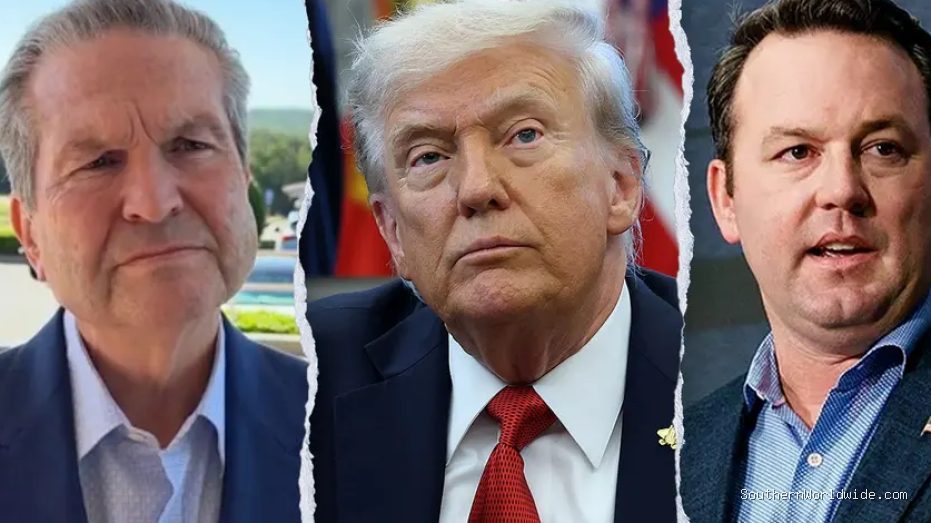
SouthernWorldwide.com – Donald Trump’s endorsement did not prove sufficient to secure victory for his chosen candidate, Georgia Lt. Gov. Burt Jones, in the Republican gubernatorial nomination race on Tuesday.
Jones was defeated by billionaire businessman Rick Jackson in the GOP runoff election for Georgia governor. This outcome means Jackson will advance to face former Atlanta Mayor Keisha Lance Bottoms in the general election this fall.
Bottoms had already secured her spot by winning the Democratic primary outright last month, surpassing six other candidates to gain a majority of the vote.
Jackson, who self-funded his campaign with over $100 million, received a late boost from Senator Ted Cruz of Texas in the final stretch leading up to the runoff election.
Throughout his campaign, Jackson frequently cited Trump as his inspiration for entering the race.
Jackson, previously unfamiliar to Georgia voters, gained significant recognition through extensive advertising. His narrative of building a business empire after growing up in foster care and being unable to afford college resonated with voters in the Peach State.
He emphasized his “outsider” status, drawing parallels to Trump. Jackson stated that voters are looking for someone who is genuinely an outsider, much like Trump, rather than just someone who has received an endorsement.
Senator Cruz joined Jackson on the campaign trail for a rally the evening before the runoff election.
When endorsing Jackson on Friday, Cruz also voiced his support for Alan Wilson in South Carolina, who is competing against Trump-backed Lt. Gov. Pamela Evette in a week’s time.
Responding to a question about whether he was distancing himself from Trump, Cruz stated emphatically that he was not. He explained that he typically endorses the most conservative candidate who has a strong chance of winning, often intervening late in races where his support could be impactful.
On the eve of Cruz’s visit, Jones criticized Jackson’s campaign strategy.
Jones expressed a preference for Trump’s direct endorsement over Jackson’s reliance on out-of-state senators for support, highlighting that Jackson needed external help while Jones focused on in-state backing.
Jones also repeatedly questioned Jackson’s loyalty to Trump, pointing to Jackson’s past campaign contributions to Democrats and anti-Trump Republicans as evidence of his misalignment with the MAGA base.
“He has been dishonest about who he is and who he has supported behind the scenes,” Jones asserted. “He is presenting himself as something he is not.”
Jackson refuted these claims, calling the attacks “lies.”
Jones and Jackson emerged as the top two candidates from last month’s competitive Republican gubernatorial primary. This primary also featured Georgia Attorney General Chris Carr and Secretary of State Brad Raffensperger. As no candidate secured over 50% of the vote, Jones and Jackson proceeded to a runoff.
Jones, a former University of Georgia football player, oil executive, and heir to Jones Petroleum Company, served in the state senate before being elected lieutenant governor in 2022. A staunch Trump supporter, he received the former president’s endorsement in August of the previous year.
He consistently promoted Trump’s endorsement throughout both the primary and runoff campaigns.
Governor Brian Kemp made a last-minute endorsement on Sunday, backing Jones. Kemp explained on Monday morning that his priority is to ensure the strongest candidates are at the top of the ticket to win in November, which is why he supports Burt Jones for governor.
Kemp believes Jones is the most qualified to lead the state forward, citing the progress made under current leadership. He warned of the negative consequences of losing, comparing the potential outcome to the political directions of Virginia, New York, and California, stating that such a decline is unacceptable.
While not directly on the ballot, Trump’s significant influence within the Republican party was once again being tested in Georgia.
The impact of Trump’s endorsements in GOP primaries had been evident over the preceding six weeks, with his endorsed candidates successfully unseating incumbents in several high-profile races across Indiana, Louisiana, Kentucky, and Texas.
However, Trump’s streak of endorsements in statewide and congressional Republican primaries was broken two weeks prior. His eleventh-hour endorsement of Republican Rep. Randy Feenstra in Iowa, who was running to succeed retiring GOP Governor Kim Reynolds, failed to secure victory for the three-term congressman.
Feenstra was narrowly defeated by Zach Lahn, a businessman, farmer, and former political strategist. Lahn received backing from the political factions of MAHA (Make America Healthy Again), a movement aligned with former Trump Health Secretary Robert F. Kennedy Jr., and Turning Point USA, a prominent conservative organization co-founded by the late Charlie Kirk.
Trump saw a rebound last week when his endorsed candidate in the South Carolina GOP gubernatorial primary, Lt. Gov. Pamela Evette, secured the top spot in a crowded field and advanced to the runoff for the nomination.
Concurrently, Senator Lindsey Graham, a long-time Trump ally, won the majority of the vote in the Republican Senate primary, thereby avoiding a runoff.
Graham, who was endorsed by Trump, faced challenges from five other candidates. Among them was conservative businessman Mark Lynch, who criticized Graham for his support of the war in Iran. Lynch had the backing of some MAGA leaders who have been critical of Trump.