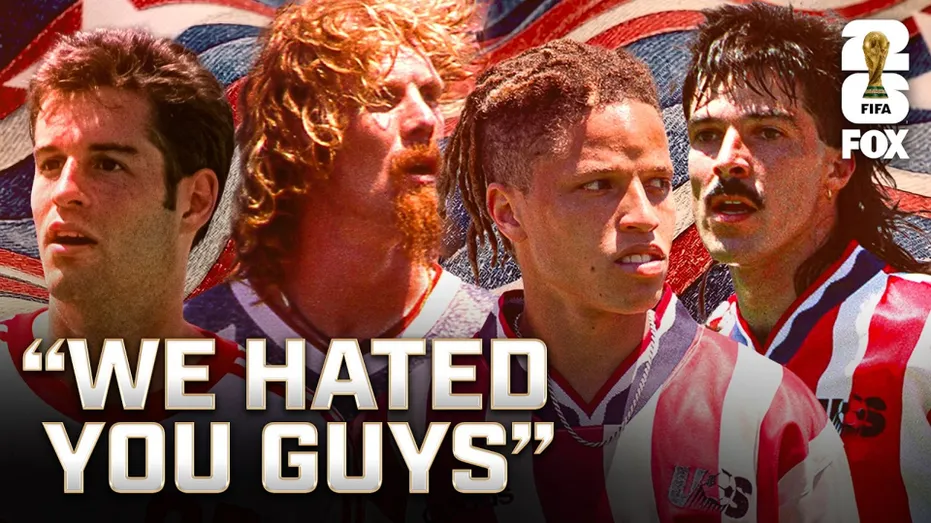
SouthernWorldwide.com – Thirty-two years ago, the global soccer community questioned the United States’ decision to host its first FIFA World Cup in 1994. At the time, the U.S. Men’s National Team was an unknown entity, often seen in distinctive denim uniforms, playing a sport that hadn’t yet reached mainstream popularity in America compared to football or baseball.
However, the tournament itself proved to be a turning point. To commemorate this historic event and look forward to the 2026 World Cup, former players Alexi Lalas, Cobi Jones, John Harkes, and Marcelo Balboa recently reunited to reminisce about the 1994 tournament that significantly impacted soccer in the United States.
Bora And The Bootcamp
The mastermind behind the U.S. team’s transformation in 1994 was coach Bora Milutinović. Renowned for his World Cup success, having led Costa Rica and Mexico to the knockout stages in previous tournaments, Milutinović was known for his ability to inspire underdog teams to exceed expectations.
Despite his legendary status, Milutinović’s methods initially caused frustration for a young Alexi Lalas. Lalas described Milutinović as an incredibly intelligent man who spoke multiple languages, albeit not fluently. He considered him the most frustrating coach he ever had, yet also the one who provided him with a life-changing opportunity.
The players’ initial reception to Milutinović’s approach was met with some resistance. However, this began to change after the team secured their first major international title at the 1991 Gold Cup.
Marcelo Balboa recalled his personal struggle with the coaching style, stating he “hated it” because he was often tasked with translating the coach’s messages. He admitted that it was “awful” to be a player translating for his own coach. However, as time went on, Balboa began to understand Milutinović’s vision.
The turning point for the team’s belief in Milutinović’s methods came during the 1991 Gold Cup. Balboa noted that it wasn’t until they started winning games, including a victory against Mexico, and ultimately won the Gold Cup, that the players truly started to buy into the strategy. “Once we won that tournament, we were like, crap, here we go,” he added.
Read more : Senator Warns Trump's Actions Could Harm GOP in November
The ‘Miracle On Ice’ Moment
By the time the 1994 World Cup commenced, the U.S. team was still largely underestimated. However, after securing a draw against Switzerland, they faced the tournament favorites, Colombia, in a vibrant atmosphere at the Rose Bowl. The subsequent 2-1 victory was a historic upset, often compared to the U.S. hockey team’s “Miracle on Ice” in 1980.
Lalas vividly recalled the moment the final whistle blew, describing it as “all hell breaks loose in the most positive way.” He expressed a desire for a celebratory moment for his country, similar to Jim Craig’s iconic image with a flag after the 1980 Olympic victory. The win against Colombia was particularly significant as most observers had predicted a loss for the U.S.
The magnitude of this victory was amplified by the team’s circumstances. At the time, the United States did not even have a domestic professional soccer league.
Balboa highlighted the team’s lack of club affiliations, stating, “When you talk about… ‘iconic wins,’ ‘best win ever.’ You look at that team with six guys, didn’t have a club team, we trained every day.” Lalas further elaborated that he and Cobi Jones never played for a club, and their experience was primarily international.
Brazil Breaks America’s Hearts
The U.S. team’s dream run eventually met its match against the formidable Brazilian squad in the Round of 16, which coincided with the Fourth of July. The game took a dramatic and unfortunate turn when U.S. midfielder Tab Ramos was hospitalized after a severe elbow from Brazil’s Leonardo.
Although Leonardo received a red card, the loss of Ramos significantly impacted the American midfield. John Harkes described the moment as “devastating” and “scared beyond belief” due to the way Ramos landed, emphasizing his concern for his teammate over the game itself.
The absence of Ramos was not only an emotional blow but also a tactical one. Lalas explained that they lost not just a player but also “the guy that could hold the ball for us” from a practical standpoint.
Despite being reduced to 10 men, the eventual world champions continued to create scoring opportunities. In the 72nd minute, Brazilian forward Bebeto scored the decisive goal, finding a narrow opening with a precise shot.
Lalas expressed his frustration with the goal, admitting he had a tackle opportunity but “overran it.” He described how the ball went through his legs and into the far corner, crediting Bebeto as a “little magician” for scoring the goal that effectively ended the U.S. World Cup campaign.
Looking Ahead To This Summer
Over three decades after the 1994 team laid the groundwork, the World Cup is set to return to North America. This upcoming tournament presents a significant opportunity for the current generation of U.S. players to surpass the achievements of their predecessors.
Harkes expressed optimism for the current squad, stating, “I think this team can go far. I think this team can go farther than 2002.” He added, “I hope we get to a semi, or even beyond that. Why not? Why not us? Let’s believe in that.”
As the pressure and expectations mount for the modern U.S. team, the pioneers of 1994 remind them that changing the landscape of the sport requires a bold vision. Alexi Lalas concluded by emphasizing the importance of dreamers.
2026 FIFA World Cup: How To Watch
The 2026 FIFA World Cup is scheduled to take place from June 11 to July 19, 2026. The tournament, hosted across three countries, will conclude with the final on July 19 at the New York New Jersey Stadium in East Rutherford, New Jersey. All 104 matches will be broadcast live on FOX and FS1, with every game available for streaming live and on-demand through the FOX One and FOX Sports apps. A record 40 matches will be aired during prime time across FOX and FS1.
The opening match on June 11, featuring Mexico and South Africa, will be streamed for free on Tubi. Additionally, the U.S. team’s opening match against Paraguay on June 12 will also be available for free streaming.