SouthernWorldwide.com – A groundbreaking study from the Penn State College of Medicine suggests that a mere four minutes of daily strength exercises can significantly enhance mobility, balance, and leg strength in older adults.
This finding challenges the conventional wisdom that lengthy exercise routines are necessary for substantial health improvements. The research focused on a home-based program dubbed Functional Activity Strength Training, or FAST-2.
The study evaluated 97 sedentary participants aged 65 and above, with an average age of 74. These individuals were previously engaging in a minimal amount of physical activity, averaging just 18 minutes per week.
Participants were randomly assigned to either an exercise group or a control group that did not receive any intervention. This design allowed researchers to isolate the effects of the FAST-2 program.
The exercise routine itself was remarkably concise. It involved performing four fundamental movements for 30 seconds each, with a 30-second rest period between each exercise. The entire circuit was completed in just four minutes.
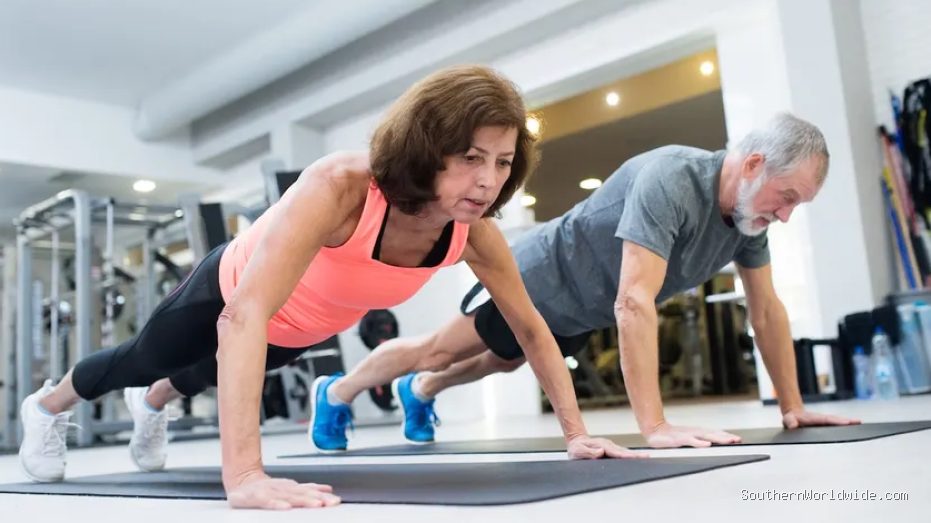
The four core exercises included push-ups, chair stands, two-arm resistance-band rows, and stair stepping. These movements are designed to target major muscle groups and improve functional strength.
To ensure accessibility, the researchers provided clear written instructions and modifications for the exercises. For instance, push-ups could be performed against a wall or kitchen counter, and chair stands could be done with knee support.
Participants were equipped with elastic resistance bands and an adjustable step platform to facilitate the exercises at home. This setup aimed to remove barriers to participation.
“Exercise is actually really complicated, because you have to decide how many repetitions, how far, how many sets, how much rest and how many times per week,” explained co-author Smita Dandekar, associate professor of pediatrics at Penn State College of Medicine.
She further elaborated on the challenge of adherence, stating, “It’s hard work … so if we can make it short, we’re part [of the] way there.” This highlights the program’s focus on simplicity and brevity.
As participants progressed, they were encouraged to increase the difficulty of the exercises. This could involve performing push-ups in a more challenging position or using a higher step for the stepping exercise.
After a period of 12 weeks, the results demonstrated significant improvements in the exercise group. A 30-second chair-stand test revealed that the exercise group performed an average of 4.2 more repetitions compared to the control group.
In a test of functional mobility, participants who exercised were able to stand up and sit down five times consecutively 2.3 seconds faster than those in the control group. This indicates improved lower body strength and coordination.
Furthermore, the exercise group demonstrated enhanced balance, extending their one-legged balance time by an average of 3.6 seconds. Better balance is crucial for preventing falls in older adults.
“These indicators … give you a sense of whether or not you’re going to be able to be active in the future.”
The researchers stressed the importance of these specific measurements. They are considered critical medical indicators of an older adult’s future health and independence.
These indicators can predict a person’s likelihood of needing nursing home care, falling, or experiencing difficulties with walking in the future. They serve as valuable markers for assessing functional decline.
“They give you a sense of whether or not you’re going to be able to be active in the future,” noted lead author Christopher Sciamanna, professor of medicine and of public health at Penn State College of Medicine.
A notable aspect of the study was the high adherence rate. Participants in the FAST-2 program completed their workouts on 81% of the tracked days. This is significantly higher than engagement rates typically seen in traditional home exercise programs.
The brevity and simplicity of the four-minute routine likely contributed to its high completion rate, overcoming common barriers such as time constraints and exhaustion.
However, the study did acknowledge certain limitations. The relatively small sample size and the 12-week duration mean that it is unclear whether these mobility gains are sustainable in the long term.
Additionally, the study did not detail the exact dropout rates or specify how the routine might impact seniors who already use assistive devices like walkers or canes.
The researchers also pointed out that the trial results were based on participants who met specific entry criteria. Further investigation is needed to determine if the short routine can be safely implemented for older adults with more severe physical limitations or cognitive decline.
The findings of this study were published in the journal PLOS One, offering valuable insights into accessible and effective strategies for improving the health and well-being of older adults.