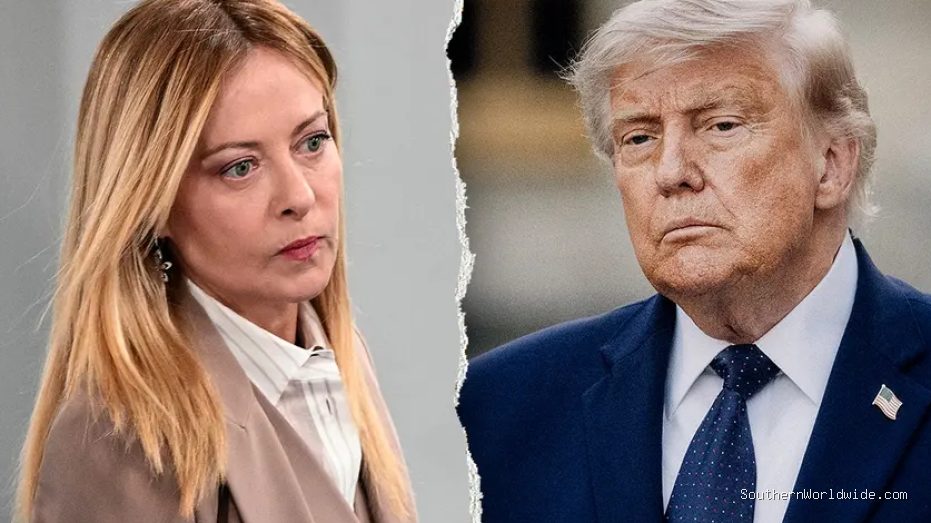
SouthernWorldwide.com – Italian Prime Minister Giorgia Meloni’s public dispute with former U.S. President Donald Trump is a strategic move to boost her domestic approval ratings, according to political analysts. This confrontation comes as Meloni faces declining popularity ahead of Italy’s general elections in 2027.
The diplomatic tension escalated after Italian Foreign Minister Antonio Tajani canceled a planned trip to Washington D.C. on June 19. Tajani was scheduled to meet with Secretary of State Marco Rubio.
“Giorgia Meloni must have calculated that a public row with Trump yields no tangible consequences, other than an increase in her domestic and international standing,” stated Mattia Diletti, a political science lecturer at Sapienza University of Rome.
Trump had claimed in an interview that Meloni “begged” for a photograph with him at the G7 summit and that he only obliged out of pity. He also alleged that Italy refused to assist the U.S. in confronting Iran’s nuclear ambitions, citing logistical inconveniences such as denied access to Italian airstrips.
“She begged me to take a picture with her,” Trump stated. “She wanted a picture with me so badly. I wouldn’t have taken it, but I felt sorry for her.”
Meloni quickly responded to Trump’s claims via a video statement on X, formerly Twitter. She strongly refuted his narrative, expressing her astonishment at his behavior towards an ally.
“I am frankly stunned,” Meloni said in her video message. “I don’t know why the president of the United States behaves this way toward his own allies. But there’s one thing he must remember: Neither I nor Italy ever beg.”
Trump further elaborated on his stance on Truth Social, directly linking the dispute to Meloni’s political standing in Italy. He suggested her popularity was suffering due to her refusal to support U.S. efforts against Iran’s nuclear program.
“Italian Prime Minister Giorgia Meloni asked, over and over, for a picture with me during the G7 meeting in France,” Trump wrote. “She is doing poorly in Italy with her level of popularity, possibly because she turned down the United States of America… when it came to denying Iran from obtaining or developing a nuclear weapon … She wouldn’t even let us use Italy’s landing strips or runways, a great logistical inconvenience … Now, after the United States defeated Iran militarily, she wants to be friends again in order to get her ‘numbers up.’ No thanks!!!”
Meloni retorted, “As for my popularity, being your friend certainly has not helped it … My popularity depends on my ability to defend Italy’s national interest… In any case, my popularity is none of your concern. I suggest you focus on yours.”
Giovanni Orsina, a political scientist at Rome’s Luiss University, also commented to the Financial Times that the public disagreement could present a “positive image” for Meloni. He described it as a “silver lining” to a confrontation she had reportedly tried to avoid.
The public exchange marks a notable shift from the previous close political alignment between Meloni and Trump. When Meloni first assumed power, she was seen as a potential bridge between Washington and Brussels, fostering ties with Trump based on shared nationalist sentiments and stances on immigration.
“Politically, Trump has favored Meloni,” Diletti observed, referencing her previous visit to Trump’s Mar-a-Lago estate in Florida in 2025. Meloni was notably the only European Union leader to attend Trump’s second inauguration.
Cracks in their relationship began to appear earlier, in April, when Trump criticized Meloni for aligning with Pope Leo XIV’s condemnation of the U.S. conflict with Iran. On Sunday, Trump again voiced his criticism of Italy and Meloni regarding their approach to Iran, accusing the NATO ally of not assisting in confronting Tehran’s nuclear ambitions.
“As the 2027 Italian general election approaches, Meloni is facing a decline in approval ratings for the first time,” Diletti explained. “The opportunity to counter a President so unpopular in Europe and Italy helps bolster her approval ratings and allows her to build European solidarity.”
The analysts suggest that Meloni might perceive little downside in confronting Trump, especially given her declining approval ratings. This strategy could potentially enhance her standing both domestically and internationally, positioning her as a defender of Italian interests on the global stage.
The spat has also drawn attention to Italy’s foreign policy decisions, particularly its stance on the conflict with Iran, and highlights the complex geopolitical relationships involving major international players. Meloni’s calculated approach aims to navigate these challenges while strengthening her political position within Italy.