SouthernWorldwide.com – The Trump administration has achieved a significant victory against China’s dominance in the rare earth minerals market through its support for American company Virtus Minerals in developing two major cobalt and copper mines in the Democratic Republic of Congo (DRC).
This initiative marks the first U.S. rare earth mineral acquisition in the African nation since President Donald Trump announced the Washington Accord in December. Historically, China has been the primary producer of these vital metals. The Strategic Studies Institute reports that the DRC accounts for 80% of the world’s cobalt production, with China controlling a substantial portion of that output.
Cobalt is a critical mineral for the U.S. government, essential for a wide array of applications including electric cars, mobile phones, and military jets. Copper, also on the critical minerals list, has traditional uses in plumbing but is also indispensable for electronics and the automotive industry.
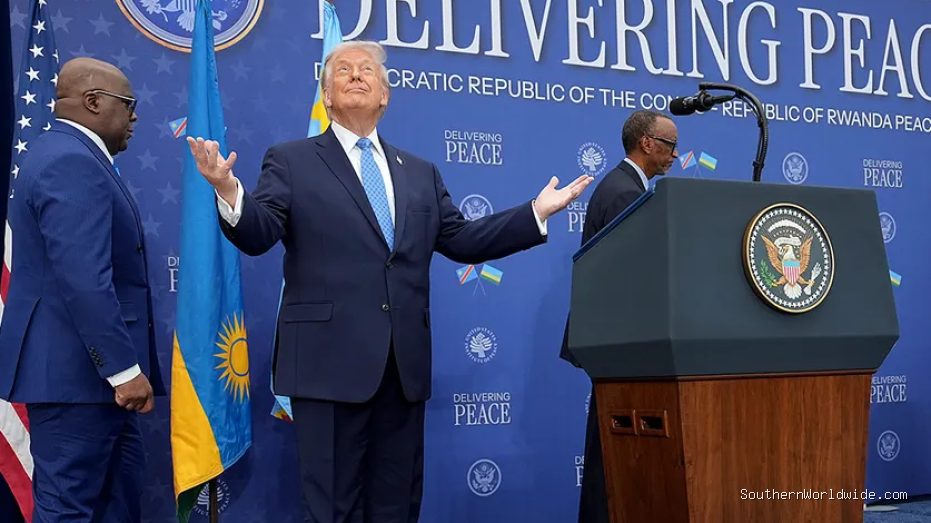
During the White House signing ceremony in December, President Trump emphasized the administration’s commitment to curbing Chinese control over these minerals and empowering American mining companies to make a significant impact in the DRC. Trump declared it “A great day for Africa, a great day for the world.” The accord also aims to quell conflicts between the DRC and Rwandan-backed forces, though the Rwandan-supported M23 rebel group has continued its incursions into eastern DRC.
Virtus Minerals, with U.S. backing, claims to be the first U.S.-owned operator in the DRC in over a decade. The company’s investment is directed towards Chemaf, a local producer of cobalt and copper with two mining operations: Étoile in Lubumbashi and Mutoshi in Kolwezi. These mines are projected to yield a combined annual output of 75,000 tonnes of copper and 20,000 tonnes of cobalt. The processing plants are currently under development and are expected to become operational next year.
The extracted minerals will be transported to Western markets via the Lobito Corridor, leading to a port in Angola. The U.S. has committed a $5 billion investment to the Lobito rail route, with the stated goal, according to a Virtus statement, of establishing a secure and verifiable copper and cobalt supply chain for the United States and its allies.
Frans Cronje, president of the Washington-based Yorktown Foundation for Freedom, views the Virtus projects as crucial indicators of the administration’s serious intent to alter the dynamics of the mineral trade with China.
Cronje elaborated that while China has established deep structural dominance in Africa’s resource sector over the past twenty years, U.S.-backed initiatives like this signal a shift towards more direct engagement. This approach moves away from reliance on Chinese-controlled supply routes. He highlighted the significance of this shift, noting that Africa’s extensive resource wealth and its strategic location along key Atlantic and Indian Ocean routes make it central to future global economic and security competition.
A spokesperson for the U.S. government affirmed their full support for Virtus Minerals’ endeavors. They stated that this acquisition serves as a flagship U.S. investment in the DRC, sending a clear message of genuine U.S. private sector interest. This, they added, is expected to spur further investment in line with the U.S.-DRC Strategic Partnership Agreement, positioning the DRC as a vital player in the Trump Administration’s global strategy to secure critical mineral supply chains.
The spokesperson further commented that increased U.S. investment will generate high-quality jobs for both American and Congolese workers, promote skill development, and support local communities. These communities, they noted, have long been subjected to exploitation by opaque systems established and maintained by adversarial foreign entities that have controlled the DRC’s critical minerals sector.
“None of this would be possible,” Braun added, “without the strong partnership now growing between the United States and the DRC, and the support of leaders in both countries who saw what was possible. We look forward to bringing our two nations closer by building a steady, trusted supply of the minerals we depend on and supporting other American companies that want to invest in the DRC any way we can.”
Cronje concluded that a more active U.S. presence in these supply chains would represent a substantial rebalancing of influence on the continent. This rebalancing, he suggested, would have implications not only for resource access but also for broader geopolitical alignments in regions experiencing increasing contention.