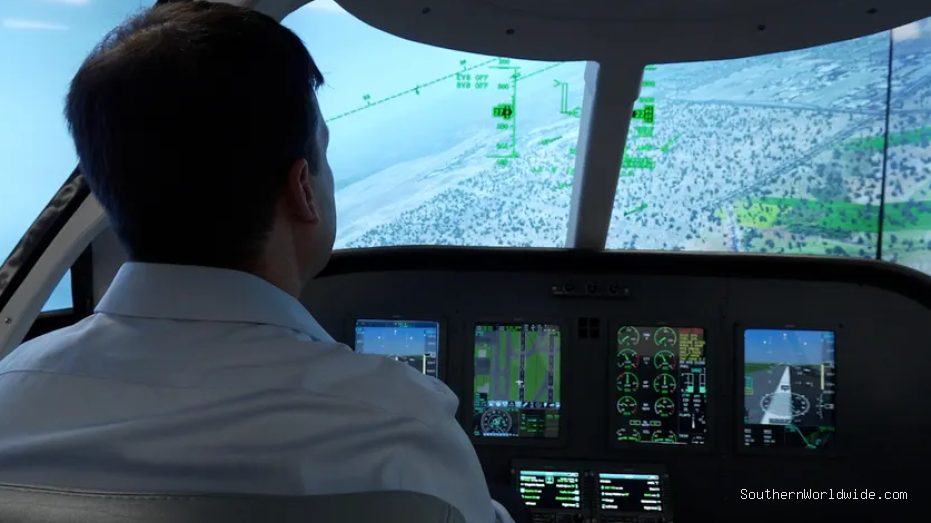
SouthernWorldwide.com – A new helmet-style cockpit vision system is poised to revolutionize how pilots navigate during periods of low visibility, enhancing safety and situational awareness.
Dror Yahav, a former commercial pilot and current CEO of Universal Avionics, shared his personal experiences flying in conditions where runways were barely visible until the final stages of landing. He is now instrumental in bringing a cutting-edge cockpit vision system to commercial aviation.
This innovative system, named AerAware, is the result of a collaboration between AerSale and Universal Avionics. It has successfully achieved Federal Aviation Administration (FAA) certification for use on Boeing 737 Next Generation aircraft.
AerAware utilizes an enhanced vision camera strategically mounted on the aircraft’s nose. This camera captures real-time imagery, which is then projected onto a wearable head display worn by the pilot. The display seamlessly overlays crucial flight data and visual information directly into the pilot’s field of view.
The system is designed to address the challenges Yahav faced during low-visibility night approaches. He described these situations as moments when looking outside reveals nothing but darkness or fog.
By integrating sensor data with visual imagery, AerAware significantly boosts situational awareness for pilots during critical phases of flight, including takeoff and landing.
A key departure from traditional head-up displays, AerAware equips both pilots with an identical wearable system. This ensures that both individuals in the cockpit receive the same vital information simultaneously.
The concept behind AerAware draws inspiration from advanced military helmet-mounted displays, such as those used in fighter jets like the F-35 Lightning II, known for their sophisticated visual augmentation capabilities.
The FAA has granted certification for the AerAware system specifically for Boeing 737 Next Generation aircraft, marking a significant milestone for its commercial deployment.
Regulators continue to place a strong emphasis on runway safety. FAA data indicates a slight decrease in runway incursions, with 1,636 incidents in fiscal year 2025, down from 1,758 in 2024 and 1,760 in 2023. Pilot deviations constituted the majority of these incursions, accounting for 62% between 2021 and 2025.
The installation of the AerAware system is a streamlined process, typically taking around two to three days per aircraft. This is followed by comprehensive pilot training conducted under an FAA-approved program.
Interest from airlines in the AerAware system has seen a notable increase, particularly in light of the ongoing focus on runway incursions and operations in low-visibility conditions.
Jacqueline Carlon, Senior Vice President of Marketing and Communications at AerSale, highlighted the key factors airlines consider when evaluating the system. These include certification status, minimal installation downtime, and seamless integration into existing operational frameworks.
She reiterated that the installation process is efficient, requiring only two to three days per aircraft, and is complemented by a mandatory, approved training program for pilots.
Carlon emphasized that the drive behind airline interest is a dual commitment to enhancing safety and improving operational efficiency. These are critical considerations as airlines assess upgrades for their Boeing 737 fleets.