SouthernWorldwide.com – President Donald Trump expressed strong disapproval following a Supreme Court decision that upheld a Mississippi law permitting mail-in ballots received up to five days after Election Day to be counted.
The ruling in the case of Watson v. RNC placed Trump at odds with some of the justices he had appointed. This decision, by affirming Mississippi’s practice of counting late-arriving mail-in ballots, dealt a setback to Trump’s broader efforts to implement stricter election rules.
The ruling also drew criticism from one of the Republican senators Trump had specifically targeted. This senator pointed out that he already supports legislation mandating that ballots must be received by Election Day.
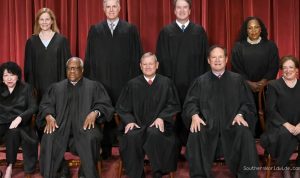
Justice Amy Coney Barrett, who was nominated by Trump, offered a rebuttal to the arguments presented by Republicans in the case. She wrote that while Election Day is the statutorily mandated date for submitting a vote, “election-day statutes do not set a deadline for ballot receipt.”
Trump responded hours later on his Truth Social platform, describing the ruling as a “tremendous loss” for voters’ rights. He asserted that the decision necessitates immediate action from Congress to nullify it by passing the SAVE America Act.
This bill, championed in the House by Rep. Chip Roy of Texas and in the Senate by Sen. Rick Scott of Florida, aims to implement nationwide voter identification requirements and effectively ban no-excuse mail-in balloting.
“It is more important than ever to pass the SAVE America Act,” Trump stated.
He further elaborated that there is “no excuse for a politician, or otherwise, to be against the above three requirements.” These requirements include voter ID, proof of citizenship, and the distribution of mail-in ballots exclusively to military members, the sick and disabled, and voters who are traveling away from their home precinct on Election Day.
“There is only one reason to oppose — cheating,” Trump declared, adding that the House had approved the SAVE Act in three different iterations.
Trump then issued a broad condemnation, stating, “In a time when there is a powerful Communist movement taking place in our country, one more dangerous than World War I, World War II, Pearl Harbor, or Sept. 11, all Dumocrats (sic) and our five Republican Senate Hold Outs, Lisa Murkowski, Susan Collins, Thom Tillis, Bill Cassidy, and Mitch McConnell must vote to save our country.”
Senator Bill Cassidy responded with surprise, suggesting that the president might need to verify his information. The Louisiana Republican clarified that he is, in fact, a co-sponsor of the SAVE Act.
“I don’t know which staffer misled you, but thank you for your attention to this matter,” Cassidy remarked, echoing Trump’s characteristic closing phrase.
While Trump and Cassidy have had disagreements on other issues, they appear to be in agreement regarding the contents of the bill. However, Cassidy also commented that it is “irresponsible” to delay a housing bill signing, which is currently on hold, until the SAVE Act is passed. He emphasized that people deserve “relief… for the high cost of housing.”
An office representing Senator Thune declined to provide further comment. The office of Senator McConnell acknowledged receipt of the statement and indicated that the former majority leader would share any comments he might have in the interim.
Although Trump broadly categorized all Democrats as being in opposition, one independent-minded member of the minority party has indicated support for a more limited version of the bill that would require voter ID.
Pennsylvania Senator John Fetterman stated recently, “If the GOP wants real reform over a show vote––put out a clean, standalone bill and I’m AYE.”
He added, “Keep it basic: PHOTO ID to vote. Stop turning this into a Christmas list and attacking vote-by-mail.”
If the Senate were to approve the version of the SAVE Act passed by the House, it could significantly alter or at least render moot certain aspects of the Supreme Court’s Watson decision.
Calls for the passage of the SAVE America Act intensified in the weeks leading up to the Supreme Court’s decision. Critics pointed to California’s ballot tabulation process, where actor Spencer Pratt was narrowly defeated by Councilwoman Nithya Raman, D-Los Feliz, in a runoff election. Additionally, critics cited the slow pace at which Democrat Xavier Becerra and Republican Steve Hilton were declared general election candidates for governor following a crowded primary.