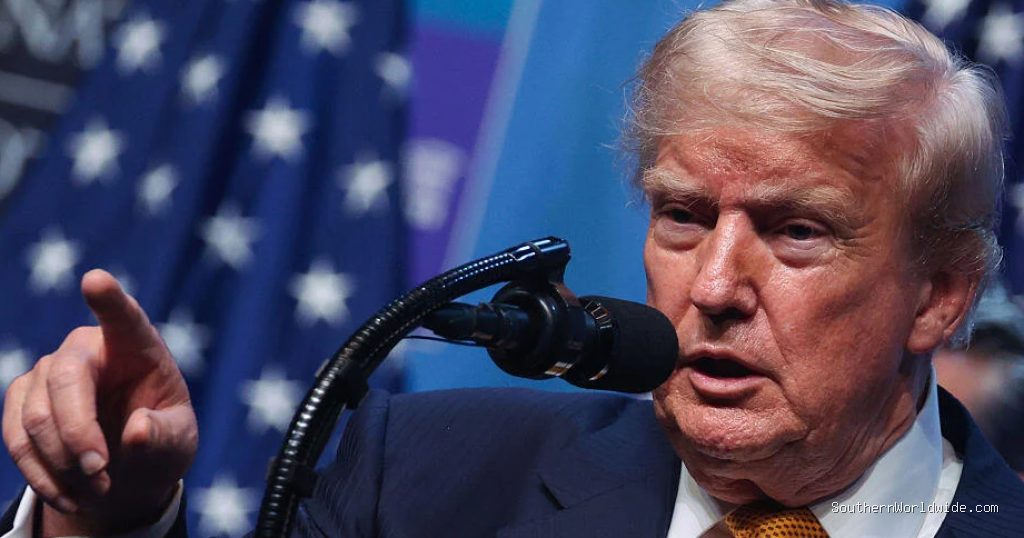
SouthernWorldwide.com – A significant bipartisan housing bill has officially become law without President Trump’s signature. The legislation automatically enacted at midnight on Saturday after President Trump chose not to sign it, a decision he linked to the Senate’s perceived inaction on an elections bill known as the SAVE America Act.
This comprehensive housing bill, titled the 21st Century ROAD to Housing Act, is being hailed as the most substantial housing legislation in decades. Its primary objectives are to expand housing supply and reduce housing costs. A key provision within the bill aims to curb the practice of institutional investors purchasing certain single-family homes.
The bill had previously passed both the House and the Senate with broad bipartisan support. A signing ceremony was scheduled for the White House last month, but President Trump abruptly canceled it just hours before it was set to take place. He had explicitly stated that he would not sign the housing bill unless Congress first approved the SAVE America Act, which proposes new regulations for voting and voter registration.
President Trump reiterated his stance on Friday morning, expressing his refusal to sign the housing bill. He posted on Truth Social, stating, “I will not sign the Housing Bill, which has been fully approved by Congress and sent to the White House, in PROTEST over the fact that the United States Senate is not capable of passing THE SAVE AMERICA ACT, which is polling at 97% with the Republican Party, and very high with the non-politician Dumocrats.”
According to the U.S. Constitution, a bill passed by both houses of Congress becomes law automatically if the President does not sign or veto it within a 10-day period, excluding Sundays. This constitutional provision is what allowed the housing bill to become law despite the President’s refusal to sign it.
Senator Elizabeth Warren of Massachusetts, a leading advocate for the legislation in the Senate, strongly criticized the President’s decision. She issued a statement expressing her disappointment and highlighting the bill’s focus on affordability.
“At the stroke of midnight, a huge bipartisan bill to lower housing costs became law without the President’s signature. Why did President Trump sit on the landmark housing bill for more than 2 weeks? Maybe because there was nothing in it for him personally — no gold-encrusted ballroom, no Qatari jet, no $2 billion crypto deal. Nothing in the 21st Century ROAD to Housing except ways to make housing more affordable,” she said. “Donald Trump couldn’t pick up the pen because he just isn’t interested in lowering costs for American families.”
The President’s decision placed Republican allies in Congress in a challenging situation. It denied them the opportunity to highlight their efforts in addressing housing affordability concerns, an issue that has remained a significant concern for many Americans. Despite the President’s persistent pressure, Senate GOP leaders have consistently indicated that the SAVE America Act lacks sufficient support for passage.
The passage of the housing bill marked a rare moment of bipartisan agreement ahead of the midterm elections, following months of dedicated work. However, President Trump characterized the bill as “a yawn,” emphasizing his preference for the focus to remain on his initiatives to ban mail-in voting, mandate proof of citizenship for voter registration, and require photo identification for casting ballots.
Despite his refusal to sign, President Trump also did not veto the bill, allowing it to proceed to become law automatically. House Speaker Mike Johnson, who had met with the President multiple times regarding the housing bill late last month, sent the legislation to the President on June 29, initiating the 10-day review period.
When questioned about his plans for the housing bill on that day, Mr. Trump informed reporters that he was unsure, adding that he considered it “so unimportant” compared to the SAVE America Act. This statement underscored his prioritization of election-related legislation.
A day later, Speaker Johnson addressed Mr. Trump’s remarks, suggesting that “the president has a lot going on and I think it’s safe to say he’s not read through every line of that piece of legislation.” The Speaker acknowledged the bill’s complexity and its beneficial aspects.
The Louisiana Republican further elaborated that he and the President had discussed the housing bill extensively. He clarified that the President’s statement meant that, in the context of ensuring election integrity through the SAVE America Act, no other issue held the same level of importance. However, Johnson also affirmed that issues like the cost of living and affordability are indeed critical and are top priorities.
Speaker Johnson ultimately expressed confidence that the bill would become law. He recounted encouraging the President to sign it with a “fat black marker” and assured him of the legislation’s positive outcomes for the American people. Johnson added, “So I hope he does sign it. If he doesn’t, it’s still law; we’ll still celebrate it. But he’s trying to make a point and I think he’s making it very effectively.”
What the housing law does
The newly enacted law comprises over 45 provisions designed to address various aspects of housing affordability and supply. A significant portion of these provisions aims to boost the development of affordable housing by removing regulatory hurdles and expediting environmental reviews.
The law also introduces a pilot program to assist local governments in converting vacant commercial properties into affordable housing. It further facilitates access to federal funding for the construction of factory-built homes and eliminates a regulation that mandated homes be built on a chassis, a steel framework used for transportation.
Additionally, the legislation establishes an innovation fund to support communities that are actively increasing their housing supply. It also provides support for housing opportunities for veterans and imposes limitations on the purchase of single-family homes by institutional investors.
Supporters of the institutional investor limits argue that these measures will reduce competition, thereby benefiting homebuyers. By applying to existing single-family homes rather than new construction, the law is designed to maintain incentives for financial firms to invest in new housing development.