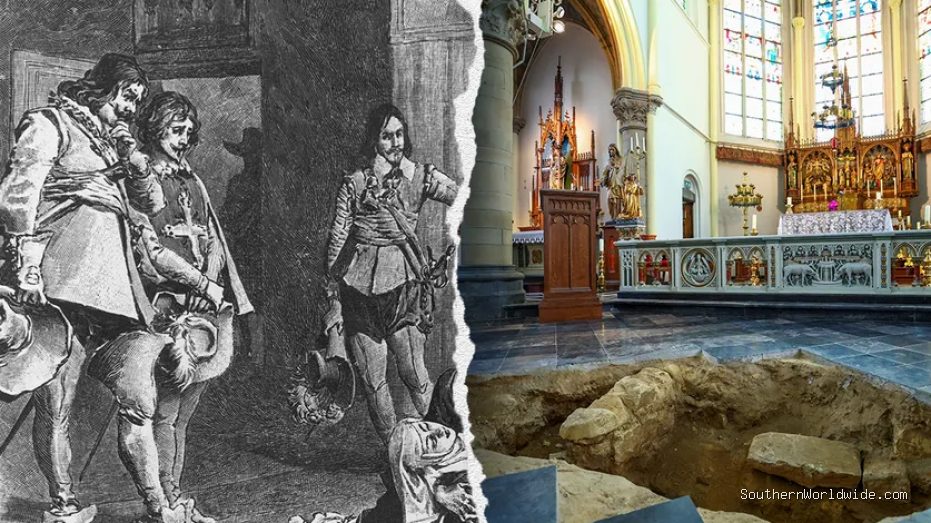
SouthernWorldwide.com – A promising archaeological discovery, potentially linking to the legendary figure who inspired “The Three Musketeers,” has been marred by a significant blunder that has destroyed crucial evidence.
The remains, believed by some to be those of Charles de Batz de Castelmore d’Artagnan, were unearthed in February near the altar of St. Peter and Paul Church in Maastricht, Netherlands. This finding had sparked considerable excitement among archaeologists.
D’Artagnan is famously known as the inspiration behind Alexandre Dumas’ iconic novel, “The Three Musketeers.” His historical demise occurred during a siege near Maastricht on June 25, 1673.
Historical documents suggest that d’Artagnan was laid to rest in consecrated ground in the vicinity, making the discovery near the church altar particularly significant and promising for researchers.
However, on July 2, the Municipality of Maastricht revealed a substantial setback in the ongoing investigation. They attributed this to improper archaeological work conducted before the official excavation commenced on March 13.
“The excavation work carried out before March 13 was not documented according to standard archaeological procedures,” stated the municipality in a recent news release.
“As a result, a significant amount of archaeological information has been irreversibly lost.”
When archaeologists began the official excavation, they discovered that only about 50% of the skeleton remained in its original position. Furthermore, approximately one-third of the skull was unaccounted for.
“The situation is highly complex because, during the initial excavation work, various bones were collected without documentation,” the release further elaborated.
The retired archaeologist who initially led the excavation prior to the official March 13 dig, Wim Dijkman, was apprehended in May. His arrest followed his refusal to hand over the collected bones to the authorities, as reported by The NL Times.
In March, Dijkman had conveyed to Reuters that the archaeological endeavor had escalated into a “top-level investigation.”
“We want to be absolutely certain — or as certain as possible — whether it is the famous musketeer who was killed here near Maastricht,” he had stated at the time.
At the current juncture, officials have indicated that it remains uncertain whether the skeleton actually belongs to d’Artagnan.
Isotope analysis revealed that 27% to 30% of the individual’s diet consisted of fish. Researchers found this dietary detail to be inconsistent with the known lifestyle and probable diet of d’Artagnan.
“Although sea fish was sold at markets in Paris and Lille in the 17th century, and salted fish was also eaten inland, it remains unclear whether musketeers would have been served this kind of food frequently,” the release noted.
“This raises the question of whether such a diet was common among Catholic musketeers from France in the 17th century.”
Officials also emphasized that the current research findings do not definitively exclude the possibility that the skeleton could indeed be d’Artagnan’s.
“Based on the current data, this makes identification as d’Artagnan less likely, although it cannot be ruled out,” the statement concluded.