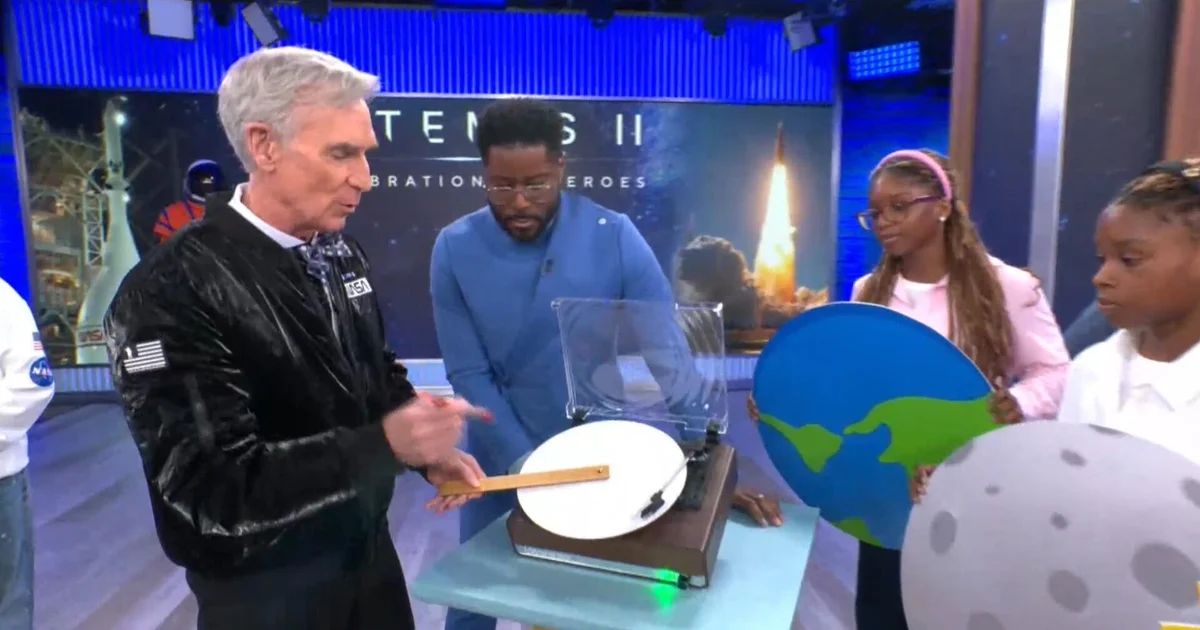
SouthernWorldwide.com – Bill Nye, also known as “The Science Guy,” recently appeared on “CBS Mornings” to illustrate key concepts related to the Artemis II mission through a series of engaging experiments.
Nye, who serves as the chief ambassador for The Planetary Society, used hands-on demonstrations to break down the complex science and engineering behind the upcoming lunar mission.
The Artemis II mission is a crucial step in NASA’s ambitious plan to return humans to the Moon. It will be the first crewed mission to the Moon in over 50 years, serving as a precursor to subsequent missions that aim to establish a long-term human presence on the lunar surface.
During his appearance, Nye focused on explaining principles such as orbital mechanics, the effects of microgravity, and the challenges of deep-space communication. His ability to translate complex scientific ideas into easily understandable and visually appealing demonstrations has long been his trademark.
One experiment likely demonstrated the concept of inertia, showing how objects in motion tend to stay in motion unless acted upon by an external force. This principle is fundamental to understanding spacecraft movement and trajectory.
Another demonstration might have illustrated the vacuum of space and the importance of life support systems. By creating a near-vacuum in a sealed container, Nye could have shown how essential air pressure is for survival.
The challenges of communicating across vast distances were also likely a topic. Nye may have used a simple analogy, perhaps involving the time delay in signal transmission, to explain how astronauts communicate with Earth.
The Artemis II mission is particularly significant because it will carry the first woman and the first person of color on a lunar mission. The crew will orbit the Moon before returning to Earth, testing critical systems and procedures.
Nye’s role as chief ambassador for The Planetary Society underscores his dedication to public science education and space exploration advocacy. The organization aims to foster a greater understanding and support for space missions among the general public.
His appearances on major news programs like “CBS Mornings” are invaluable for demystifying space science and inspiring the next generation of scientists, engineers, and astronauts.
The Artemis program, named after the Greek goddess of the Moon and the twin sister of Apollo, represents a new era of lunar exploration. It aims to achieve sustainable lunar presence and serves as a stepping stone for future Mars missions.
Nye’s knack for making science accessible and exciting ensures that complex topics like those involved in the Artemis II mission can be appreciated by a wide audience.
His demonstrations are not just educational but also entertaining, capturing the imagination and curiosity of viewers.
Read more : AI as a Major Driver of Layoffs, Causing 26% of Job Cuts in April
The Artemis II crew consists of four astronauts: Reid Wiseman, Victor Glover, Christina Koch, and Jeremy Hansen. Their journey around the Moon is expected to be a major milestone.
Nye’s contribution through these demonstrations helps to build public enthusiasm and understanding for the scientific and technological achievements of the Artemis program.
The mission highlights the collaborative nature of space exploration, involving international partners and a vast network of engineers and scientists.
By simplifying complex concepts, Bill Nye plays a vital role in making space exploration relevant and engaging for everyone.
His work continues to inspire a sense of wonder about the universe and the possibilities of human endeavor beyond Earth.
The Artemis II mission is scheduled to launch in the coming years, building on the foundational work of previous uncrewed missions.
Nye’s ability to connect scientific principles to tangible experiences makes the abstract concepts of space travel more concrete for the public.
His continued presence in science communication ensures that important missions like Artemis II receive the attention and understanding they deserve.
The experiments showcased are designed to be both informative and memorable, leaving viewers with a clearer grasp of the mission’s objectives.
Bill Nye’s commitment to science education makes him a crucial figure in bridging the gap between complex scientific endeavors and public comprehension.
The Artemis II mission is poised to be a landmark event, and Nye’s participation helps to illuminate its significance.