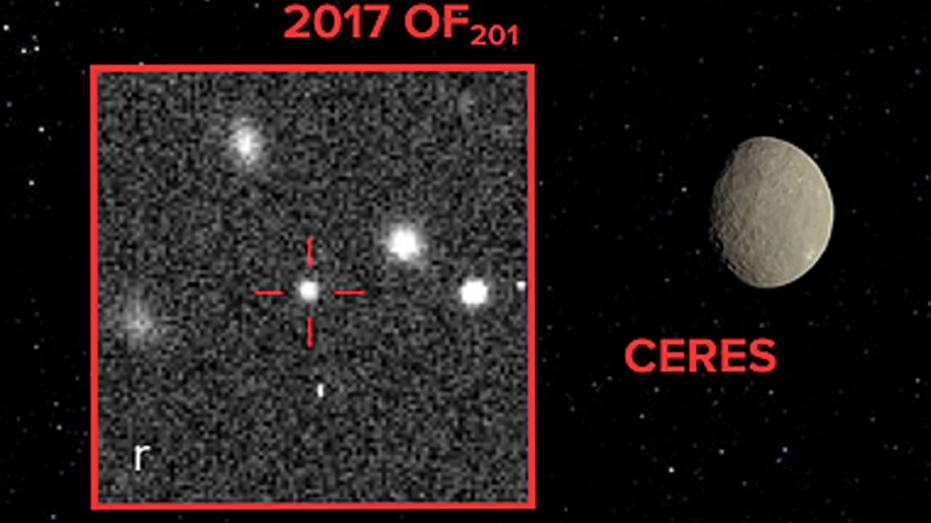
SouthernWorldwide.com – A recent discovery by scientists may provide a significant clue in the ongoing search for the elusive Planet Nine.
A team from the Institute for Advanced Study’s School of Natural Sciences in Princeton, New Jersey, has identified a new trans-Neptune Object (TNO) named 2017OF201. This object resides beyond the Kuiper Belt, a cold and remote region of our solar system.
TNOs are minor planets that orbit the Sun at distances greater than Neptune. The discovery of 2017OF201 at the solar system’s fringe is noteworthy due to its considerable size and highly eccentric orbit.
The research team, which included Sihao Cheng, Jiaxuan Li, and Eritas Yang from Princeton University, utilized sophisticated computational techniques to pinpoint the object’s unusual trajectory through the sky.
“The object’s aphelion — the farthest point on the orbit from the Sun — is more than 1600 times that of the Earth’s orbit,” Cheng stated in a press release. “Meanwhile, its perihelion — the closest point on its orbit to the Sun — is 44.5 times that of the Earth’s orbit, similar to Pluto’s orbit.”
With an orbital period of approximately 25,000 years around the Sun, Yang suggests that 2017OF201 must have undergone interactions with a massive planet. These encounters likely led to its ejection into its current wide orbit.
Cheng further theorized that the object’s journey might have involved multiple stages. It’s possible that 2017OF201 was initially expelled to the Oort Cloud, the most distant region of our solar system known for hosting comets, before eventually being sent back towards the inner solar system.
This finding has considerable implications for our understanding of the architecture of the outer solar system.
In January 2016, astronomers Konstantin Batygin and Mike Brown of the California Institute of Technology (Caltech) presented research suggesting the existence of a planet roughly 1.5 times the size of Earth in the outer solar system. This hypothetical celestial body is often referred to as Planet Nine or Planet X.
However, the existence of Planet Nine remains purely theoretical, as direct observation of such a planet has not yet occurred.
The theory posits that Planet Nine is comparable in size to Neptune and is located far beyond Pluto, somewhere near the Kuiper Belt, the region where 2017OF201 was discovered.
If it exists, Planet Nine is estimated to have a mass up to 10 times that of Earth and could be orbiting the Sun at a distance up to 30 times farther than Neptune.
An orbit around the Sun for such a planet would take between 10,000 and 20,000 Earth years.
Previously, the area beyond the Kuiper Belt was thought to be largely empty. However, the discovery of 2017OF201 challenges this assumption.
Cheng indicated that only about 1% of 2017OF201’s orbit is currently observable to us.
“Even though advances in telescopes have enabled us to explore distant parts of the universe, there is still a great deal to discover about our own solar system,” Cheng commented.
NASA has noted that the existence of Planet Nine could potentially explain the peculiar orbital paths of some smaller objects found in the distant Kuiper Belt.
Read more : Is Your Password Secure? A World Password Day Check
For now, Planet Nine remains a theoretical entity, with its potential existence supported by observed gravitational anomalies in the outer solar system.