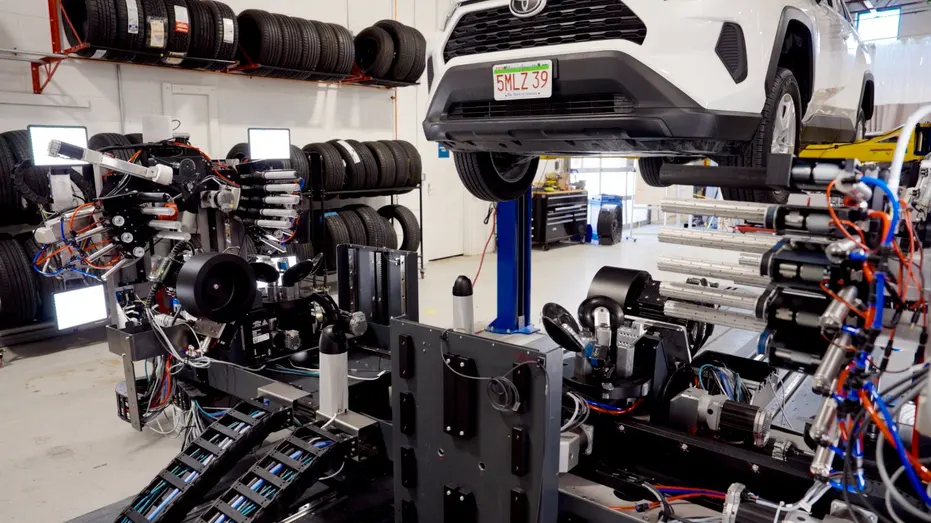
SouthernWorldwide.com – Tire shops, traditionally not seen as hubs of cutting-edge technology, may soon be revolutionized by Automated Tire, Inc. (ATI). The Boston-based company has introduced SmartBay, an AI-powered robotic platform designed to transform tire changes and wheel balancing at dealerships, tire shops, and service centers.
This innovation arrives at a crucial time for the automotive service industry. Many repair shops are grappling with a shortage of skilled technicians. Simultaneously, the rise of electric vehicles (EVs) is increasing the demand for tire services, as EVs tend to wear out tires more quickly due to their weight and instant torque.
SmartBay aims to address these persistent challenges by automating routine, physically demanding tasks that have historically required human expertise. The system leverages physical AI, computer vision, and machine learning to perform tire work with minimal human intervention, adapting to each vehicle’s unique specifications in real time.
Andy Chalofsky, CEO of ATI, describes SmartBay as the “next generation of the automotive service bay.” He highlights that it is a robotic-first system built to automate labor-intensive processes, freeing up technicians for more complex diagnostic and repair work.
“Instead of a technician manually removing the wheel, dismounting the tire, balancing it, and reinstalling everything, SmartBay handles the tire change and wheel balance itself with only light-touch oversight from an operator,” Chalofsky explained.
A particularly innovative aspect of SmartBay is its ability to change tires without removing the wheel from the vehicle. The car is lifted as usual, but the robot dismounts the tire directly from the rim while the rim remains attached to the car. This patented approach eliminates the need to disturb lug nuts or the tire pressure monitoring system.
Following the mounting of a new tire, SmartBay employs ATI’s trademarked Real Force Balance technology. This system balances the entire wheel-end assembly, including all rotating components within the wheel well, rather than just the tire itself. ATI claims this results in the most comprehensive and accurate balance available on the market.
The unpredictability of tire shop operations is well-known. A technician calling in sick or a single job taking longer than expected can quickly disrupt an entire schedule. SmartBay is designed to alleviate these bottlenecks.
ATI states that a single technician can manage up to three SmartBay-equipped service bays concurrently. The system is designed to fit within a standard 12-foot service bay, negating the need for extensive infrastructure modifications by the shops.
ATI projects that initial SmartBay units will be capable of a 45-minute door-to-door tire change for four tires, including mounting and balancing. As the technology evolves and learns, this time could be reduced to as little as 30 minutes.
SmartBay’s AI is engineered to handle the diverse array of vehicles that enter a service bay. Even within the same model line, variations in configurations can be significant. The system must also contend with varying levels of dirt and grime on vehicles, such as mud, snow, road salt, brake dust, or rain, while still accurately identifying components.
Chalofsky emphasizes that SmartBay’s “self-learning AI layer adapts in real time to hundreds of data points per vehicle.” This allows the system to replicate the judgment and experience that technicians develop over years, creating a repeatable and continuously learning process.
Speed and consistency are key benefits highlighted by ATI. SmartBay’s ability to execute the same process with minimal variation between vehicles enhances efficiency. Chalofsky notes that a single technician operating two or three SmartBays in parallel could process approximately 24 tires per hour, a significant increase compared to the current rate of about four tires in 75 minutes.
This increased throughput can help prevent appointment backlogs and reduce customer wait times. For service centers, it translates to greater billable volume and more predictable scheduling, particularly for high-volume operations.
The evolving landscape of EVs presents new challenges and opportunities for tire shops. “EVs are reshaping the tire economy. Because of their weight and instant torque, EV tires wear faster and need to be replaced more often,” Chalofsky stated. He added that tires are now “the single largest lifetime maintenance expense on most EVs,” surpassing traditional costs like oil changes and filter replacements.
This shift means EV owners may frequent tire shops more often. If shops are already struggling with staffing, this increased demand could exacerbate existing waiting-room problems. ATI believes SmartBay can help shops manage this additional workload without a proportional increase in labor.
The system’s adaptability is a key feature, as Chalofsky points out that “a Tesla, an F-150, and a Chevy Silverado all run through the same system.” This versatility allows it to service a wide range of vehicle classes.
Addressing the common concern about job displacement, Chalofsky clarifies that SmartBay aims to augment rather than entirely replace technicians. “Both, but mostly the latter,” he responded when asked if SmartBay replaces technicians or changes their work.
He explains that while robotics can handle repetitive tasks more efficiently, SmartBay can also empower existing workers. “In many cases, it allows a shop to take a lower-skilled operator and get three to four times the throughput out of them, which means shops can actually pay those operators more because the work is more valuable,” Chalofsky said.
This shift allows skilled mechanics to dedicate more time to diagnostic and mechanical work that requires their specialized expertise, moving away from the physically demanding aspects of tire handling.
“Every wave of automation we’ve seen in adjacent industries has played out the same way: technology augments the workforce far more than it replaces it, and that’s the dynamic we expect here,” Chalofsky added.
Tire work is inherently physical, with heavy wheel assemblies posing risks of strain to backs, shoulders, and knees. SmartBay’s design, particularly its ability to leave the rim on the vehicle, aims to mitigate these risks. “Because SmartBay leaves the rim on the vehicle, technicians are no longer lifting heavy, expensive wheel assemblies on and off mounting machines. This eliminates one of the most common sources of strain injuries and workers’ compensation claims in tire work,” he noted.
The equipment is also equipped with sensors to ensure safe operation around people in a busy service bay. Furthermore, SmartBay systems are interconnected through a network, allowing one unit’s learning to benefit all others in near real time. For instance, data from a new F-150 trim package encountered in California could be used to train machines across the country.
For most drivers, the primary indicators of success will be the time saved and the improved driving experience after service. Chalofsky believes customers will notice the enhanced consistency, leading to “a faster, more predictable visit, with their car in and out in a defined window rather than depending on which technician happens to be working that day.”
The Real Force Balance is expected to contribute to a smoother ride by balancing the entire wheel assembly. Additionally, SmartBay’s automated visual inspection can identify issues within the wheel well that a busy technician might overlook, providing customers with a clear record of checks and their importance.
This comprehensive approach promises a more seamless tire service experience for drivers and offers service centers a tangible way to demonstrate the thoroughness of their work.
Tire services, while perhaps not the most glamorous aspect of automotive maintenance, represent a significant reason for vehicle visits to service centers. The work is frequent, physically demanding, and notoriously difficult to staff, making it an ideal candidate for automation.
“Tire changes and wheel balancing check nearly every box for a first product. It’s one of the most frequent reasons a vehicle comes into a service bay, it’s a high-dollar transaction, the work is physically arduous and exactly the kind of task a robotic-first platform is well suited to handle, and the labor shortage is most acute precisely in this part of the workforce,” Chalofsky explained.
He cites the growth of EVs, the retirement of experienced technicians, and the widespread demand across dealerships, aftermarket shops, and fleet services as key drivers for this innovation. Chalofsky’s background as a fourth-generation tire industry entrepreneur, having founded businesses like SimpleTire, provides ATI with invaluable practical insight into the operational realities of tire shops.
This industry-specific experience allows ATI to address a long-standing bottleneck with practical, robotics-based solutions, rather than pursuing abstract technological applications. For owners of gasoline-powered cars, hybrids, and EVs alike, this technology could transform tire appointments from a lengthy waiting game into a more efficient process.
Robotic tire systems can help shops process vehicles more quickly, especially during peak times. Enhanced balancing consistency may also lead to a smoother ride post-service. EV owners may experience these benefits sooner, given the faster tire wear on heavier electric vehicles and the associated replacement costs.
SmartBay could also redefine the technician’s role. By automating the most physically demanding tasks, technicians can shift their focus to oversight and more complex repairs, thereby increasing their value to the shop.
For service centers, the adoption of SmartBay promises more stable operations. When one technician can effectively manage multiple bays, the likelihood of a busy day devolving into significant backups is reduced.
The integration of physical AI into tire service raises questions about the future of the industry. While cars have become increasingly sophisticated, many tire shops continue to rely on manual processes that have remained largely unchanged for decades. ATI is betting that physical AI can bridge this gap and bring service bays up to par with the advanced vehicles they serve.
The ultimate test will be the system’s performance during high-demand periods, such as a busy Saturday morning. While robots may impress in controlled demonstrations, their true value will be determined by their ability to withstand the rigors of busy service bays and genuinely reduce the hassle of tire appointments for drivers.
Read more : Trump's Economic Vision Carrier Passes Key Early Test
The question remains whether consumers would entrust an AI robot with the critical task of changing and balancing their tires, particularly if it leads to a faster service experience and a smoother ride. The evolution of tire service technology, as exemplified by SmartBay, suggests a future where efficiency and technological advancement are paramount.