SouthernWorldwide.com – Air travel is increasingly automated, with self-service kiosks and baggage drop-offs becoming commonplace. Now, another aspect of the airport experience is poised for a robotic transformation.
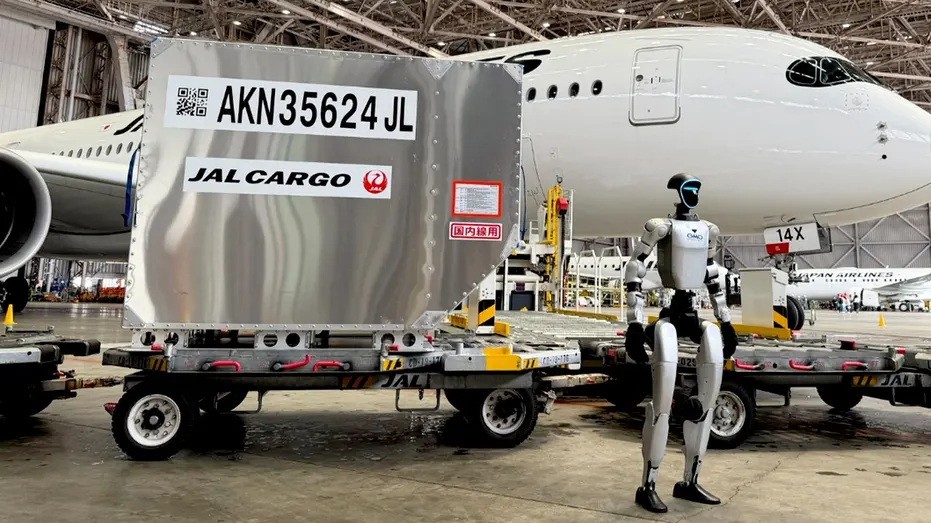
At Haneda Airport in Japan, one of the world’s busiest air hubs, humanoid robots are being trialed to assist ground crews. Japan Airlines is spearheading this initiative, intending to test machines capable of handling baggage and cargo directly on the tarmac.
This pioneering project is a collaboration between Japan Airlines’ ground service teams and GMO AI & Robotics, a specialized robotics division within the GMO Internet Group. The core objective is to assess the integration of these robotic systems into actual airport operational workflows.
The overarching vision is to foster a more sustainable operational model for airports as passenger demand continues its upward trajectory.
Airports are currently facing a dual challenge: a surge in passenger numbers coupled with a dwindling workforce.
Japan, in particular, is experiencing this strain acutely. The nation’s tourism sector is booming, yet its working-age population is in decline. This demographic shift creates a labor deficit that cannot be solely addressed through traditional recruitment methods. Japan Airlines, employing thousands of ground crew personnel, underscores the magnitude of this challenge.
Rather than undertaking a complete overhaul of existing airport infrastructure, companies are exploring the potential of humanoid robots that can seamlessly integrate into current operational practices. A robot designed with a human-like form can navigate the same spaces, utilize existing equipment, and work alongside human teams without necessitating significant modifications.
The robots undergoing testing are manufactured by Unitree Robotics. One particular model, the G1, is notably compact, allowing it to maneuver through confined areas while possessing the strength to lift and transport cargo. It stands just over four feet tall and weighs approximately 77 pounds. Its foldable design further enhances its utility by enabling efficient storage in space-constrained airport environments.
Its effectiveness is not solely attributed to its size. The robot is equipped with advanced sensors, including 3D LiDAR and depth cameras, enabling it to perceive and interpret its surroundings. It can identify objects, dynamically adjust its movements, and even respond to verbal commands.
In a recent demonstration, the robot was observed pushing cargo onto a conveyor belt and signaling to a human colleague. While seemingly a minor interaction, it vividly illustrates the potential for real-time coordination between machines and humans. These initial trials are meticulously designed to evaluate the robots’ capacity to safely support operations in realistic airport conditions, rather than function autonomously.
Before any physical interaction with luggage, these robots undergo extensive training in a virtual environment. Engineers create digital replicas of the machines and train them using sophisticated simulations. Nvidia’s Isaac Simulator, for instance, provides a platform where robots can repeatedly practice tasks without any risk of real-world damage.
Motion capture technology is employed to enable the robots to mimic human movements. Subsequently, reinforcement learning algorithms are utilized to refine these actions through iterative practice. Once the system demonstrates reliable performance in simulation, its learned behaviors are transferred to the physical robot. This methodology, often referred to as Sim2Real, significantly minimizes the likelihood of errors when the robot is deployed in a dynamic setting like an airport.
Even as automation gains traction, airlines are establishing clear distinctions regarding robotic roles. Robots are anticipated to undertake repetitive and physically demanding tasks, such as baggage handling, cargo loading, and equipment assistance.
Looking ahead, their responsibilities may expand to encompass a broader range of duties, including cabin cleaning or operating specific types of ground support equipment. GMO AI & Robotics also foresees a shift in human roles towards supervision, strategic decision-making, and robot management as the technology matures.
Nevertheless, critical responsibilities will continue to rest with human personnel. Airports are inherently complex and unpredictable environments where people, aircraft, and ground equipment operate in close proximity. For the foreseeable future, the primary objective is to identify how humanoid robots can safely augment the capabilities of human crews while alleviating physical strain.
Previous attempts to automate airport tasks have encountered difficulties. Conventional robots have struggled in unpredictable scenarios involving moving objects, pedestrian traffic, and rapidly changing conditions. Humanoid robots present a more adaptable solution, as their human-like form allows them to integrate without demanding substantial infrastructure alterations.
The trial at Haneda Airport is scheduled to continue until 2028, providing ample time for airlines to meticulously evaluate performance and refine the integration of these machines into daily operations. The rollout is planned as a phased approach, commencing with observation and testing before progressing to more practical applications. Should the outcomes prove successful, similar robotic systems could be deployed in airports worldwide.
While the immediate deployment of robots on U.S. airport tarmacs is not anticipated, the developments in Japan may well serve as a precursor to global trends. If these trials yield positive results, comparable systems could emerge at major U.S. airports, potentially leading to expedited baggage handling and reduced delays during peak travel seasons.
This evolution could also positively impact the working conditions for airport crews. By undertaking the most strenuous tasks, robots may help mitigate workplace injuries and contribute to more sustainable employment over time. Concurrently, new considerations will arise. Airlines will be tasked with demonstrating the safety, reliability, and readiness of these systems for real-world operational pressures before their widespread adoption in busy U.S. airports.
The prospect of robots handling luggage on airport tarmacs might initially seem unusual. However, it becomes more comprehensible when considering the driving forces behind these trials. Airports are experiencing escalating passenger volumes, and ground crews are already engaged in physically demanding work under considerable pressure. If these robots can safely manage the most arduous tasks, they could provide crucial support to human workers and contribute to smoother flight operations. The ultimate measure of success will be the effectiveness of human-robot collaboration in the high-stakes, time-sensitive environment of a busy airport.
Read more : Dinosaur Fossils Found During National Park Parking Lot Construction
If robots begin handling your luggage, would you trust them to ensure its safe and timely arrival? Share your thoughts by contacting us at CyberGuy.com.