SouthernWorldwide.com – The familiar feeling of navigating airport terminals after clearing security, with ample time before a flight, often leads to a search for a comfortable seat, a power outlet, or reasonably priced refreshments.
At Minneapolis-St. Paul International Airport (MSP), a novel lounge aims to transform this idle waiting period into a more engaging experience. Portal Lounge, a new high-tech airport lounge founded by the creators of Gameway, officially opened its doors on May 28th.
This innovative space seamlessly blends elements of gaming, dining, music, interactive design, and robotic beverage preparation into a social hub designed for travelers seeking a more fulfilling way to spend their pre-boarding hours.
The concept for Portal Lounge originates from Jordan and Emma Walbridge, the entrepreneurs behind Gameway. Their established airport gaming concept is already operational in nine U.S. airports, with plans to expand to eleven locations by year-end.
Portal Lounge builds upon the gaming foundation of Gameway by broadening it into a comprehensive hospitality experience. Rather than replicating the traditional lounge model focused on quietude and exclusivity, the founders envisioned a vibrant social environment where entertainment and technology take center stage.
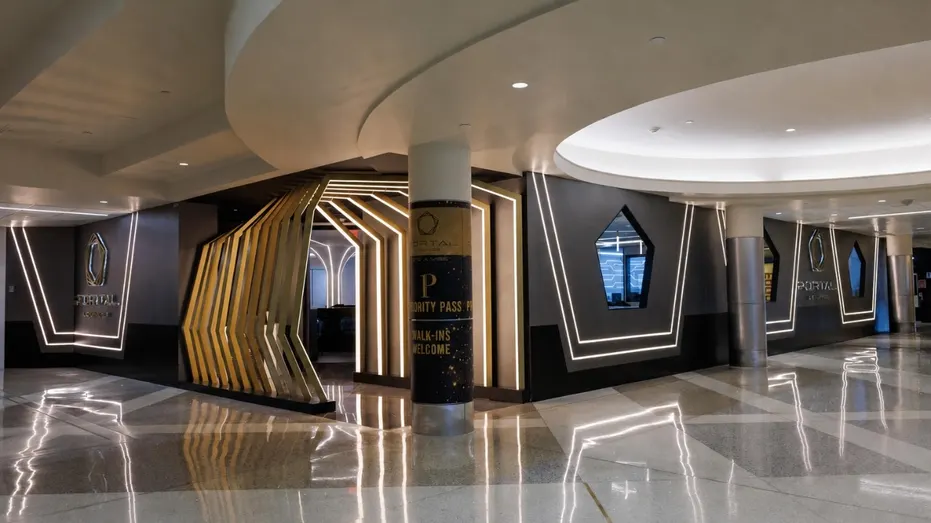
Spanning 3,800 square feet, the lounge can accommodate approximately 114 guests. Its design features an immersive, portal-inspired entrance, cinematic lighting, interiors influenced by art deco aesthetics, carefully curated music selections, bespoke furnishings, and communal seating areas.
A significant technological highlight is the extensive gaming setup, featuring 17 dedicated gaming stations equipped with Nintendo Switch, Xbox, PlayStation consoles, and custom-built gaming PCs.
Travelers have access to a library of nearly 30 game titles, catering to various preferences including casual play, multiplayer experiences, streaming, and competitive gameplay. Notably, adults aged 30 to 39 now constitute the largest demographic of gamers in the U.S. This same demographic often includes travelers who are willing to invest in enhanced airport experiences.
Emma Walbridge shared that Gameway’s success demonstrated travelers’ positive reception to interactive environments.
“Gameway truly revealed how much travelers engage with environments that feel interactive and purposeful,” Emma told CyberGuy. “When people are traveling, especially during delays or extended layovers, they seek ways to decompress and reset, rather than simply occupying another generic waiting area.”
This insight was instrumental in shaping Portal Lounge beyond just gaming. Emma explained that the team aimed to create a space that felt welcoming, energetic, and experience-focused, while still providing the comfort expected from a premium lounge.
“The gaming and entertainment aspects are integral to this, as is the overall ambiance, the food and beverage offerings, the music, and the design of the space,” she elaborated.
The robotic bartender is poised to be a major attraction, and for good reason. Portal Lounge claims to introduce the first robotic bartender of its kind within a U.S. airport lounge. Developed in Italy, this robot operates in conjunction with a traditional bar program, capable of preparing both alcoholic and non-alcoholic cocktails while providing an engaging visual spectacle for patrons.
This feature exemplifies the lounge’s embrace of tech-enabled hospitality. The robot is not intended to replace the entire bar service but rather to serve as a memorable centerpiece that guests are likely to document, share, and discuss before their flights. Essentially, the robot bartender acts as the initial draw, with the broader narrative being the evolving trend of airports transforming waiting times into interactive experiences.
“For us, technology serves to enhance the experience, not dominate it,” Jordan Walbridge stated to CyberGuy. “We envisioned Portal Lounge as a modern, social, and experiential destination, a departure from the way traditional airport lounges have largely remained stagnant.”
Read more : Your Older Parents Are Easier to Impersonate Than You Are
He further explained that technology is integrated throughout the entire lounge experience, from check-in and entertainment to lighting and music, including gaming. “The objective was to craft an environment that feels seamless and immersive from the moment guests enter,” he added.
Portal Lounge also endeavors to elevate the typical airport dining experience. The menu features chef-curated small plates, regional beverages, and cocktails inspired by Minnesota. A signature drink, named “Lag Free,” is a Minnesota-themed margarita incorporating notes of Honeycrisp apple, maple, and citrus.
Additionally, “Prince’s Lemonade,” a non-alcoholic cocktail, pays homage to the iconic Minnesota musician Prince. This local connection helps the lounge feel rooted in Minneapolis, distinguishing it from generic airport spaces. It also reflects a broader shift in travel preferences, with many travelers now seeking memorable and visually appealing venues that are connected to the cities they are visiting.
Airport lounges were once predictable spaces, offering a quieter seat, a snack, Wi-Fi, and perhaps a drink before a flight. For many years, this was considered sufficient. However, a growing number of travelers now expect more from their time spent within airports. Some lounges are often crowded, and gate areas can be chaotic. The prospect of sitting idly for an hour or two before boarding can quickly become monotonous.
This is precisely where Portal Lounge introduces a novel approach. It operates as an independent common-use lounge, distinct from airline-specific clubs. Travelers can gain access through Priority Pass and various participating credit card programs, including Chase, American Express, and Capital One. Walk-in access is also available, with prices expected to be around $70, subject to availability.
This price point might give some pause. For a brief stop before a flight, it may not seem cost-effective. However, for those facing a significant delay, an extended layover, or families with ample time to fill, the value proposition shifts. Portal Lounge is banking on the appeal of games, food, music, and robot-prepared beverages to make airport waiting feel considerably less like waiting.
Minneapolis-St. Paul International Airport provides a strategic launchpad for Portal Lounge’s concept. MSP served approximately 36 million passengers in 2025, with many commencing their journeys there. This volume ensures a substantial number of travelers arrive early, clear security, and still have considerable time before their flights depart.
This surplus time is precisely what Portal Lounge is designed to cater to. Travelers rushing to their gates are unlikely to stop for a gaming session or a robot-made mocktail. However, for those with 90 minutes to spare, the proposition changes dramatically. Suddenly, the airport wait transforms from a passive experience of crowded gates and vigilant bag-guarding into an opportunity for engagement. Portal Lounge anticipates that travelers with time to spare will seek more fulfilling ways to spend it.
Portal Lounge has the potential to significantly upgrade the airport waiting experience. For those flying through MSP, it offers a more entertaining way to pass the time. Guests can engage in gaming, enjoy food, listen to curated music, and witness a robotic bartender in action before their departure.
Emma Walbridge expressed that the objective is for travelers to perceive the lounge as an integral part of their journey, rather than merely a waiting period. “We hope travelers leave feeling that their time at the airport became part of the trip itself, not just time spent waiting for a flight,” she stated. “Portal Lounge was designed to create a more immersive, engaging, and entertainment-driven experience, where guests can genuinely relax, connect, and enjoy themselves in a way that feels very different from a traditional airport lounge.”
This proposition is particularly appealing for those facing flight delays or traveling with companions who tend to become restless before boarding. Nevertheless, the most engaging lounge in the airport is of little use if one misses their flight. It is crucial to set alarms, monitor boarding times, and avoid letting an extra game turn into a last-minute dash to the gate.
Portal Lounge appears to be a harbinger of the future of airport travel. Passengers are increasingly seeking more than just a place to sit and watch a boarding screen for two hours. They desire comfort, entertainment, and more productive uses of their time. While the robotic bartender will undoubtedly capture attention, the more significant technological narrative lies in the holistic experience: the gaming stations, interactive design, curated music, social seating, and a lounge model that aligns with contemporary methods of spending downtime.
Whether this concept will appeal to every traveler remains to be seen. Some individuals may still prefer a quiet corner and a strong cup of coffee. However, for travelers who view airport time as unproductive, Portal Lounge could transform the wait into a more valuable and significantly more enjoyable experience.