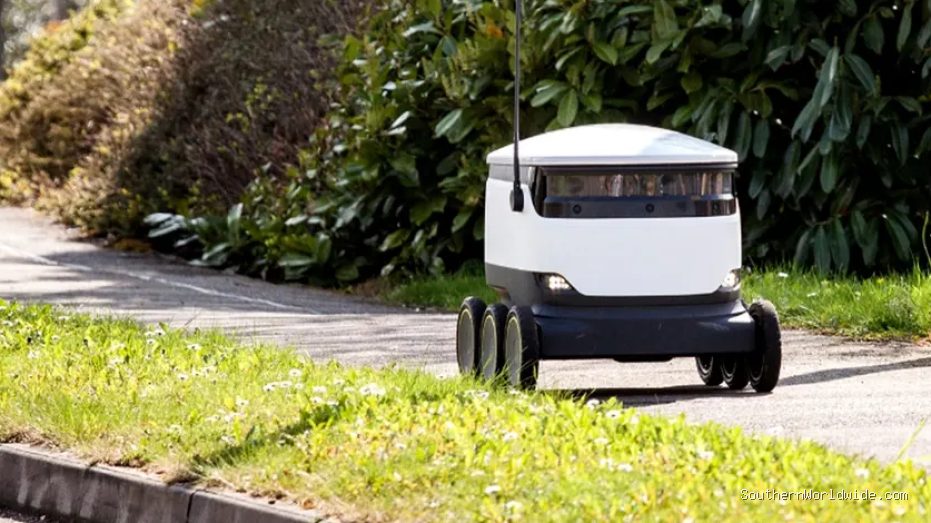
SouthernWorldwide.com – The familiar sight of small, white delivery robots navigating college campuses with food and snacks is set to change as Starship Technologies announces a significant shift in its operational strategy.
Starship Technologies recently revealed its decision to phase out its operations on U.S. university campuses. This move will see over 1,200 of its robots being redeployed to urban environments across the United States and Europe, focusing on grocery and hot food delivery services for established retail chains.
These autonomous robots, often observed patiently waiting at crosswalks, had become a beloved fixture on many campuses. They served a dual role as a convenient service and a sort of campus mascot. Now, the company is transitioning from the controlled environment of campuses to the more challenging and unpredictable setting of public city streets.
This transition raises a pertinent question: will these formerly charming campus companions be as well-received when they begin sharing crowded city sidewalks with pedestrians?
Starship attributes this strategic pivot to a desire for increased focus. The company highlights that its grocery delivery services are projected to experience tenfold growth over the next two years, fueled by strong demand from major retailers in both the U.S. and Europe.
In Finland, Starship’s robots are already a significant part of the grocery delivery landscape, reportedly handling approximately one in five deliveries. This success provides the company with a tangible model it aims to replicate in other regions. To facilitate this expansion, the robots previously used on U.S. campuses will be integrated into the grocery delivery fleet, marking a substantial change in their deployment.
Campuses played a crucial role in establishing Starship’s brand presence in the United States and served as essential testing grounds for the robots. The company made a notable debut at George Mason University in 2019, which was the first U.S. university to offer autonomous robot deliveries from Starship.
From this initial partnership, the robots gradually expanded their presence to numerous other campuses. This expansion was logical, considering that college students often have irregular eating schedules, may have limited kitchen facilities, and are generally receptive to new technologies, especially those that deliver food directly to their dorms without the need for social interaction.
The necessity for contactless delivery became even more pronounced during the pandemic. A robot capable of delivering meals while minimizing human-to-human contact suddenly proved its value in a new light.
Starship has indicated that it is working collaboratively with its university partners and industry stakeholders to ensure a smooth transition, with services expected to continue through the 2026–2027 academic year. This suggests a phased withdrawal rather than an abrupt cessation of campus operations, allowing for a gradual shift as the fleet prepares for a more intensive focus on grocery and restaurant deliveries.
While students who grew fond of the campus bots might perceive this as the end of an era, for Starship, it represents a move towards markets where the company believes stronger economic potential lies. Starship CEO and co-founder, Ahti Heinla, asserts that their robots can deliver groceries at a cost of $3 to $4 less per delivery compared to traditional courier services. This cost-effectiveness is particularly attractive to retailers seeking to optimize their last-mile delivery operations.
The next phase of Starship’s operations is likely to present its own set of challenges. Delivery robots will need to coexist with a diverse range of sidewalk users, including pedestrians, individuals with strollers, wheelchair users, shoppers, and commuters. This necessitates careful consideration of every design and operational aspect.
A robot that obstructs a curb ramp, for instance, could create significant accessibility issues. Similarly, a robot that stops unexpectedly in a busy area could quickly transition from being a novelty to a nuisance. Any instance of a robot reversing without warning or becoming immobilized near a crosswalk could rapidly diminish its perceived value.
There have already been instances that foreshadow these potential difficulties. Reports have surfaced detailing delivery robots colliding with pedestrians, becoming stuck in inconvenient locations, and raising concerns about accessibility. In Chicago, for example, there has been local opposition and safety concerns regarding sidewalk delivery robots, indicating that Starship still has considerable work to do to gain widespread public acceptance in urban settings.
The challenge Starship now faces is that the same robot that was perceived as charming on a college campus might be viewed as mere clutter on a narrow city sidewalk.
Grocery delivery operates on a different scale and with different expectations than campus food delivery. While a campus order might consist of a single sandwich or snack, a grocery run often involves heavier items, more frequent routes, and customers who expect consistent reliability.
If Starship can successfully navigate these complexities, the potential rewards could be substantial. Grocery stores are actively seeking more cost-effective local delivery solutions, consumers desire speed without exorbitant fees, and cities aim to reduce traffic congestion caused by short-distance delivery vehicles.
Starship estimates the global food delivery market to be worth $650 billion, a sector that increasingly demands delivery systems with higher levels of autonomy. The company also points to its track record of over 10 million completed deliveries as a significant advantage in the sidewalk robot category.
However, public perception will be a crucial factor. While people might appreciate a robot delivering essential items on a rainy evening, they could easily become frustrated if the same robot impedes pedestrian flow during peak hours.
The ultimate success of sidewalk robots will hinge on whether they become a normalized part of urban life or face increased local restrictions. Starship was founded in Tallinn, Estonia, in 2014 by Ahti Heinla and Janus Friis. Estonia continues to be the hub for the company’s core engineering and AI development teams, a fact that underscores the technological sophistication behind this strategic shift.
Starship’s transition signifies a broader trend in the delivery robot industry. While college campuses provided a conducive environment for developing user acceptance and brand recognition, grocery delivery will likely determine the profitability of these autonomous services.
Ultimately, city sidewalks are public spaces. This means that companies venturing into this domain require more than just advanced technology; they need to cultivate trust, establish clear operational guidelines, and design robots that are considerate of all individuals navigating urban environments.
A delivery robot should never impede the accessibility of a sidewalk for individuals using canes, strollers, or wheelchairs. It should not transform public thoroughfares into obstacle courses. For these robots to be perceived as a normal and beneficial addition to city life, companies must demonstrate their ability to operate without adding to daily frustrations.
The departure of Starship from U.S. campuses marks the end of a unique chapter, particularly for students who became accustomed to the presence of these small, autonomous delivery vehicles. However, this shift also offers insights into the future trajectory of autonomous delivery services.
The next significant challenge will unfold on city sidewalks, rather than within the confines of university grounds. If these robots can genuinely reduce costs and decrease the number of short car trips, they could prove immensely valuable. Conversely, if they contribute to sidewalk congestion or create safety concerns, public resistance is likely to grow.
In essence, the true test lies in whether robot delivery can function harmoniously for everyone utilizing the sidewalk, including those who have not placed an order. The question remains: would you welcome a delivery robot on your street, or would you prefer to keep your sidewalks free of them?