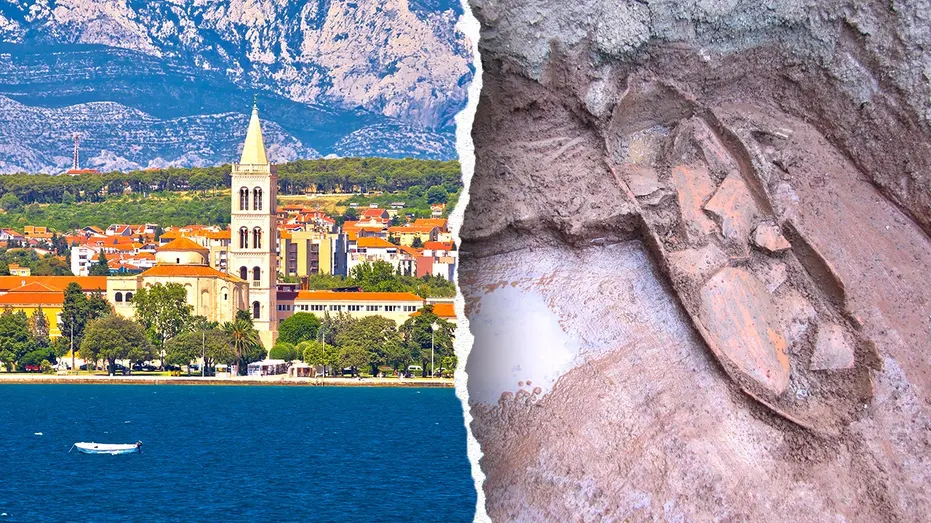
SouthernWorldwide.com – Archaeologists have unearthed ancient Roman graves beneath a bustling Adriatic city, providing a unique window into life in the area long before it became a popular tourist destination.
The discovery was made in the Relja district of Zadar, a coastal city in Croatia renowned for its picturesque coastline and rich historical heritage, which includes numerous Roman ruins.
According to a statement from the University of Zadar’s Department of Archaeology, the necropolis dates back to a period spanning from the first century B.C. to the fifth century A.D.
The department noted that the busy Relja neighborhood is situated atop a significant portion of the ancient necropolis of Roman Zadar.
Historically, cemeteries in Roman times were typically located outside city walls, often along main thoroughfares. This particular site served as a burial ground for Romans for nearly 500 years, situated along one such route.
Across the broader Relja area, which encompasses a major shopping center and various other landmarks, archaeologists have identified an impressive 3,000 graves.
The department highlighted that the area where the site is located is currently one of Zadar’s most dynamic and rapidly developing sectors. However, during the Roman era, when the necropolis was first established, it was situated in a suburban setting.
Professor Igor Borzić from the University of Zadar reported that approximately 15 ancient burials have been uncovered at the site.
He explained that cremation was the predominant burial practice during the first and second centuries A.D. Grave goods from this period included items such as small glass vessels, ceramic bowls, oil lamps, coins, and other offerings.
By the second century, inhumation, or the burial of bodies, began to become increasingly prevalent.
Borzić further elaborated that over time, these burials tended to contain fewer grave goods. This shift is believed to reflect evolving attitudes towards the afterlife and broader changes in religious beliefs, moving away from the pagan traditions of classical antiquity towards the eventual dominance of Christianity.
Borzić concluded that the findings from these approximately 15 graves suggest that the population of Roman Iader closely mirrored the cultural and religious trends observed throughout the wider Roman Empire. This supports the notion of a highly interconnected, culturally unified, and trend-conscious society within such an extensive imperial system.
While the discovery of ancient graves beneath a modern city might seem unusual, Borzić stated that such findings are not entirely unexpected in Zadar.
“It is difficult to say that anything truly unexpected has emerged, although every single find tells its own story and deserves to be approached as such,” Borzić commented.
He added that modern archaeology increasingly relies on a wide array of laboratory analyses, which can provide insights into aspects such as origin, diet, health, and causes of death.
“It is precisely in this area that we believe new and potentially surprising information may still come to light,” he noted.
Among the key discoveries are a burial that may predate Roman Zadar, likely originating from the prehistoric Liburnian period, as well as “carbonized remains” dating from the second or third century A.D.
Borzić indicated that these remains were likely food or grains and will be sent for further analysis.
The archaeologist also mentioned that artifacts recovered from the site will undergo careful processing and study before being temporarily displayed in the Department of Archaeology’s collection.
In addition to Roman-era findings, the site has also yielded artifacts from the 20th century related to the Italian occupation of Zadar. Borzić pointed out that this serves as a further reminder of the city’s continuous importance throughout its history.
He attributed this enduring significance largely to its strategic location along major maritime routes on the eastern Adriatic coast, as well as its exceptionally fertile agricultural hinterland.
Read more : House Republican Absent Again, Affecting Thin Majority's Votes
“Together, these factors ensured that Zadar remained a significant center across many different historical periods,” Borzić concluded.