SouthernWorldwide.com – Archaeologists in Egypt have unearthed a significant artifact, a massive statue believed to represent King Ramses II, a pharaoh prominently featured in the Old Testament’s narrative.
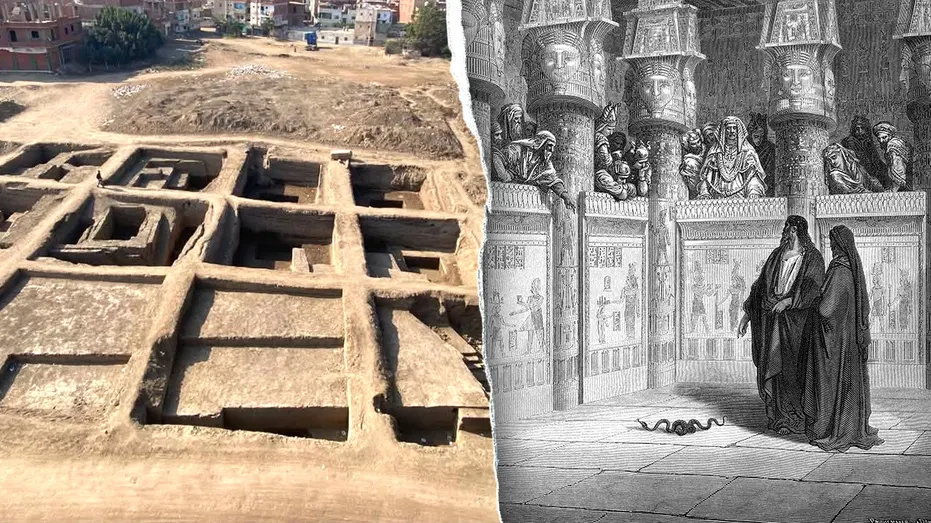
The discovery was made at the Tel Pharaoh site, located in the Husseiniya Center of the Sharqia Governorate, as announced by the Egyptian Ministry of Tourism and Antiquities on April 22. This site is situated in Egypt’s Nile Delta, northeast of Cairo.
Officials highlighted the statue’s impressive dimensions, noting its weight of approximately 5 to 6 tons and a length exceeding 7 feet.
The ministry’s translated statement indicated that the statue was found in a “relatively poor condition of preservation,” with its legs and base notably absent.
Despite its condition, authorities have expressed confidence that the statue “likely represent[s] King Ramses II.”
Ramesses II, born in 1303 B.C., is widely regarded as one of the most influential and powerful rulers during the New Kingdom era of ancient Egypt.
Scholars frequently identify him as the potential pharaoh mentioned in the biblical Book of Exodus, although the Old Testament does not explicitly name him.
According to historical accounts, Ramesses II is believed to have resisted Moses’ demands, leading to a series of plagues. He passed away in 1213 B.C.
Read more : AOC's $30 Minimum Wage Plan: Potential Unforeseen Consequences, Experts Caution
Mohamed Abdel Badie, an Egyptian antiquities official, suggested that the statue was likely moved and repurposed at the Tel Pharaoh site during ancient times.
“Preliminary studies indicate the statue was transported in ancient times from the city of Pi-Ramesses to the Tel Pharaoh site, known in ancient times as ‘Imet,’ to be reused within one of the religious complexes, reflecting the religious and historical importance of the site across different periods,” Badie stated.
The ministry further described the statue as “one of the important archaeological pieces of evidence that shed light on aspects of religious and royal activity in the eastern Delta region.”
“As part of efforts to preserve this discovery, the statue was immediately transferred upon its discovery from within the temple complex at the site to the museum storage facility in the San El-Hagar area,” the statement elaborated.
This transfer is “in preparation for the start of precise and urgent restoration work, in accordance with the highest scientific standards followed in the conservation and preservation of antiquities.”
This recent find contributes to a growing number of archaeological discoveries announced across Egypt in recent times.
In late March, authorities revealed eight rare papyrus scrolls, estimated to be nearly 3,000 years old, whose contents remain unexamined.
Additionally, officials recently unveiled the remnants of an ancient religious complex located in North Sinai, a site often associated with a biblical city mentioned in the Old Testament.