SouthernWorldwide.com – Archaeologists in Jerusalem have unearthed a remarkable and somewhat enigmatic ancient tunnel, located in close proximity to archaeological sites associated with the biblical Kingdom of Judah.
The Israel Antiquities Authority (IAA) officially announced this significant discovery on May 14th.
The tunnel was found near Kibbutz Ramat Rachel, an area previously identified through IAA excavations as being connected to the biblical-era Kingdom of Judah.
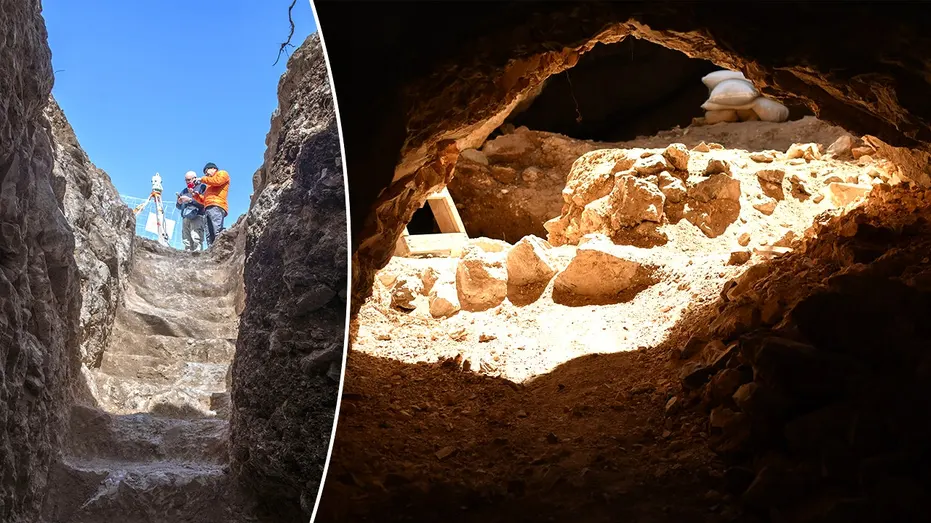
This newly discovered rock-hewn tunnel measures approximately 164 feet in length and was uncovered in anticipation of the construction of a new residential neighborhood north of Ramat Rachel.
With a height of about 16 feet and a width of roughly 10 feet, officials emphasized the meticulous nature of the rock-cutting work involved in its creation.
The IAA stated that the tunnel was found filled with accumulated soil, suggesting it had been buried for hundreds, possibly even thousands, of years.
It is evident that considerable effort, careful planning, and substantial resources were invested by those who originally carved this tunnel to achieve their objective.
Excavation directors Sivan Mizrahi and Zinovi Matskevich informed the IAA that the discovery was entirely unexpected.
They described the moment of discovery, stating they were excavating in a rocky and exposed area when they encountered a natural karstic cavity.
To their surprise, as the excavation progressed, this cavity revealed itself to be a long tunnel, parts of which are still collapsed, meaning it has not yet yielded all of its secrets.
In 2020, previous IAA excavations in the vicinity of Ramat Rachel had uncovered seal impressions and structures linked to the Kingdom of Judah, indicating governmental activities in the region at that time.
However, thus far, no evidence has been found to directly connect the newly discovered tunnel to the Kingdom of Judah or the biblical era, and its exact age remains undetermined.
Mizrahi and Matskevich noted that the tunnel is situated only a few hundred meters from two important ancient sites: a public building from the Iron Age (First Temple period) in the Arnona neighborhood, and Tel Ramat Rachel, which contains settlement remains spanning from the Iron Age to the Islamic period.
While the exact purpose of the tunnel is still a subject of speculation, researchers theorize it might have been excavated to access a chalk layer for quarrying building stones or for the production of lime.
The IAA pointed to potential supporting evidence for this theory, including a shaft carved into the tunnel’s ceiling, possibly for ventilation, and quarrying debris found on the tunnel floor, though they acknowledge this interpretation is not definitive.
Experts have ruled out the possibility that the tunnel was part of an ancient water system.
Some theories suggest that the site may have been abandoned before the construction of the tunnel was completed.
Alternatively, the IAA suggests that the findings could indicate that the quarrying and construction of the tunnel were never finished, leaving its intended purpose and nature unknown.
Amit Re’em, a Jerusalem district archaeologist at the IAA, commented that this find is part of a continuous stream of discoveries being made throughout the city on a daily basis.
Re’em highlighted that the archaeologists and researchers of the Israel Antiquities Authority are constantly working, as Jerusalem continues to reveal its surprises.
Read more : FDA Delays Cost Trillions, Slowing Lifesaving Drugs
He added that while explanations are usually found for their discoveries, some instances, like this one, leave them in a state of astonishment and amazement.