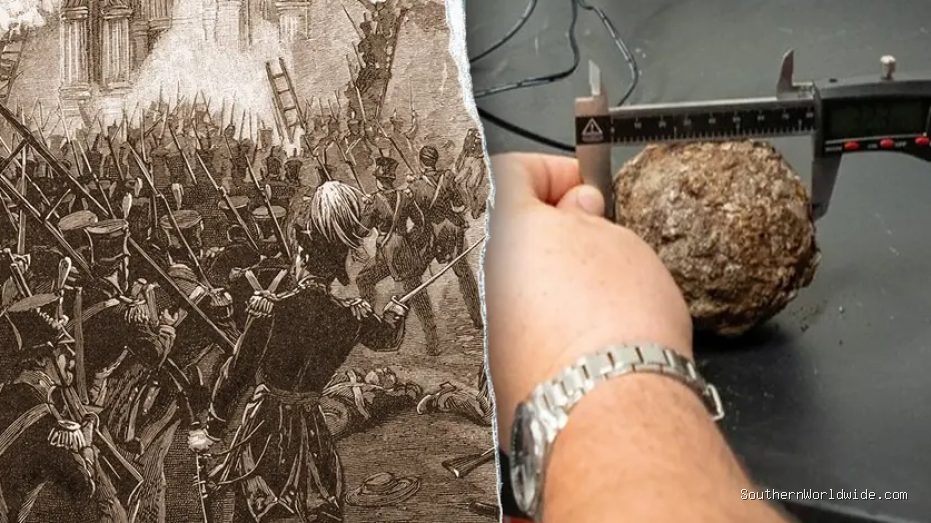
SouthernWorldwide.com – Archaeologists have unearthed a cannonball that is believed to have been fired during the pivotal 1836 Battle of the Alamo. This remarkable discovery comes just three months after a similar, rare cannonball was found at the historic site.
The cannonball was officially discovered on June 2.
The Alamo Trust, the non-profit organization responsible for the preservation and management of the Alamo Mission, officially announced this significant finding on June 16.
This newly found artifact was located outside the northeast corner of the Alamo Church. It was unearthed in an adjacent excavation unit, a location that yielded another intact cannonball back in March.
Images of the cannonball reveal a substantial amount of rust covering its surface, giving the iron projectile an orange-brown hue.
Given its discovery at a similar depth to the first cannonball and in a neighboring excavation area, archaeologists are confident that this artifact has likely remained undisturbed for approximately 190 years.
“So whenever they were dropped, the very first time — possibly in 1836, probably — they haven’t been touched since,” stated Tiffany Lindley, director of archaeology at the Alamo, in a press release.
“And that’s what makes them extra special.”
The Battle of the Alamo stands as one of the most significant conflicts in the history of Texas. It was a fierce engagement fought between Mexican forces and Texian rebels.
The battle, which spanned from February 23 to March 6, 1836, witnessed Texian forces, including notable figures like Davy Crockett and William B. Travis, bravely defending their position against a significantly larger Mexican army.
The siege lasted for 13 days and concluded with Mexican troops successfully overwhelming the Texian defenders. This outcome became a powerful rallying cry that fueled the Texas Revolution.
Lindley further explained that the Alamo site has experienced extensive human activity throughout its history. This includes periods of occupation by the U.S. military quartermaster and considerable commercial development surrounding the historically significant grounds.
“All of that has impacted a significant portion of the underground resources,” Lindley commented.
“It was amazing to find one cannonball, and then to follow it up a couple of months later with a second was quite surprising.”
The recently discovered cannonball, according to Lindley, is not as well-preserved as the first one found, a difference attributed to the varying types of metal used in their construction.
The initial cannonball discovered was made of solid bronze, whereas this second find is composed of solid iron.
“However, it’s still in pretty good condition,” she added. “We are hoping to send both artifacts off for conservation.”
While the archaeological team remains hopeful of uncovering more artifacts directly related to the Battle of the Alamo, Lindley emphasized that the ongoing excavations consistently yield dozens of historic finds on a daily basis.
“We are finding dozens of exciting historic artifacts every day, along with hundreds of maybe not so exciting artifacts, like nails and brick,” Lindley shared.
“We find what gets left behind, and often that means broken and discarded items.”
Lindley concluded by noting that, despite its historical significance and excitement, the cannonball represents only “one small part in this project.”
“After excavations end, analysis of the data will provide valuable insight into the daily lives of the inhabitants of the site,” she stated.