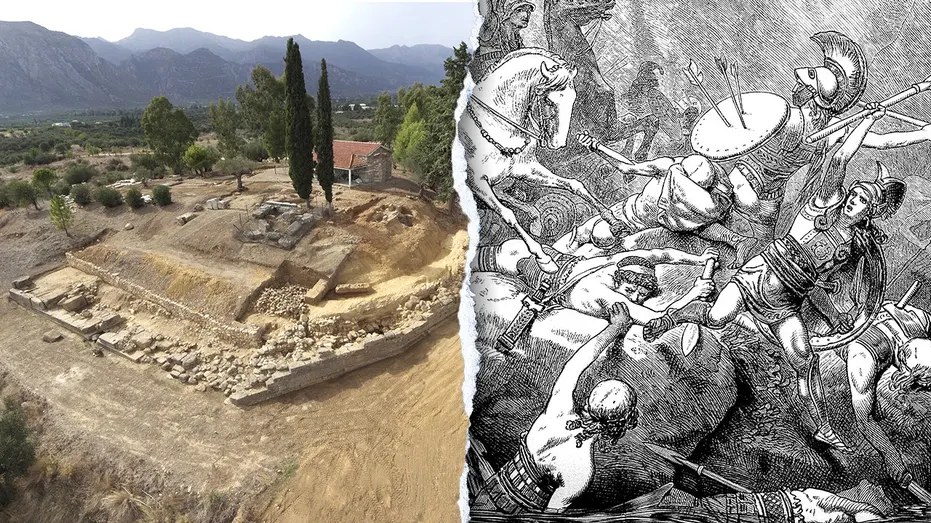
SouthernWorldwide.com – New historical research suggests that one of history’s most legendary cities did not initially emerge as a conquering warrior state, thereby challenging its foundational myth.
The study, which focused on Sparta, was recently published by historian Hans Beck in The Annual of the British School at Athens, as reported by Cover Media.
Sparta rose to prominence in the 9th century B.C. and exerted dominance over much of the Peloponnese for a period spanning approximately from 700 to 371 B.C.
In 371 B.C., the Spartans faced a significant defeat at the hands of the Thebans in the Battle of Leuctra, an event that signaled the beginning of their decline.
While Sparta is commonly remembered as a warrior society built through conquest, the historical narrative appears to be far more intricate.
Utilizing archaeological findings from a site known as Aghios Vasileios, Beck posits that Sparta evolved from an older Lakedaimonian cultural landscape rather than being established from scratch by conquering warriors.
The Lakedaimonians were the inhabitants associated with the region of Lakedaimon, also referred to as Laconia, which encompassed the area surrounding Sparta.
At Aghios Vasileios, archaeologists unearthed the remnants of a palace complex, along with frescoes, bronze swords, and administrative records inscribed in Linear B, the earliest known form of written Greek.
Crucially, the study indicated that a significant sanctuary named Amyklai remained operational even after the palace’s collapse. This sanctuary later gained importance for both the Spartans and the Lakedaimonians.
“The emergence of Sparta profoundly altered the landscape,” wrote Beck, a professor at the University of Münster.
“Yet, Amyklai preserved its status as a primary location for Lakedaimonian legacies.”
The continued ritualistic activities at Amyklai suggest that older Lakedaimonian traditions persisted into the era when Sparta was beginning to rise, thus complicating the conventional account of conquest.
This study does not refute Sparta’s later reputation as a formidable military power but argues that the city-state’s origins were not solely a straightforward narrative of conquest.
These findings emerge amidst a series of new discoveries that are illuminating aspects of Ancient Greece.
Earlier in 2026, officials announced the discovery of what might be the oldest wooden tools, dating back hundreds of thousands of years.
These tools were discovered in the Megalopolis basin, a low-lying valley situated in the Peloponnese peninsula of southern Greece.
More recently, a German teenager discovered an ancient Greek coin, marking the first such find ever recorded in Berlin.