SouthernWorldwide.com – SpaceX successfully launched an unpiloted Dragon cargo ship on Friday, carrying approximately 6,500 pounds of essential supplies and equipment to the International Space Station (ISS). The payload includes nearly a ton of research materials designated for around 50 distinct scientific investigations.
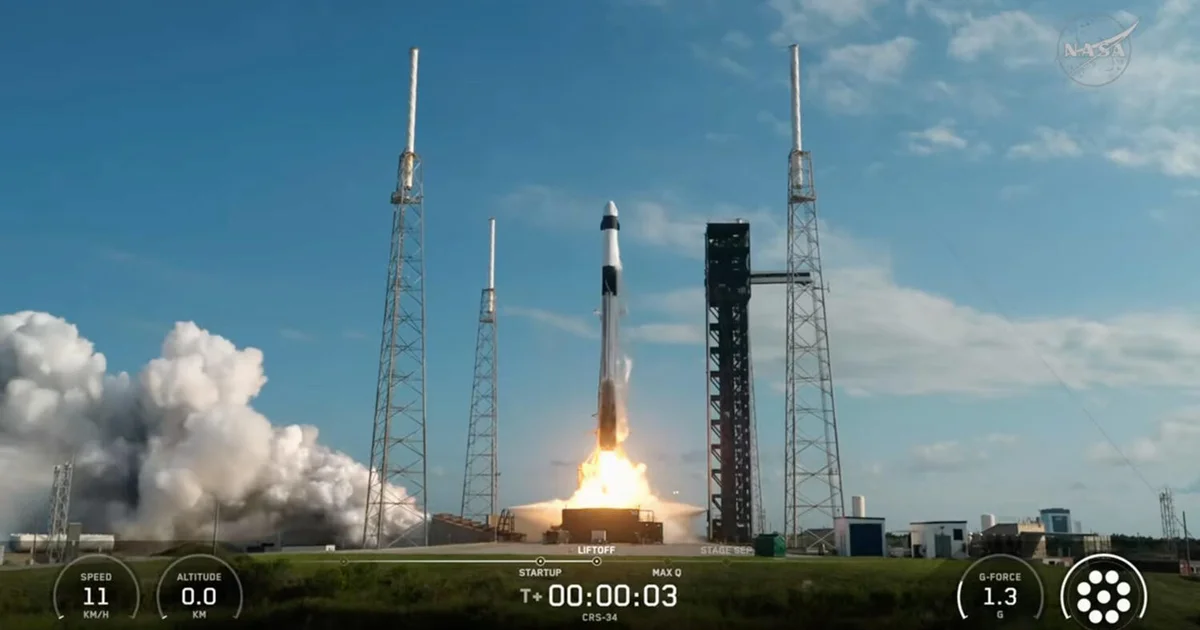
The launch, which was delayed by three days due to adverse weather conditions, commenced at 6:05 p.m. Eastern Time. The Falcon 9 rocket ignited its engines and ascended from pad 40 at the Cape Canaveral Space Force Station, arcing towards the northeast in alignment with the ISS’s orbital path.
A SpaceX Falcon 9 rocket ascends from Cape Canaveral Space Force Station, carrying a Dragon cargo ship laden with equipment and supplies destined for the International Space Station. (NASA/SpaceX)
Approximately two and a half minutes after liftoff, the rocket’s first stage, which was on its sixth flight, separated and successfully returned for a controlled landing on a designated pad near the launch site. The second stage continued its ascent, ultimately releasing the Cargo Dragon spacecraft to navigate independently towards orbit just nine minutes and 20 seconds post-launch.
A view from a camera on the Falcon 9 first stage captures its approach to the landing pad, while a ground camera documents the dramatic final moments of its descent. (NASA/SpaceX)
This mission marked SpaceX’s 638th Falcon 9 launch since its inception in 2010. It also represents the company’s 56th launch of the year and its 611th successful booster recovery, underscoring its consistent operational performance.
The first stage of the Falcon 9 successfully completed its sixth flight with a precise landing at Landing Zone 40, near its launch pad at Cape Canaveral Space Force Station. (NASA/SpaceX)
“This is the first Cargo Dragon spacecraft to make a sixth journey to the station, which is a significant milestone,” stated Bill Spetch, ISS operations integration manager at the Johnson Space Center. “We are delivering over 6,000 pounds of crucial hardware, supplies, and scientific experiments for our Expedition 74 crew.”
Spetch further elaborated that the mission’s cargo includes items ranging from water purification systems to research materials designed to enhance our understanding of space weather. The successful delivery of these items is vital for ongoing scientific work and station operations.
Assuming all systems function as expected, the Cargo Dragon is scheduled to autonomously rendezvous with the ISS early Sunday morning. It will then dock at the forward end of the Harmony module, with docking anticipated around 7 a.m.
Following the docking, the hatch will be opened, and the spacecraft’s contents will be unloaded by Expedition 74 commander Jessica Meir and her fellow crew members: pilot Jack Hathaway, European Space Agency astronaut Sophie Adenot, and cosmonaut Andrey Fedyaev. Their collaboration is essential for integrating the new supplies and equipment.
Also currently aboard the ISS as part of the seven-person Expedition 74 crew are Soyuz MS-28/74S commander Sergey Kud-Sverchkov, cosmonaut Sergey Mikaev, and NASA astronaut Chris Williams. Their presence ensures continuous operations and research on the station.
The Cargo Dragon is carrying a substantial payload, exceeding 3 tons in total weight. This includes 1,363 pounds of crew provisions such as clothing and food, over 1,000 pounds of vehicle hardware, 282 pounds of components for spacewalks, 186 pounds of computer equipment, and a significant 1,834 pounds of research apparatus and collected samples.
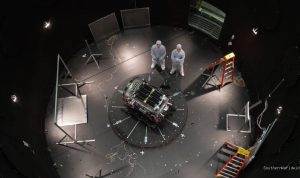
A representative image related to the cargo manifest for a NASA CRS mission. (NASA)
“The ISS has facilitated over 4,000 unique science experiments and technology demonstrations throughout its 25-year operational history,” commented Liz Warren, deputy chief scientist for the space station program. “This represents the collective effort of more than 5,000 researchers hailing from 110 different countries worldwide.”
Warren emphasized the ISS’s role as a global collaborative platform. “The International Space Station is a truly global endeavor. It serves both as a proving ground for scientific breakthroughs and as a critical stepping stone to help enable the Artemis program, lunar exploration and future Mars missions,” she added, highlighting its importance for future space exploration initiatives.
The next significant event for the space station program is slated for July. Soyuz MS-29 commander Pyotr Dubrov, cosmonaut Anna Kikina, and NASA astronaut Anil Menon are scheduled to launch from the Baikonur Cosmodrome in Kazakhstan on July 14. They will be replacing Kud-Sverchkov and his two Soyuz MS-28 crewmates, ensuring continuity in the crew rotation schedule.
Following this, a Russian Progress cargo ship is expected to launch in early September. Subsequently, NASA’s Crew 13, comprising Jessica Watkins, Luke Delaney, Canadian astronaut Joshua Kutryk, and cosmonaut Sergey Teteryatnikov, will depart aboard a SpaceX Crew Dragon capsule on September 12. This crew will succeed Crew 12, continuing the cycle of crewed missions.
Read more : Detroit Tigers Broadcasters Criticize MLB Replay Following Overturned Calls
The year is set to conclude with three additional cargo flights. Crew rotation missions are anticipated to resume in early 2027, maintaining the ongoing presence and operational capacity of the ISS.