SouthernWorldwide.com – A palpable sense of disapproval towards Donald Trump has permeated much of Europe, with leaders in Brussels and Berlin expressing confusion and hostility towards his “America First” agenda. This sentiment fuels discussions around “strategic autonomy,” a nuanced approach for Europe to assert its independence from a Washington that prioritizes tangible outcomes over mere pronouncements.
In stark contrast, Serbia, a nation historically wary of the United States, has witnessed a surge in affinity for America in recent years. This is a notable development, as Serbia is not inherently pro-American, largely due to the painful memories of the 1999 US-led NATO bombings, an event that inflicted immense suffering and national trauma on millions of Serbians.
The lingering pain of the past makes it challenging for Serbians to embrace the United States or its leaders. However, today, the reflexive anti-Americanism prevalent elsewhere in Europe is rare in Serbia. During extensive travels across the country, a sentiment is increasingly evident: an unreserved admiration for Donald Trump’s leadership.
My personal perspective on Donald Trump was shaped during his initial term. His administration, including his close advisors, demonstrated a remarkable willingness to seriously consider Serbia’s position without prejudice. This was a welcome departure from previous experiences. I recall lengthy meetings at the White House with his inner circle, which extended well beyond difficult negotiations. At no point did I feel my concerns were dismissed or that I was being patronized. The common portrayal of Trump as an aggressive bully did not align with my personal interactions; he was direct, yes, but he also listened attentively, engaged genuinely, and treated Serbia with respect.
For the leader of a smaller nation, such respectful engagement is profoundly significant, a fact that leaders in larger powers may not always fully appreciate. In Brussels, for instance, smaller nations frequently feel lectured rather than heard. Trump’s approach was so impactful that I publicly expressed my admiration for him and his core team in various forums.
The ability to gain the support of people in a country like Serbia is a testament to Trump’s compelling personality. He has managed to dissolve long-standing suspicions by projecting a different kind of American presence. In a region where some neighboring countries have named avenues after American presidents associated with war and chaos, Serbians perceive something unprecedented in Trump: a peacemaker.
This understanding is why the recent, alarming attempt on President Trump’s life at the White House Correspondents’ Dinner resonated so deeply throughout Serbia. Witnessing a leader targeted for his convictions is a tragedy that resonates with our own history. While some offered perfunctory condemnations, the Serbian people expressed a genuine and visceral solidarity.
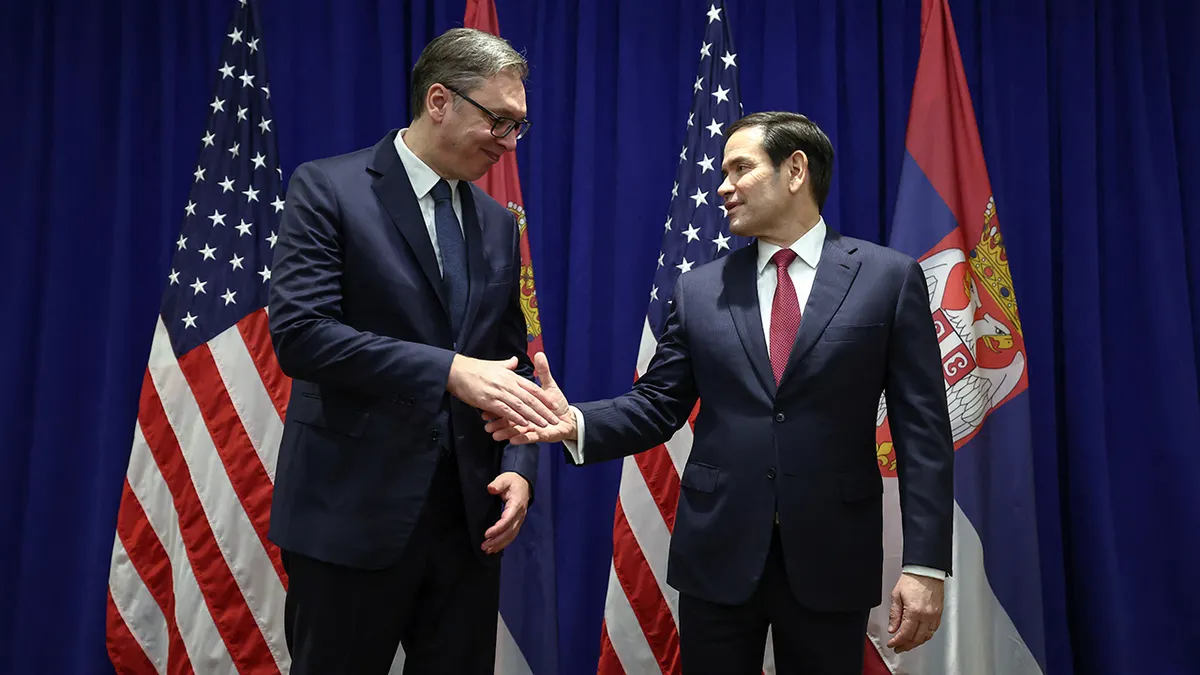
Serbia remains steadfast in its pursuit of full membership in the European Union. However, we believe that a more robust Europe can only be achieved through resolute, sovereign partners. We envision a Europe that draws strength from its historical alliances. For us, the path to Brussels does not necessitate a divergence from Washington. On the contrary, we believe Serbia’s distinctive relationship with the United States can serve as a crucial asset for the stability and growth of the entire continent.
Elites across the Atlantic have engaged in years of vilification of Trump, yet the Serbian people have recognized a kindred spirit. We see a leader who values national sovereignty over faceless bureaucracy, who prioritizes economic realities over ideological fantasies, and who understands that a nation is defined by its culture, faith, traditions, and heritage.
Serbia has historically had to repeatedly fight for its right to self-governance and the preservation of its freedom. During the Second World War, Serbia was among the few nations in occupied Europe to launch a large-scale popular uprising against Nazi occupation. This historical experience has given Serbians a profound understanding of the human cost when the sanctity of borders is violated.
The growing respect for President Trump in Serbia, which is helping to erode decades of mistrust towards US leadership in the region, is rooted in shared values. We are a small yet proud nation that has endured centuries of being caught between empires. We understand the struggle to defend one’s interests when the international community urges silence. When Donald Trump speaks of protecting workers, defending cultural heritage, and demanding respect on the global stage, he articulates the sentiments of the Serbian people.
It has been over half a century since a sitting American president made a state visit to Belgrade. That visit was by Richard Nixon in 1970, who was greeted by immense crowds. Since then, Europe’s geopolitical landscape has transformed significantly, yet the potential for a historic partnership has only grown.
I can state with absolute certainty: should Donald Trump visit Belgrade, he would receive a welcome unparalleled in Europe since Nixon’s era. He would witness a sea of American and Serbian flags, held by ordinary citizens who genuinely desire to see America thrive. Unlike the elites in Europe’s traditional power centers, they understand that a strong America is indispensable for global stability.
President Trump, and indeed the American people, would quickly recognize that contemporary Serbia is a profoundly transformed nation. It boasts one of Europe’s most dynamic economies and is among its most attractive destinations for serious long-term investment. We are evolving beyond a mere crossroads between East and West to become a hub for industrial growth, energy development, and technological innovation in this part of Europe.
Consider the economic indicators. Serbia currently exhibits one of the highest GDP growth rates in Europe, consistently surpassing the Eurozone. From substantial data centers to our pivotal role in the European electric vehicle supply chain, Serbia is now a focal point for future technologies. We possess the continent’s second-largest mineable lithium deposits—a resource critical for Western industrial independence—and we are actively seeking partners who value efficiency and tangible results.
From a strategic perspective, the logic for the United States is clear. Serbia is strategically located at the nexus of vital energy, transport, and digital corridors connecting Southeast Europe to the broader continent. Our rapid expansion in advanced manufacturing and data infrastructure, coupled with significant investments in artificial intelligence, biotechnology, and energy diversification in anticipation of EXPO 2027 in Belgrade, positions us as a valuable partner. At a time when Washington is seeking dependable supply chains and reliable regional allies, Serbia offers strategic depth, political stability, and a government committed to execution rather than ideology.
While others may seek aid, we are interested in mutually beneficial deals. We are looking for the spirit of “The Art of the Deal” that secures supply chains, enhances energy independence, builds modern infrastructure, and generates numerous employment opportunities. For too long, Washington has viewed our region through the lens of the 1990s. It is time to focus on the realities of the 2020s. Serbia stands as the largest economy in the Western Balkans, an anchor of stability, and a nation that remembers its friends.
Baca juga di sini: The Left Celebrates Luigi Mangione, Whom They Helped Create
To the American people and to Donald Trump, my message is straightforward: While others may dismiss your vision, Serbia understands it. While others may fear your strength, Serbia respects it. Our doors are open, our economy is prepared, and the groundwork for a genuine partnership is already established. The future of American-European cooperation need not be confined to the outdated paradigms of the past; it is waiting to be forged in the heart of the Balkans.