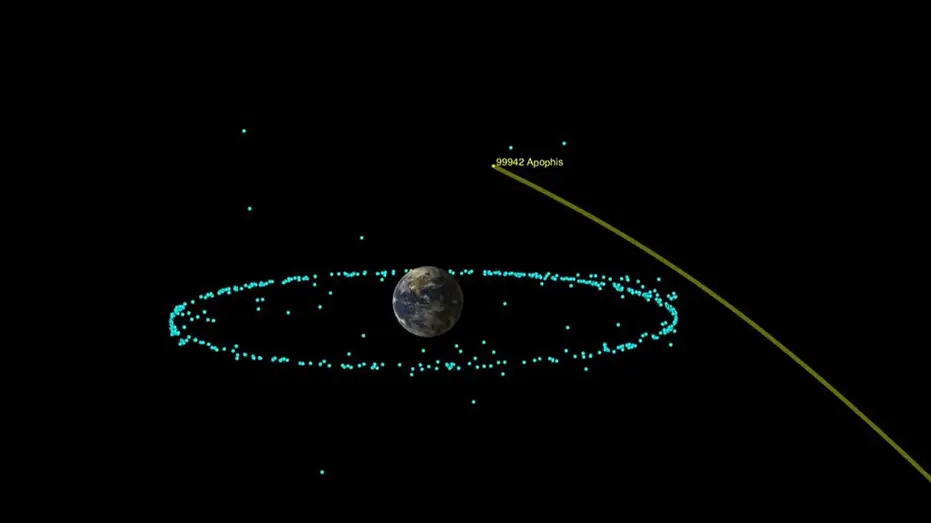
SouthernWorldwide.com – An asteroid roughly the size of the Eiffel Tower, known as Apophis, is set to make an exceptionally close pass by Earth in 2029. Despite its proximity, scientists have confirmed there is no threat of an impact.
The asteroid is predicted to fly approximately 20,000 miles above Earth’s surface on April 13, 2029. This distance is closer than many of the satellites currently orbiting our planet, according to NASA. Apophis is categorized as “potentially hazardous” and is composed of primordial material that never formed into a planet or moon.
When Apophis was first detected in 2004, there was a possibility it could impact Earth in 2029, 2036, or 2068. However, astronomers have since meticulously tracked the asteroid using optical telescopes and ground-based radar. This continuous observation has significantly improved our understanding of its orbital path.
Based on the accumulated data, NASA is now confident that Apophis poses no impact risk to Earth for at least the next 100 years. This reassurance comes after years of dedicated monitoring and advanced calculations.
The initial discovery of Apophis occurred on June 19, 2004. The astronomers responsible for its identification were Roy Tucker, David Tholen, and Fabrizio Bernardi, working at the Kitt Peak National Observatory near Tucson, Arizona.
Unfortunately, the initial observation period was brief, lasting only two days. This was due to a combination of technical issues and unfavorable weather conditions. Later, in December 2004, another group of astronomers in Australia managed to re-establish contact and observe the asteroid, as confirmed by NASA.
Read more : Sunday Morning: A Deliberate Experience
The upcoming close approach of Apophis in 2029 is considered a historic event. Observatories across the globe, as well as those in space, will be utilized to study the asteroid’s physical characteristics in detail. In preparation for this significant encounter, NASA has re-tasked a spacecraft to intercept Apophis shortly after its closest approach to Earth.
This spacecraft, originally known as OSIRIS-REx, successfully completed its mission to collect a sample from asteroid Bennu and return it to Earth in September 2023. Following this achievement, it was redirected to study Apophis. The spacecraft has been renamed OSIRIS-APophis EXplorer (OSIRIS-APEX) and is currently en route to meet its new celestial target.
The European Space Agency (ESA) is also participating in this scientific endeavor, dispatching its own spacecraft to conduct observations of Apophis. This international collaboration highlights the importance of understanding this unique asteroid.
Apophis is expected to be a spectacular sight for observers in the Eastern Hemisphere. Weather permitting, it will be visible to the naked eye, meaning no telescope or binoculars will be required to witness this astronomical event.
NASA emphasizes the unique scientific opportunities presented by this close encounter. The gravitational forces exerted by Earth will significantly influence Apophis as it passes. These forces are expected to pull, twist, stretch, and squeeze the asteroid in ways that are only possible during such a rare and close approach.
The overall gravitational pull will also alter Apophis’s orbit around the Sun. This alteration will result in a slightly larger orbit and a longer orbital period for the asteroid, providing valuable data on orbital dynamics.