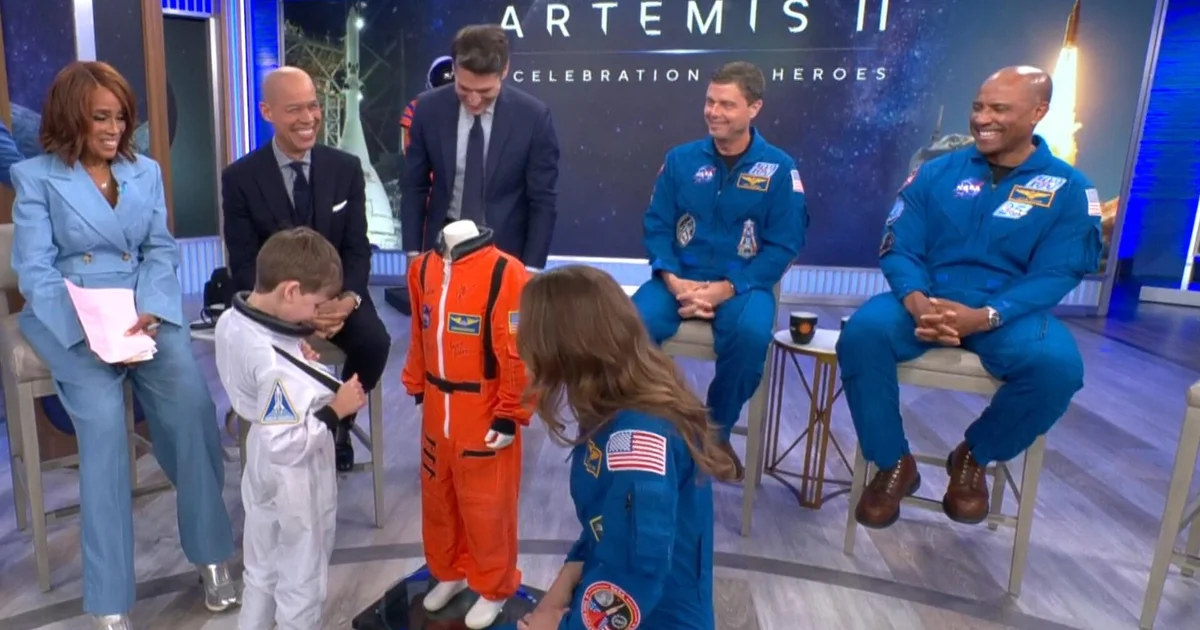
SouthernWorldwide.com – The Artemis II mission, a pivotal step towards returning humans to the Moon, has not only captured the world’s attention for its scientific advancements but also for its human-interest stories. Recently, the astronauts of the Artemis II mission shared a heartwarming encounter with a 5-year-old boy who is an ardent space enthusiast. The astronauts also addressed some peculiar yet fascinating questions about life in space, including the possibility of burping. The astronauts appeared for a CBS News town hall event titled “Artemis II: A Celebration of Heroes,” where these engaging details were revealed.
The young fan, a 5-year-old boy with a passion for space exploration, received a special gift from the Artemis II crew. While the specifics of the gift were not detailed, the interaction underscored the profound impact these missions have on inspiring the next generation of scientists and explorers. The astronauts’ willingness to connect with young fans highlights the human element of space exploration, reminding everyone that behind the technology and mission objectives are individuals dedicated to pushing the boundaries of human knowledge.
During the town hall, co-host Gayle King posed a series of “true or false” questions to the astronauts, delving into the curious aspects of living in microgravity. One of the most intriguing questions was whether astronauts can burp in space. The astronauts confirmed that while it is possible to burp in space, the experience is quite different from what we are accustomed to on Earth.
On Earth, gravity plays a crucial role in separating liquids and gases in our digestive system. When we swallow food and air, gravity helps to keep the denser liquid lower and the less dense gas higher. A burp is essentially the release of gas that has accumulated in the stomach. This gas is typically lighter than the surrounding liquid, allowing it to rise to the top and be expelled.
In the microgravity environment of space, however, this separation doesn’t occur in the same way. Without the consistent pull of gravity, gases and liquids in the stomach tend to mix together. This means that when an astronaut burps, it’s more likely to bring up a mixture of gas and liquid, often described as a “wet burp” or regurgitation. This is because the gas doesn’t have a distinct layer to rise from, leading to a less controlled and potentially more uncomfortable expulsion.
The astronauts also addressed the question of whether humans grow taller in space. They explained that this is indeed true. On Earth, gravity constantly compresses our bodies, particularly the cartilage in our spines. This compression causes our vertebrae to stack closer together, resulting in our typical height. In the microgravity environment of space, however, this compression is removed.
Read more : Artemis crew gives special gift to 5-year-old aspiring astronaut
Without the constant downward force of gravity, the cartilage in the astronauts’ spines expands, and their vertebrae spread slightly apart. This decompression leads to a temporary increase in height, often by a couple of inches. Astronauts typically experience this increase shortly after arriving in space, and their height returns to normal once they are back on Earth and subjected to gravity’s familiar embrace.
These insights into the daily realities of space travel, shared by the Artemis II astronauts, offer a fascinating glimpse into a world far removed from our own. The mission, aimed at establishing a long-term human presence on the Moon and eventually reaching Mars, continues to inspire awe and curiosity. The astronauts’ ability to explain complex scientific concepts in an engaging and relatable manner, especially to a young audience, is a testament to their dedication not only to their mission but also to fostering public interest in space exploration.
The “Artemis II: A Celebration of Heroes” town hall provided a valuable platform for the astronauts to connect with the public, sharing their experiences and answering questions that range from the highly technical to the endearingly mundane. Such interactions are vital for maintaining public support and enthusiasm for ambitious space endeavors, ensuring that the dream of space exploration continues to ignite the imaginations of people of all ages.
The Artemis II mission represents a significant leap forward in humanity’s quest to explore the cosmos. By sharing these personal anecdotes and answering questions about the physical effects of space travel, the astronauts humanize the mission, making it more accessible and understandable to a broad audience. The young boy’s special gift and the astronauts’ candid answers about burping and height changes in space serve as powerful reminders of the blend of scientific rigor and human experience that defines space exploration.
As the Artemis program progresses, it promises to unlock further secrets of the universe and inspire countless individuals. The stories shared by the Artemis II crew, from their encounter with a young fan to their explanations of space phenomena, are integral to this ongoing narrative of discovery and human achievement.