SouthernWorldwide.com – The Euclid space telescope has achieved a groundbreaking discovery, identifying the most distant quasars ever observed. This finding deepens a perplexing mystery in cosmology, challenging current understandings of the early universe.
Quasars are exceptionally luminous celestial objects, powered by supermassive black holes at the center of nascent galaxies. These black holes consume surrounding matter at an immense rate, generating light that can be trillions of times brighter than our sun.
Due to their intense brightness and the fact that observing distant objects means looking back in time, astronomers have long sought ancient quasars. These ancient beacons are crucial for unraveling the mysteries of the universe’s formative stages.
An international team of astronomers, utilizing data from the European Space Agency’s Euclid telescope, announced the discovery of 31 quasars in a study published on Monday. Among these, two stand out as the oldest ever detected.
The light from these two most ancient quasars originated when the universe was approximately 670 million years old. This is a mere five percent of the universe’s current estimated age of 13.8 billion years.
This new record surpasses the team’s previous discovery of the most distant quasar in 2021 by about 20 million years. The Euclid telescope, positioned about 1.5 million kilometers from Earth, has significantly advanced this field of research.
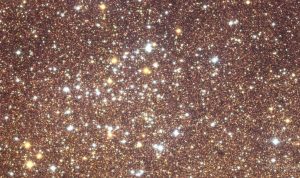
This collage displays 15 of the 31 quasars recently discovered by the European Space Agency’s Euclid space telescope.
European Space Agency
Previously, quasar hunting relied heavily on ground-based telescopes. However, the launch of Euclid in 2023 has revolutionized the field, according to Daming Yang, the lead author of the study published in Astronomy & Astrophysics, who spoke with AFP.
In just two years, Euclid has doubled the number of known ancient quasars, Yang, a PhD student at Leiden University in the Netherlands, explained.
“Euclid is a true game-changer,” Yang stated in a press release. “Previously, we could only find a handful of the very brightest ancient quasars. Now, Euclid allows us to search much more efficiently across vast areas of the sky, capturing fainter light. It’s an unparalleled tool for quasar hunting.”
Cosmic quandary
The newly identified quasars date back to the epoch of reionization. This critical period marked the formation of the first stars and galaxies, signaling the end of the cosmic dark ages.
“We can use quasars as cosmic lighthouses to study the gas situated between us and them,” Daming Yang elaborated. “This allows us to trace how the universe was reionized throughout its early history.”
These quasars also represent the latest evidence supporting a growing enigma that has scientists increasingly baffled.
As more advanced telescopes enable deeper views into the universe’s past, galaxies and other cosmic structures have been found to be significantly larger than previously thought possible for such early cosmic epochs.
“With each step further back in time, the puzzle becomes more perplexing,” commented study co-author Joseph Hennawi in a statement regarding the new quasar discoveries.
“These colossal objects, weighing billions of times the mass of our sun, somehow already existed when the universe was in its infancy,” he continued. “We currently lack a comprehensive understanding of how they managed to grow so massive, so rapidly.”
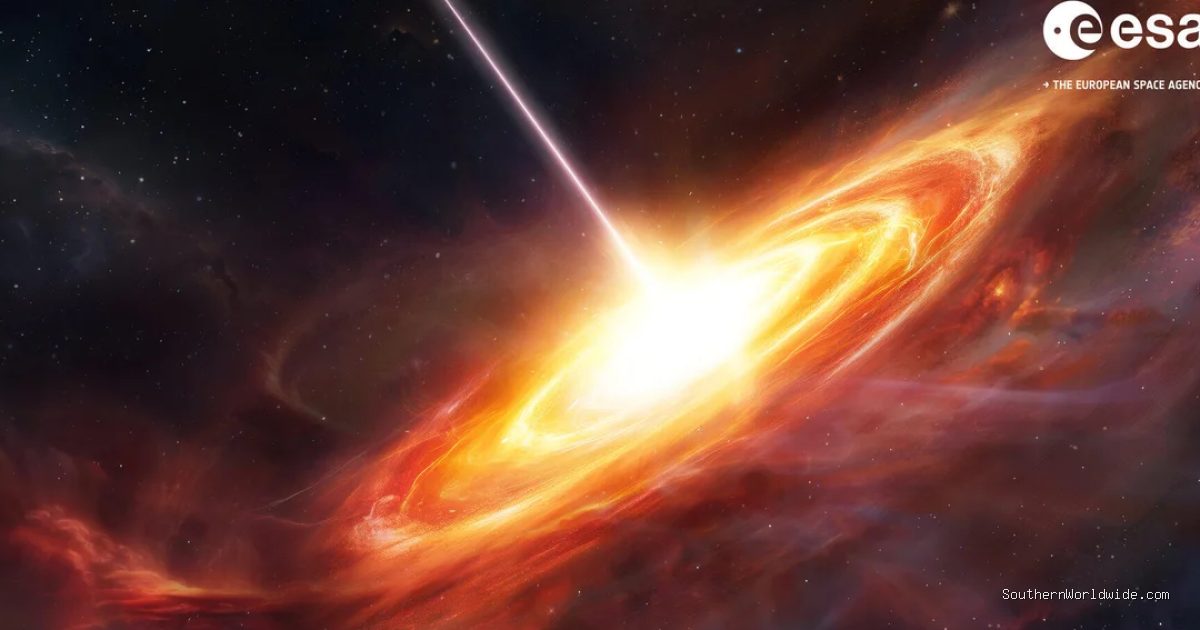
Artist’s concept of an ancient quasar.
European Space Agency
In pursuit of answers, researchers are actively searching for even older quasars.
The James Webb Space Telescope, renowned for its long-range observational capabilities, also recently observed the newly announced quasars, Daming mentioned. The research team is set to begin analyzing the data collected by Webb shortly.
Ultimately, the team aims to construct “a quasar chronicle of the first billion years,” Hennawi stated.
Euclid’s cosmic mission
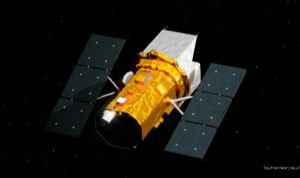
Euclid embarked on its mission in 2023 with the ambitious goal of mapping one-third of the sky. Its primary objective is to shed light on the enduring mysteries surrounding dark matter and dark energy.
Just last month, scientists revealed that the Euclid telescope had captured the most extensive and detailed image ever taken of the Milky Way’s dense galactic center. This spectacular image, according to the European Space Agency, contains approximately 60 million stars.
In 2024, Euclid produced stunning images of the cosmos, including a view of a massive galaxy cluster named Abell 2390. This cluster, located 2.7 billion light-years from Earth, encompasses over 50,000 individual galaxies.
Another remarkable image, captured in 2023, offers a breathtaking wide-angle perspective of the Perseus galaxy cluster. This view reveals at least 1,000 gravitationally bound galaxies, with an additional 100,000 more scattered across the distant background, many of which had never been observed before.
Launched from Cape Canaveral on July 1, 2023, aboard a SpaceX Falcon 9 rocket, the $1.5 billion Euclid observatory is positioned roughly one million miles from Earth, beyond the Moon’s orbit.
Throughout its six-year operational period, Euclid is scheduled to image the entire sky surrounding the Milky Way. It will meticulously monitor galaxies and galaxy clusters dating back as far as 10 billion years.