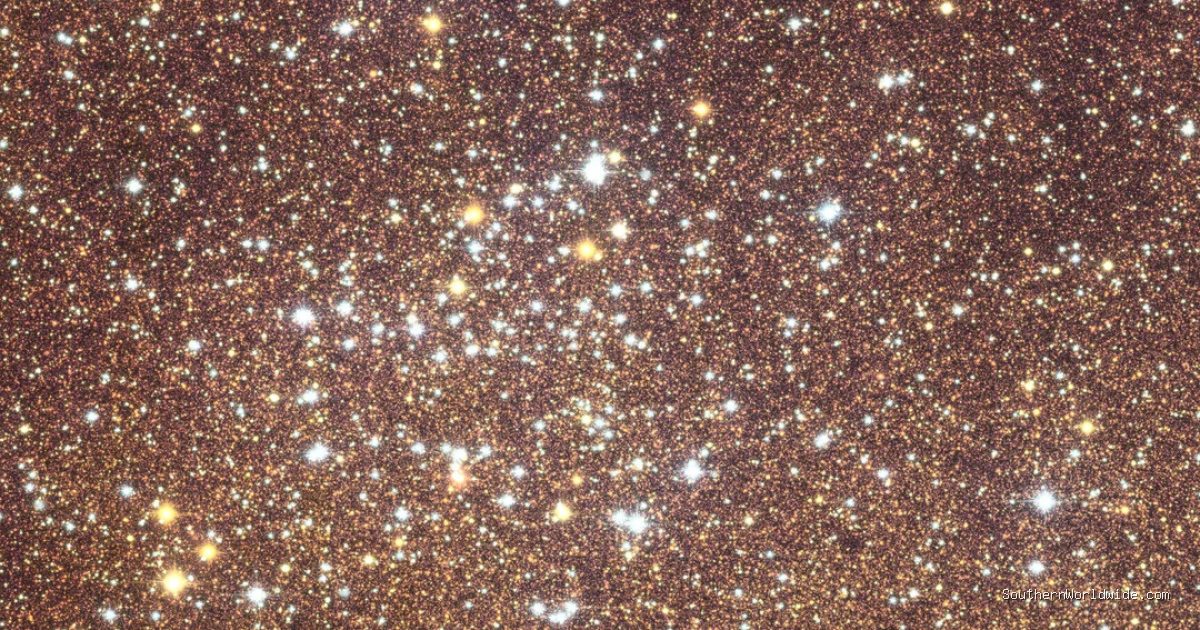
SouthernWorldwide.com – The Euclid space telescope has delivered its most detailed photograph yet of the Milky Way’s core, a stunning image containing an estimated 60 million stars, as announced by the European Space Agency on Wednesday.
This remarkable new image of our galaxy’s luminous center is expected to significantly aid in the ongoing search for planets located outside our Solar System, according to the agency.
At the very heart of our spiral galaxy lies what is known as the bulge, described as a vast, spherical structure housing billions of stars, explained French astronomer Jean-Charles Cuillandre, who is involved in the Euclid mission, in a statement to AFP.
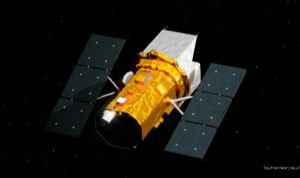
Euclid, which was launched in 2023, has been tasked with mapping a third of the entire sky. Its primary objective is to shed light on the persistent mysteries surrounding dark matter and dark energy.
Cuillandre expressed his enthusiasm, stating that they have now directed Euclid towards the brightest region of the sky, and the results have been exceptionally successful and extraordinary.
The space agency also released a supplementary three-minute video that showcases the newly captured images.
Operating from a position approximately 930,000 miles from Earth, Euclid managed to capture this image using its visible light camera over a span of 26 hours during March 2025.
This intricate mosaic is actually comprised of nine individual photographs, with each one depicting a section of the sky larger than the apparent size of the Moon.
The initial photograph was taken in black and white. However, color was subsequently added by incorporating observations gathered from the Canada-France-Hawaii Telescope, which is situated in Hawaii.
Cuillandre emphasized that the primary motivation behind this endeavor was not merely to produce a visually appealing image.
“Cosmic magnifying glass”
Over the past few decades, scientists have successfully identified thousands of planets orbiting stars beyond our own Solar System, collectively known as exoplanets.
While it is unlikely that new exoplanets will be directly discovered within this specific Euclid image, it will serve as a valuable tool for scientists to determine the mass of exoplanets that have already been identified, as well as those that will be found in the future.
This measurement is made possible through a phenomenon called microlensing. Microlensing occurs when one star passes in front of another star.
The European Space Agency explained in a statement that the closer star effectively acts as a “cosmic magnifying glass,” which bends and amplifies the light emanating from the background star.
If a planet happens to be orbiting the closer star, its gravitational influence also causes a slight bending of this light. This subtle alteration in brightness is what enables scientists to detect and track the presence of such planets.
French astronomer Jean-Philippe Beaulieu stated in the release that over the past 20 years, nearly 300 exoplanets have been discovered using this very technique. He noted that all these discoveries were made using ground-based telescopes and were directed towards the center of our galaxy.
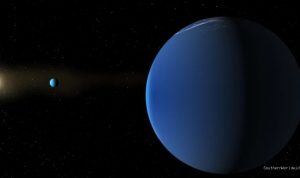
Beaulieu provided an example, mentioning that he led the team responsible for discovering an icy planet, which he likened to “Hoth from Star Wars,” approximately 20 years ago.
He added that the new image from Euclid includes 51 known planetary systems and will be instrumental in studying many more that are expected to be discovered.
In 2024, Euclid had already captured striking images of the cosmos, including a photograph of a vast galaxy cluster named Abell 2390. This image of the cluster, situated 2.7 billion light-years away from Earth, encompasses more than 50,000 individual galaxies.
Another breathtaking image, taken in 2023, offered a spectacular wide-angle perspective of the Perseus galaxy cluster. This image revealed at least 1,000 galaxies bound by gravity, with an additional approximately 100,000 galaxies scattered across the more distant background – many of which had never been observed before.
Launched from Cape Canaveral on July 1, 2023, atop a SpaceX Falcon 9 rocket, the $1.5 billion Euclid observatory is positioned roughly one million miles from Earth, on the far side of the Moon’s orbit.
Throughout its planned six-year mission, the observatory is set to image the entire sky surrounding the Milky Way. It will continuously monitor galaxies and galaxy clusters, with the aim of observing objects dating back as far as 10 billion years.