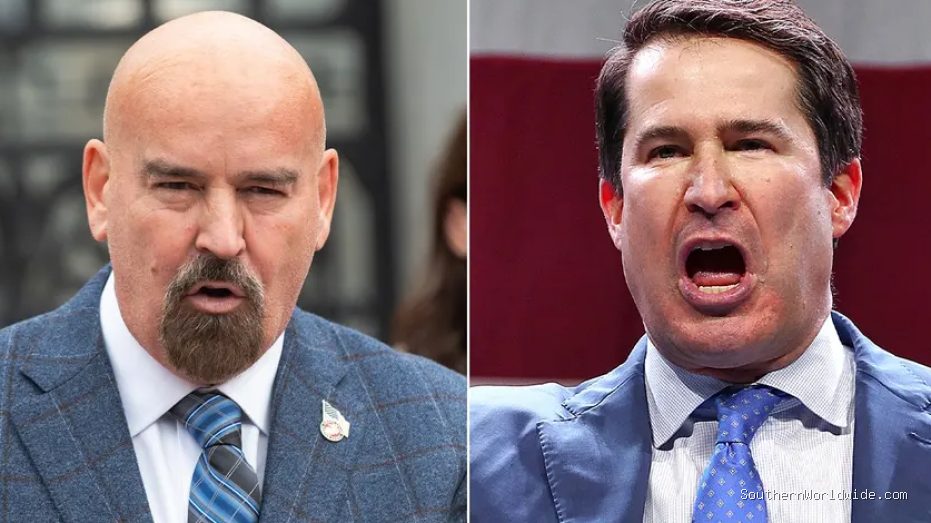
SouthernWorldwide.com – The race to unseat Massachusetts Senator Ed Markey heated up Tuesday night as the two candidates vying for the position engaged in a spirited debate, trading sharp criticisms across a spectrum of issues.
Democratic Representative Seth Moulton and Republican attorney John Deaton found themselves in direct confrontation. Their discussions touched upon President Donald Trump, sanctuary city policies, the ongoing situation in Israel, and Senator Markey himself, who was notably absent from the event.
Throughout the debate, Moulton made a concerted effort to link Deaton to former President Donald Trump. This strategy aimed to leverage Trump’s low approval ratings in the predominantly Democratic state of Massachusetts. Deaton, however, maintained his position, asserting that he has never cast a vote for the former president.
“You may say you’re independent, you may say you haven’t voted for him, but you’re just going to enable his agenda,” Moulton stated, emphasizing his belief that electing a Republican to Washington would be detrimental to the interests of Massachusetts voters.
In his defense, Deaton countered that Massachusetts requires a representative like him, someone who will “stand up for America and working people.” He expressed a strong disillusionment with both major political parties.
“‘F’ the Republican Party. ‘F’ the Democrat Party — they all suck,” Deaton declared, signaling his disdain for the established political structures.
The Republican candidate also took aim at Senator Markey for his decision to skip the debate. Deaton characterized Markey as “too much of a coward to be here tonight,” questioning his commitment to engaging with the electorate.
Moulton, while defending Markey, also subtly advocated for a shift in leadership. He suggested that the time might be right for a new generation to take the helm.
“He’s not a coward — he’s a lifelong public servant,” Moulton remarked. “We should honor that service,” he added, acknowledging Markey’s extensive career in public office.
Senator Markey, who was first elected to the U.S. House of Representatives in 1976, continues to hold significant favor among the most progressive voters in Massachusetts. His long tenure has solidified his base within this demographic.
Current polling indicates that Moulton is trailing Markey in the Democratic primary. Meanwhile, Deaton is widely considered the underdog in the broader race. He previously ran for a Senate seat two years ago, unsuccessfully challenging Senator Elizabeth Warren.
On the complex issue of immigration, the candidates presented diametrically opposed viewpoints during the debate. Their stances reflected the deep divisions within the national discourse on the topic.
Moulton voiced support for prosecuting Immigration and Customs Enforcement (ICE) officials who were involved in carrying out President Trump’s mass deportation agenda. Deaton, on the other hand, argued for an expansion of legal immigration pathways while simultaneously advocating for a strict “zero tolerance” policy towards illegal immigration.
Deaton also dismissed calls to abolish ICE, labeling them as mere election-year rhetoric. He drew a parallel between these calls and the “defund the police” movement that gained traction in 2020, suggesting they were superficial slogans rather than substantive policy proposals.
Regarding foreign aid, Deaton adopted a firm stance. He stated that he would not support allocating additional funds to Israel, Ukraine, or other nations unless it could be definitively “proven” that such aid directly served the interests of Americans and Massachusetts residents.
He further criticized Moulton, alleging that the Democratic representative had sought an endorsement from the American Israel Public Affairs Committee (AIPAC). Deaton claimed that Moulton later distanced himself from AIPAC after failing to secure that endorsement.
Moulton, in contrast, expressed support for conditional aid to Israel. He articulated that the United States should not offer unconditional backing to Israeli Prime Minister Benjamin Netanyahu. Moulton also confirmed that he had returned donations from AIPAC, explaining that he believed the organization’s positions had evolved in recent years, leading to his decision.