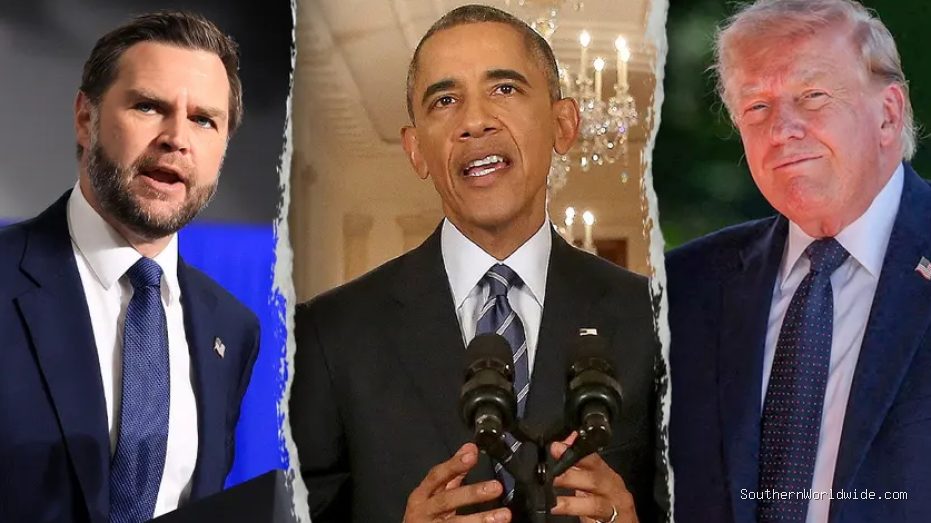
SouthernWorldwide.com – Vice President JD Vance is refuting claims that a proposed Iran deal involving the Trump administration mirrors the logic of the Obama-era nuclear agreement, despite concerns raised by national security hawks.
Critics have drawn parallels between the emerging Trump-Vance pact and the 2015 Joint Comprehensive Plan of Action (JCPOA), commonly known as the Iran nuclear deal. The memorandum of understanding, released recently, reportedly outlines economic benefits for Iran contingent upon adherence to nuclear restrictions. This structure, critics argue, is reminiscent of how the Obama administration promoted the JCPOA, a deal that Trump and Vance have consistently opposed.
“You’ve got Iranian propagandists out there saying, well, ‘we get all these things’, and they leave out the fact that they only get those things if they fundamentally transform themselves as a country,” Vance stated. He added that compliance could pave the way for Tehran’s economic engagement across the Middle East.
Vance emphasized the potential benefits for the United States regardless of Iran’s actions. “So the United States wins either way. As the president said, either they get nothing, we destroy their nuclear program and the Strait of Hormuz [is] open, or they fundamentally transformed themselves. And that’s a big one too. It’s really up to them,” he explained during an appearance on “The Five.”
Host Jesse Watters concurred, asserting that the new deal represents the “exact opposite” of the agreement negotiated under President Obama and former Senator John Kerry a decade ago. He highlighted that if Iran funds proxies, it forfeits economic benefits. Furthermore, he claimed that Iran’s missile capabilities are significantly diminished, with 85% of their missiles destroyed and 90% of their industrial base compromised.
“They’ve been disarmed. They can’t re-arm because they can manufacture more weapons and now they can really project power outside of their borders because they have no Air Force and they have no Navy and they don’t pose an imminent threat to the United States anymore,” Watters elaborated. He also pointed out that Iran cannot enrich uranium, as only the U.S. possesses the capability to recover the necessary uranium dust.
In a July 2015 statement defending the JCPOA, President Obama used language that some observers find similar to current administration talking points. A White House statement from that time read, “[W]e give nothing up by testing whether or not this problem can be solved peacefully. If, in a worst-case scenario, Iran violates the deal, the same options that are available to me today will be available to any U.S. president in the future. And I have no doubt that 10 or 15 years from now, the person who holds this office will be in a far stronger position.”
Obama also contended that a future president would be in a “far stronger position” if Iran breached the agreement years later, citing inspections and transparency measures that would allow the U.S. to monitor Tehran’s nuclear stockpiles. Vance, however, countered that few such stockpiles remain following strikes ordered by the Trump administration months prior.
Similar to the current administration’s approach, Obama sought to preempt criticism. In an August 2015 speech, he cautioned that advertisements and “accompanying commentary” would attempt to discredit the deal. He stated, “Before getting sanctions relief, Iran has to take significant, concrete steps like removing centrifuges and getting rid of its stockpiles. If Iran violates the agreement over the next decade, all of the sanctions can snap back into place.”
Obama further argued, “On the other hand, if Iran abides by the deal and its economy begins to reintegrate with the world, the incentive to avoid snapback will only grow,” a sentiment echoed by current administration officials.
However, some critics remained unconvinced. They pointed out that Trump spent years denouncing the JCPOA, arguing it provided economic relief in exchange for inadequate concessions. Senator Mark Kelly, a critic of Trump and a former astronaut, suggested that the current deal would have been heavily criticized by candidate Trump.
“I did read what was reported on those 14 points [of the agreement] and I got to say, I mean, if this was something that President Obama or Biden had put forward, I don’t think Donald Trump would have been too supportive of it, right?” Kelly questioned. He expressed concern, stating, “It gives everything: It’s basically everything that the Iranians would want.”
Taleblu, who heads the Iran program at the Foundation for the Defense of Democracies, a nonpartisan research institute, commented on the administration’s emphasis that the deal does not involve American money, whether for reconstruction or future oil revenue for the regime. He cautioned, however, that “any deal with the Islamic Republic is a deal with the devil.”
Taleblu recalled that when Trump withdrew from the Iran deal in 2018, it was not due to a violation but because “that which the U.S. got was not worth that which the U.S. gave.” He explained this meant the nuclear concessions gained by the U.S. did not justify the sanctions relief it provided.
According to Taleblu, the most effective way for the administration to secure a narrative “win” would be to fully disclose the deal’s text. This would allow for a direct comparison with both the JCPOA and the lesser-known 2013 Joint Action Plan (JPA), also negotiated under Obama. Taleblu suggested that the JPA serves as a more relevant comparison to the reported terms of the Trump deal, noting its smaller scope and its role in setting the stage for the 2015 agreement.
He pointed out that the current deal, like the JPA, includes a 60-day window for Iran to comply. “They have to show that that which they got is worth more than that which they gave. And based on leaks of the [pending deal] in Bloomberg and CNN and Al-Arabiya, it’s not looking good,” Taleblu stated.
Another challenge facing the administration is the limited public tolerance for economic disruptions, such as increased gas and commodity prices or stock market fluctuations. “This is not just political it’s cultural and social which means the administration has to do a better job bringing the public along,” he advised.
Taleblu underscored that Iran has been in conflict with the U.S. since 1979 and stressed the need for more effective “political communications” to garner public support. He also warned that while the economic impact of a war with Iran on the U.S. might be significant, it would be dwarfed by the fallout from a conflict with a more formidable adversary: China.
The memorandum of understanding reportedly includes immediate waivers for Iranian oil exports and a framework for $300 billion in economic development. During a press call, officials emphasized that negotiations would cease immediately if Iran was found to be misleading the U.S., reaffirming their skepticism regarding Tehran’s intentions.