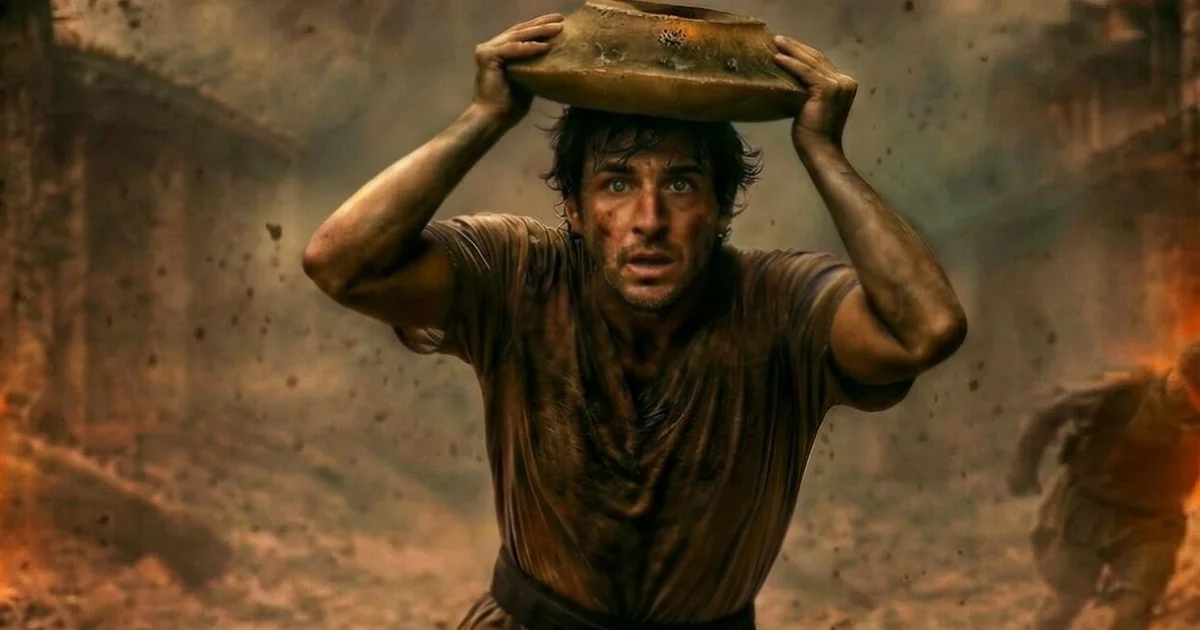
SouthernWorldwide.com – Archaeologists at the ancient Roman site of Pompeii have employed artificial intelligence for the first time to digitally recreate the face of a victim of the AD 79 eruption of Mount Vesuvius. This innovative approach provides a new perspective on one of history’s most renowned natural disasters.
The digital portrait depicts an older man who was among two individuals discovered attempting to escape the city towards the coast of modern-day Italy during the volcanic cataclysm. Researchers surmise that this man perished earlier in the event, succumbing to a heavy fall of volcanic debris.
This reconstruction was a collaborative effort between the Pompeii Archaeological Park and the University of Padua. It is based on archaeological survey data gathered from excavations near the Porta Stabia necropolis, situated just outside the ancient city’s perimeter.
Pompeii, a UNESCO World Heritage site located near Naples, was engulfed by ash and pumice when Mount Vesuvius erupted almost two millennia ago. This catastrophic event remarkably preserved the city and thousands of its inhabitants in intricate detail.
Read more : Trump family's World Liberty Financial sues billionaire for defamation
Archaeologists discovered the victim clutching a terracotta mortar. They interpret this as a makeshift attempt to shield his head from the falling lapilli, the small volcanic stones that rained down during the eruption.
Ancient historical accounts, including those by the Roman writer Pliny the Younger, detail how residents used objects to protect themselves as ash and debris blanketed the city.
The man was also carrying an oil lamp, a small iron ring, and ten bronze coins. These personal belongings offer valuable insights into his final moments and the daily life in Pompeii prior to the disaster.
Archaeologists observed that this victim, along with many others, was found near the city gates. This discovery underscores the fact that many individuals may have lost their lives outside the city while trying to reach safety on the coast.
Last year, archaeologists unearthed evidence suggesting that Pompeii was reoccupied after the devastating eruption. This was due to some survivors being unable to afford to start new lives elsewhere.
The digital portrait was generated using artificial intelligence and photo-editing techniques. These methods were specifically designed to transform skeletal and archaeological data into a realistic human likeness.
“The sheer volume of archaeological data is now so immense that only with the assistance of artificial intelligence can we adequately preserve and enhance it. When utilized effectively, AI can contribute to a renaissance in classical studies,” stated Pompeii park director Gabriel Zuchtriegel in a press release.
The project’s objective is to make archaeological research more accessible and emotionally resonant for the public, while rigorously maintaining a scientific basis, according to the researchers.
“Pompeii stands as perhaps the most distinguished site globally for archaeological research, where every new discovery vividly illuminates the narrative of ancient life,” commented Italian Culture Minister Alessandro Giuli. He added that “Investigations conducted with these excavations demonstrate that innovative methodologies, when applied with care, can unveil new historical perspectives.”
Earlier this year, archaeologists announced the discovery of a 2,000-year-old love note and an illustrated gladiator fight scene on a wall in Pompeii.