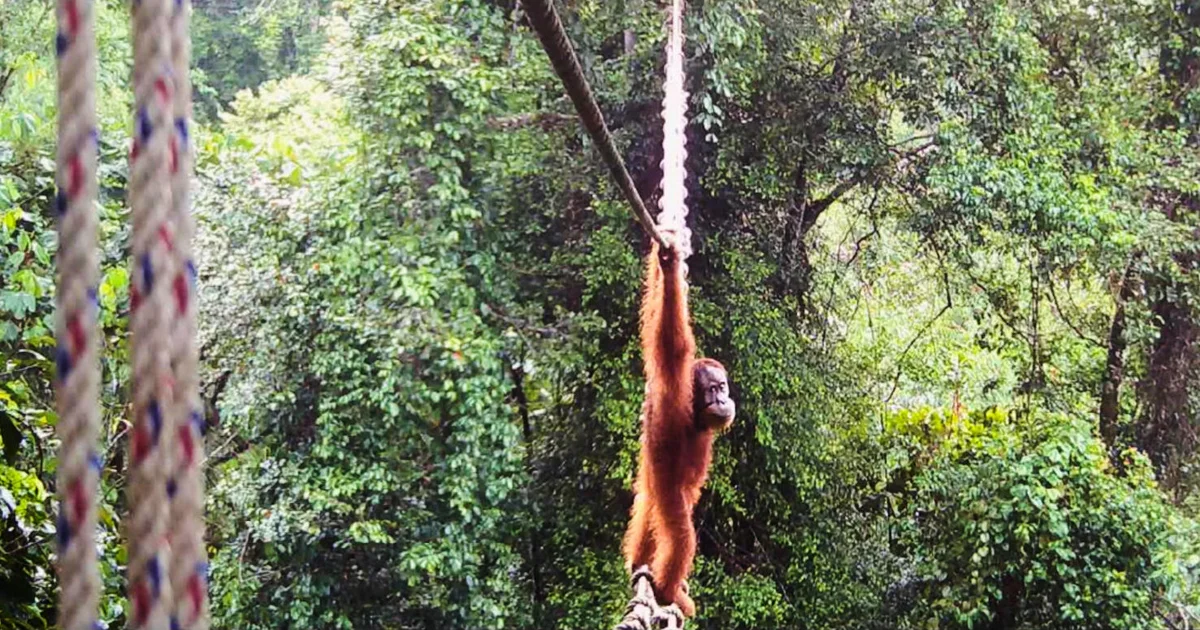
SouthernWorldwide.com – In a groundbreaking first, an endangered Sumatran orangutan has been documented using a man-made canopy bridge to cross a public road on the Indonesian island of Sumatra.
This significant event, observed by conservationists, marks a pivotal moment in efforts to protect this critically endangered species, whose habitat is increasingly fragmented by development.
The remarkable footage was captured by a motion-sensitive camera, showing a young orangutan cautiously approaching the bridge. It was seen gripping a rope with precision before stepping out over the open air.
Midway across, the orangutan paused, looking down at the road below. The Sumatran Orangutan Society (SOS) described the moment, noting the ape’s “cheeky glance to camera” before continuing its journey.
Conservationists have hailed this as the first documented instance of an orangutan species on the brink of extinction utilizing an artificial canopy bridge to traverse a public road that bisects its natural environment.
“This was the moment we had been waiting for,” stated Erwin Alamsyah Siregar, executive director of the Indonesian conservation group Tangguh Hutan Khatulistiwa (TaHuKah), in comments to The Associated Press. He expressed gratitude for the canopy’s contribution to orangutan conservation.
Siregar explained that the bridge crosses the Lagan-Pagindar road in Pakpak Bharat district. This road is a crucial link for remote villages, providing access to essential services like schools and healthcare.
However, the road also cuts directly through a vital orangutan habitat, effectively dividing an estimated 350 orangutans into two isolated forest sections: the Siranggas Wildlife Reserve and the Sikulaping Protection Forest.
The road’s upgrade in 2024 led to a wider gap in the forest canopy, eliminating natural pathways for arboreal wildlife to move between the two forest areas.
“Development was necessary for people,” Siregar acknowledged. “But without intervention, it would have left orangutans trapped on either side.”
Read more : What Spirit Airlines' potential grounding means for travelers
In response, TaHuKah, in collaboration with SOS and various government agencies, proposed a straightforward solution: rope bridges suspended between trees to enable arboreal animals to cross safely above the road traffic.
While other species, including gibbons and long-tailed macaques, have also been observed using the bridges, SOS confirmed to AFP that this is a “world first for Sumatran orangutans.”
SOS emphasized the ongoing need for more such interventions, stating in a social media post, “One orangutan has crossed, but a population of 350 still remains isolated.”
Five canopy bridges were installed, each equipped with a camera trap. Their placement was determined by extensive surveys of orangutan nests, forest cover, and animal movement patterns.
The design of these bridges had to accommodate the weight of orangutans, which are the world’s largest tree-dwelling mammals. This presented a significant engineering challenge.
The program is under continuous observation. Camera traps are active on all bridges, and regular patrols are conducted to deter any encroachment into the forest areas.
Conservationists are hopeful that the initial success will encourage more orangutans to utilize the bridges and follow the lead of the first pioneer.
“Seeing this young male orangutan confidently cross the road is a huge milestone for conservation — proving that it is possible to stitch fragmented forests back together,” SOS shared on social media.
It took two years of waiting and observation before the first orangutan was recorded crossing the bridge. Prior to this, only smaller animals were seen using the structures.
Camera traps had previously captured images of squirrels, langur monkeys, and macaques, followed by gibbons, which were seen as promising indicators of wildlife adapting to the new crossings.
The orangutan’s journey across the bridge was characterized by cautious behavior. It reportedly built nests near the bridge, lingered at its edges, and tested the ropes over time.
“They observe,” Siregar explained. “They don’t rush. They watch, they try, they retreat. Only when they’re certain it’s safe do they move.”
Then, one day, the orangutan successfully crossed the entire span. Conservationists stated this is a landmark achievement, not only for Sumatra but for the species globally on a public road.
While similar bridges have been used by orangutans in other locations, these were typically over rivers or on private industrial forest roads. Conservationists highlight that public roads, with their inherent noise, traffic, and unpredictability, present a far greater obstacle.
The stakes for orangutans are exceptionally high. Isolation can lead to inbreeding, weakening their genetic makeup and ultimately causing population decline.
Restoring connectivity between forest fragments is considered crucial for their survival.
Historically found across southern Asia, orangutans are now confined to the islands of Sumatra and Borneo.
Current estimates indicate fewer than 14,000 Sumatran orangutans remain in the wild. Additionally, there are approximately 800 Tapanuli orangutans and around 104,700 Bornean orangutans, according to conservation organizations.
“These bridges allow orangutans to move, to mix, to maintain healthy populations,” Siregar concluded. “It reduces the risk of extinction.”