SouthernWorldwide.com – Alan Greenspan, a distinguished economist who helmed the U.S. Federal Reserve for an unprecedented tenure under four American presidents, has passed away at the age of 100.
His wife, Andrea Mitchell, announced his death on Monday, stating that Greenspan died at his home due to complications arising from Parkinson’s Disease. Mitchell, who is the chief Washington and foreign affairs correspondent for NBC News, shared this information in a statement that was subsequently reported by NBC News.
Greenspan’s time at the helm of the central bank, spanning from 1987 to 2006, largely coincided with a period known as the “Great Moderation.” This era, roughly from the mid-1980s to 2007, was characterized by remarkable economic stability, marked by low inflation rates, robust stock market performance, and consistent economic growth.
However, this period of stability was not without its challenges. Greenspan’s leadership also witnessed several significant financial crises. These included the dramatic stock market crash of 1987 and the bursting of the dot-com bubble in the early 2000s. In 1996, he famously articulated concerns about market speculation by coining the term “irrational exuberance,” particularly in reference to the fervent investor enthusiasm for internet company stocks.
More controversially, Greenspan’s legacy is closely intertwined with the 2008 global financial crisis and the subsequent Great Recession. Although the full impact of the crisis manifested after his departure from the Fed in early 2006, critics have pointed to his monetary policies in the years prior, often described as “loose money,” as contributing factors to the subprime housing crisis. This crisis ultimately triggered the most severe economic downturn in the United States since the Great Depression.
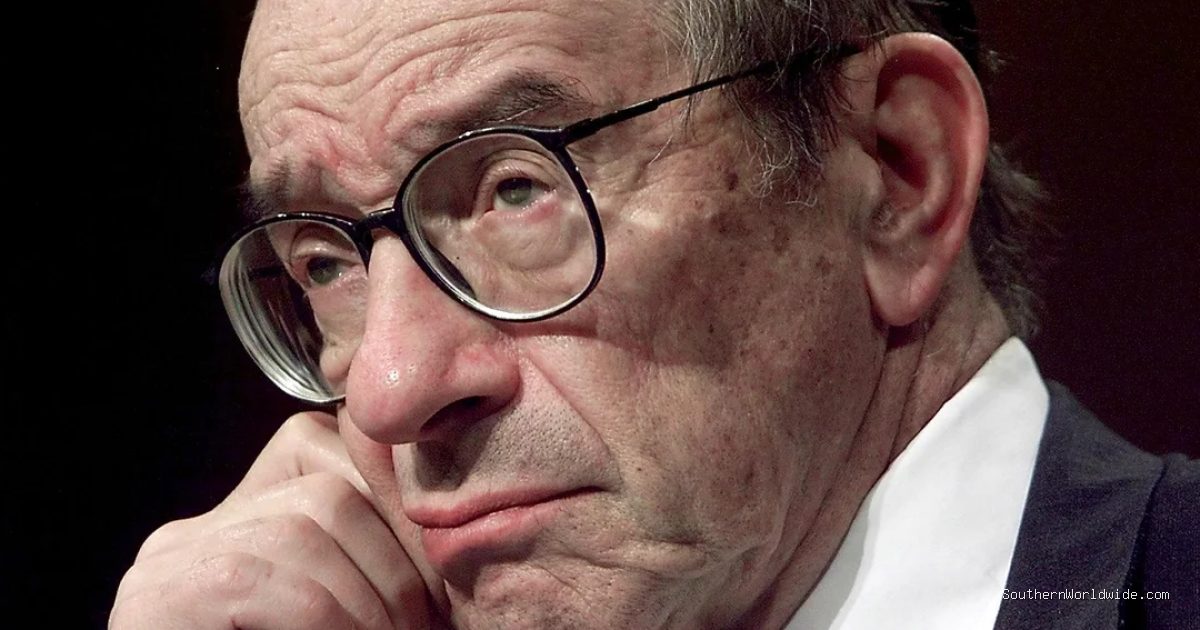
Then-Federal Reserve Chairman Alan Greenspan appears at a Senate hearing on Sept. 20, 2001.
Tim Sloan/AFP via Getty Images
In a 2017 essay, The Economist reflected on the prevailing criticisms of Greenspan’s tenure. The publication noted that “The main post-crisis criticism of Mr. Greenspan was that he was a naive believer in market efficiency, failing to pop bubbles in the late 1990s or mid-2000s and failing to regulate the financial sector properly.”
Greenspan himself defended his actions and decisions leading up to the Great Recession. In a 2007 interview with Fortune Magazine, he suggested he was a victim of “revisionist history.” He asserted that he had indeed issued warnings about subprime mortgages and other potential issues brewing within the housing market.
Reflecting on his earlier economic philosophies, Greenspan told Fortune that as a younger economist, he had initially downplayed the significance of human behavior in economic models, considering it “not worth evaluating.” However, he later acknowledged a crucial realization: “there were very important missing variables in the forecasting system, and these all related to systemic activities of human beings.”
“You can count that human beings will become euphoric on occasion, and in deep distress and fear. What you can count on is that will never change,” he stated in the same interview, underscoring his evolving understanding of market psychology.
During his time as Fed chair, Greenspan gained a reputation for delivering concise and often enigmatic economic pronouncements. These statements were intensely scrutinized by lawmakers, economists, and investors, all seeking to decipher their underlying meaning and implications.
Concurrently, Greenspan was a proponent of greater transparency within central banking. He championed a shift away from the less informative statements that had characterized the Federal Reserve prior to the 1980s, advocating for clearer communication from central bankers.
“You don’t want to surprise the markets unless there is a purpose to it,” Greenspan explained in a 2009 oral history interview conducted by the Federal Reserve. He added, “Too often in the past we would surprise markets with no particular purpose, which was not good.”
Born in New York City on March 6, 1926, Alan Greenspan was the son of Herbert Greenspan, a stockbroker, and Rose Greenspan, a homemaker. According to the New York Times, his parents’ divorce when he was five years old was partly attributed to financial strains resulting from the aftermath of the 1929 stock market crash.
Greenspan demonstrated a remarkable aptitude for mathematics from a young age, with the Times noting his ability to perform three-digit addition mentally by the age of five. In his teenage years, he developed an interest in music, studying the clarinet at Juilliard. He later pursued economics at New York University, where he ultimately obtained his bachelor’s, master’s, and doctoral degrees.
During his academic pursuits in economics, Greenspan became an ardent follower of novelist Ayn Rand. An NYU alumni magazine reported that he regularly attended her “objectivist salon” held at her Manhattan apartment, indicating a significant intellectual influence.
His early career included a role at the National Industrial Conference Board, where he analyzed the demand for essential industrial materials like aluminum, copper, and steel. He subsequently founded his own economic consulting firm, Townsend-Greenspan & Co., as noted by the Federal Reserve.
Greenspan’s public service extended to advisory roles under Republican administrations. He served as chairman of the President’s Council of Economic Advisers during President Gerald Ford’s term and was a member of President Ronald Reagan’s Economic Policy Advisory Board.
His appointment as Federal Reserve chair came in 1987, nominated by President Reagan. He continued to serve in this pivotal role under three subsequent presidents: George H.W. Bush, Bill Clinton, and George W. Bush, marking a prolonged period of influence over U.S. monetary policy.
Alan Greenspan, who married journalist Andrea Mitchell in 1997, concluded his distinguished service at the Federal Reserve Board in 2006.
When questioned by Fortune Magazine about whether any president had ever directly requested him to lower interest rates during his tenure as Fed chair, Greenspan stated that he never received such a direct request.
“[B]ut a few hinted it,” he admitted. “However, I will tell you… no politician ever called me up and asked me to raise interest rates,” he added with a touch of wry humor, highlighting the political dynamics surrounding monetary policy decisions.