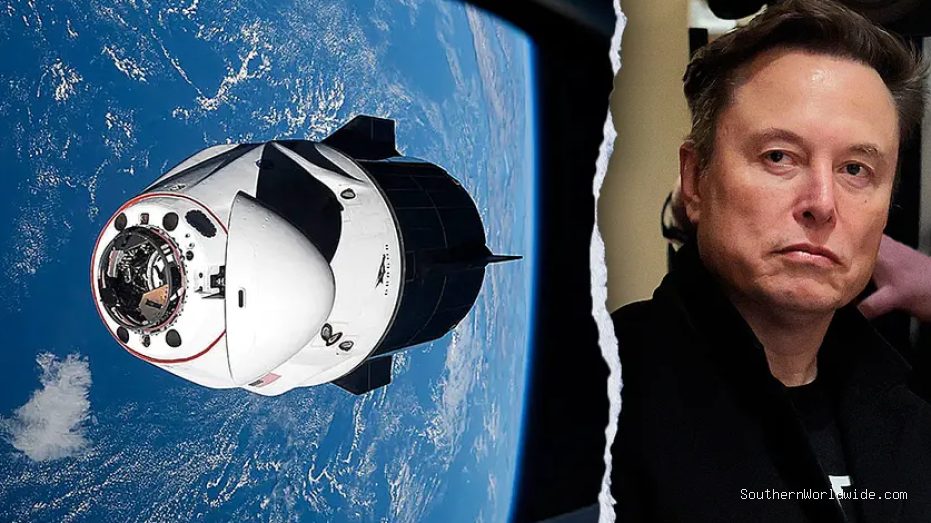
SouthernWorldwide.com – When SpaceX went public on June 12, propelling Elon Musk to the status of the world’s first trillionaire on paper, the predictable reactions were swift.
Some saw this milestone as a stark symbol of modern capitalism’s flaws, while others hailed it as the ultimate testament to entrepreneurial success.
However, both perspectives overlook the larger context.
The most significant aspect of Elon Musk becoming the first trillionaire isn’t the sheer magnitude of his wealth. It is the fact that his journey was only possible in a nation that continues to champion innovation, risk-taking, and the freedom to pursue ideas that many initially deem impossible.
In 1992, Musk arrived in the United States as a young immigrant, seeking educational and entrepreneurial opportunities. Few could have envisioned that three decades later, he would have built a constellation of companies that would revolutionize industries spanning payments, transportation, aerospace, communications, and artificial intelligence.
This achievement warrants a deeper examination, as history is replete with wealthy individuals. What distinguishes Musk is not merely the sum of his accumulated wealth, but the sheer breadth of his accomplishments.
Many entrepreneurs dedicate their entire careers to establishing a single successful company. Musk, on the other hand, played a pivotal role in building PayPal, a company that fundamentally reshaped digital payments. He then leveraged a significant portion of his fortune to embark on ventures that many investors considered high-risk.
Tesla challenged a century-old automotive industry, significantly accelerating the global adoption of electric vehicles. SpaceX drastically reduced the cost of launching payloads into space, achieving feats previously thought to be exclusively within the domain of governments.
Starlink is now extending internet connectivity to remote regions across the globe. His work with Neuralink and his artificial intelligence initiatives continue to push the boundaries of what was once considered conceivable.
Whether one aligns with Musk’s political views is secondary. The truly remarkable element of his narrative is his consistent ability to identify opportunities where others perceived only obstacles. He has repeatedly ventured into industries considered untouchable by established players and entered arenas where failure seemed far more probable than success.
This is precisely where the role of America becomes central to the story.
The United States remains one of the few places globally where an entrepreneur with a clear vision can access capital, attract top talent, challenge established competitors, and strive to build something truly revolutionary.
While our system is far from perfect, it continues to offer a degree of economic freedom that is difficult to replicate elsewhere.
Musk’s success is not evidence of a broken capitalist system; rather, it demonstrates capitalism’s capacity to reward individuals who generate extraordinary value.
Critics often fixate solely on the outcome, viewing a trillion-dollar net worth and questioning whether any individual should possess such immense wealth. A more constructive inquiry would be to examine how that wealth was generated in the first place.
Musk did not attain his trillion-dollar status through inheritance of a dominant corporation or by benefiting from a protected monopoly. His fortune is largely derived from companies that investors have voluntarily assigned value to, believing these businesses have profoundly impacted and will continue to shape the world.
Consider the number of individuals Musk has employed throughout his ventures. Think about the payroll taxes he has contributed to the system. And reflect on the countless individuals who have become millionaires simply by being employed by his companies.
The reality is that wealth on this scale is typically a byproduct of successfully addressing significant challenges. Tesla compelled legacy automakers to accelerate their innovation efforts. SpaceX transformed commercial spaceflight and bolstered America’s leadership in space exploration.
Starlink has provided crucial communication infrastructure in areas where traditional networks were unable to reach.
None of these achievements were guaranteed. In fact, several came perilously close to outright failure. Musk himself has openly discussed periods when both Tesla and SpaceX were on the verge of collapse.
While most entrepreneurs might have retreated in the face of such adversity, he doubled down.
This unwavering willingness to endure failure, criticism, and uncertainty may be the most critical lesson embedded within his story.
At a time when many Americans question the continued existence of the American Dream, Musk’s rise offers a powerful reminder of its original essence. It was never a promise of guaranteed wealth or an assurance of success.
Instead, it represented the freedom to pursue ambitious goals, the opportunity to take calculated risks, and the ability to build something meaningful, irrespective of one’s starting point.
Elon Musk’s trillion-dollar milestone will undoubtedly capture global headlines. However, the more enduring narrative is not about a net worth figure.
It is about a country that continues to empower exceptional individuals to pursue exceptional ideas.
Despite all of America’s imperfections, it remains one of the few places on Earth where a young immigrant, armed with talent, ambition, and an unconventional vision, can arrive and ultimately build companies that redefine the future.
This is not solely Elon Musk’s story.
It is also America’s story.