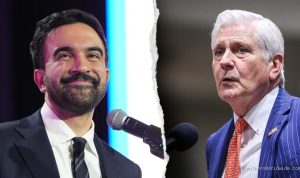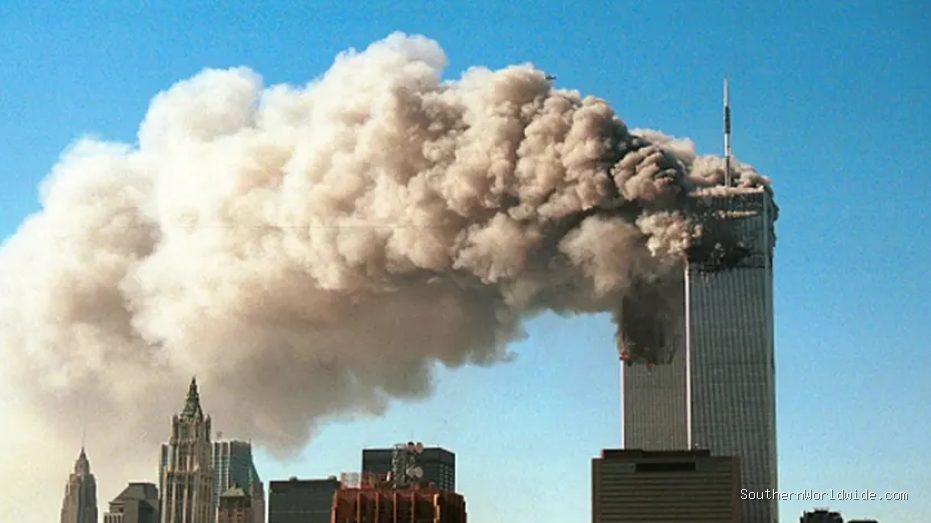
SouthernWorldwide.com – A former New York City firefighter whose brother was killed on 9/11 is expressing outrage over what he calls “radical” Muslim candidates winning key Democratic primaries.
Don Arias, whose brother died in the South Tower of the World Trade Center on September 11, 2001, is questioning how voters can support candidates he believes hold extreme views, especially in recent primary elections in New York and New Jersey.
Arias, an Air Force veteran, witnessed the 1993 World Trade Center bombing firsthand. The subsequent attacks on 9/11, which claimed the life of his brother, profoundly impacted him and shaped his perspective on radical Islamic terrorism.
“When it comes to terrorist sympathizers, I don’t really suffer fools kindly, and this guy is beyond the pale,” Arias stated, referring to Dr. Adam Hamawy, the Democratic nominee for Congress in New Jersey’s 12th Congressional District.
Hamawy, a combat plastic surgeon and veteran, won a crowded Democratic primary on June 2. His victory has drawn criticism due to past associations with radical Islamic figures.
Arias recounted a conversation with his brother on the morning of 9/11, describing the chaos and the desperate acts of victims jumping from the burning towers.
Hamawy’s past includes connections to Omar Abdel-Rahman, known as the “Blind Sheikh,” who masterminded the 1993 World Trade Center bombing. Hamawy met Abdel-Rahman in 1991 and reportedly accompanied him to mosques and testified on his behalf during his trial.
Despite Hamawy’s credentials as a doctor and a veteran, Arias expressed deep distrust. He questioned Hamawy’s claims of not hearing the “Blind Sheikh” speak about jihad, finding such statements untruthful.
“Show me who your friends are, and I’ll tell you who you are,” Arias emphasized. “And if this guy Hamawy is going to try and forget all about that — he wants it to go down the memory hole and say, ‘oh, I was a veteran, you know, I did good stuff’ — I’m not going to forget, and I don’t think people should forget.”
Further complicating Hamawy’s background is his involvement with the Benevolence International Foundation (BIF) during a humanitarian mission to Bosnia in 1994. The U.S. government later designated BIF as a financier of terrorism due to its ties to al-Qaeda.
Arias believes that voters are not adequately researching their candidates. He feels that if voters were fully aware of Hamawy’s connections, they would not elect him. He urged people to bring these facts to the forefront.
The article also highlights another election result that concerns Arias: Aber Kawas, the Democratic nominee for the New York State Senate District 12. Kawas, described as the Muslim daughter of illegal immigrants, reportedly suggested in a 2017 podcast that the United States deserved 9/11.
Kawas’s comments, made on the “Islamophobia beyond 9/11 with Aber Kawas” podcast, suggested that systems like capitalism, racism, and White supremacy have been used to colonize lands and exploit resources, and that 9/11 was a manifestation of this continuation.
“The idea we have to apologize for a terror attack that a couple of people did and then there is no apology or reparations for genocides and for slavery… is something I find reprehensible,” Kawas reportedly said.
Arias condemned these statements as well, criticizing the American education system for what he perceives as grooming students for far-left activism rather than genuine learning. He believes that young, uninformed, and “indoctrinated” voters are supporting candidates like Hamawy and Kawas in large numbers.
“I don’t know what happens to a person where they actually grow to hate their own country, but I blame universities and the schools for this,” Arias stated. He characterized these young voters as “Islamo-Nazis at this point.”
Arias further explained that for individuals like Kawas, Zionism, Judaism, and Israel are conflated with “White supremacy,” which they believe needs to be “put down.”
He also described socialism as a “luxury belief,” supported by individuals who are young, wealthy, or from upper-middle-class backgrounds. According to Arias, these supporters are “cruising” and can afford to engage in “ethereal conversations about mankind” because they are out of touch with reality.