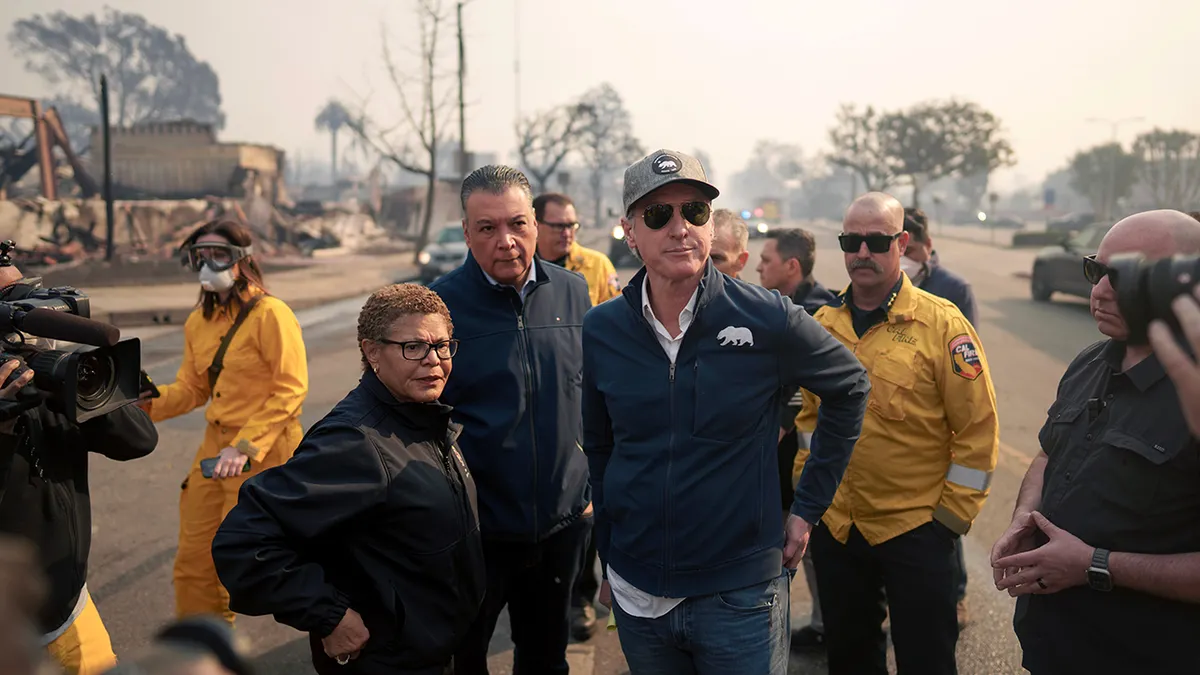
SouthernWorldwide.com – The state of California has once again demonstrated a peculiar approach to vote counting, a process that in many other states is completed within a day. While large states like Florida can declare election winners in 24 hours, California may require up to two weeks to tally all the ballots.
Even Los Angeles, a major metropolitan area, struggles to count its votes within a timely manner, despite a substantial annual budget for its Clerk’s office, amounting to $336 million, and a generous annual salary of $448,179, supported by 1,100 budgeted positions.
In most states, such a display of incompetence, waste, and inefficiency would likely incite outrage among voters. However, in the Golden State, residents often react with a shrug, as if they can no longer expect more than subpar performance from their elected officials.
This phenomenon can be described as the “Politics of Low Expectations,” with California serving as a national model.
Years ago, my students would often inquire about the secret to a successful marriage that has lasted nearly four decades. The answer is quite simple: I managed to lower her expectations so drastically that I have consistently surpassed them on a daily basis.
This strategy began with our elopement on New Year’s Eve. We were married following what could only be described as a shotgun wedding, with the visibly expectant teenage bride’s family hurling profanities at the teenage groom. After a payment of $50 and using my high school ring as a wedding band, we emerged onto the street of Old Town Alexandria to witness a drunk individual retching in the gutter. This left ample room for improvement.
On any given day, my wife is simply relieved that I haven’t traded the house and car for a handful of magic beans.
California Democrats appear to have adopted my approach to matrimony and applied it to politics, cultivating a voter base with exceptionally low expectations, a dream scenario for any politician.
This is most starkly illustrated by Governor Gavin Newsom’s notoriously stalled high-speed train project, often referred to as a “train to nowhere.”
In 2008, voters were promised a 500-mile high-speed train connecting San Francisco to Los Angeles for an estimated $33 billion. The current projected cost has ballooned to somewhere between $126 billion and $231 billion. After approximately two decades, no track has been laid, and the current plan focuses on constructing a segment between Bakersfield and Merced.
In the absence of any tangible track construction, Newsom recently stood before a freight train on an existing track to assert that his project was progressing rapidly.
One might expect citizens to confront their leaders with torches and pitchforks in such a situation. Instead, there is a widespread indifference, as if it is perfectly normal to allocate more funds than Amtrak’s entire budget to a non-existent train.
The same leadership has squandered billions on other ill-conceived projects, including a massive solar power farm that generated energy at an exorbitant cost and was responsible for the annual deaths of thousands of birds.
California is currently confronting a escalating crisis characterized by rising homelessness, declining educational outcomes, and a significant exodus of businesses and wealthy taxpayers. Furthermore, the state has implemented taxes that make gasoline the most expensive in the nation while simultaneously stifling its own energy industry.
Now, after many voters took the unusual step of supporting Republican candidates for governor and the mayor of Los Angeles, citizens must endure weeks of waiting to learn the election results – results that would have been announced days earlier by countries often considered to be in the third world.
The same “politics of low expectations” is observable in other states. In New York City, voters seem unfazed by the fact that the city’s budget rivals that of the entire state of Florida, leading to deplorable conditions in education, infrastructure, and other public services. Voters have witnessed wealthy taxpayers relocate their money and businesses to other states.
In response, figures like Mayor Zohran Mamdani propose ambitious initiatives such as state-run grocery stores, which are projected to cost tens of millions of dollars to establish and operate at a loss.
In Minnesota, elected officials permitted billions of dollars to be lost through fraud, while businesses departed a state grappling with riots and homelessness.
Across virtually every major city, from Los Angeles to Chicago and New York, public schools are spending vast sums on education, yet many graduating students lack basic proficiency in English and mathematics. In Baltimore, one student failed all but three of his classes and was still ranked in the top half of his graduating class.
Despite these outcomes, voters have reelected the same leaders responsible for denying generations of students genuine opportunities for advancement. While other nations maintain superior educational systems at a fraction of the cost, urban voters continue to cast their ballots, almost as if compelled, for the same party and politicians.
In states like California, politics has long been guided by a philosophy akin to Henry Ford’s assertion that one could have any color Model T as long as it was black. This election, however, seemed to offer voters a genuine choice, something rarely seen in many years: a clear distinction between a Republican governor and an L.A. mayor.
As California’s vote count slowly progresses, the strong likelihood remains that the state will continue to be dominated by a single party. Poor public services, escalating crime rates, pervasive homelessness, hundreds of billions of dollars in wasted expenditure, and a litany of other failures are treated as almost inevitable occurrences. The consequence is an electorate that any politician would find ideal: passive voters who anticipate little from their government and receive even less in return.