SouthernWorldwide.com – After nearly a century of broadcasting, CBS News Radio is set to go silent later this month, marking the end of an era for a significant player in broadcast journalism.
The decision by CBS executives is attributed to evolving news consumption habits, with a notable shift towards social media, coupled with challenging economic conditions in the media landscape.
Steve Kathan, the final anchor of the long-running “CBS World News Roundup,” recalled his early days with the network. He first encountered CBS News Radio in the 1960s through a transistor radio, hearing the voices of distinguished CBS News broadcasters.
Kathan emphasized the immediacy of the experience. “You were hearing something live. It was a live broadcast,” he stated, highlighting the unique nature of radio news at the time.
Correspondent Allison Keyes, who has spent over 25 years in radio, spoke about the legacy and respect associated with the CBS name. She shared a profound personal experience covering the events of September 11, 2001, live on air.
Keyes vividly described the scene: “I can hardly breathe. It looks like a nuclear war happened here. You can’t see the sky at all. It’s all grey smoke.” She underscored the public’s need for unfiltered, real-time information during such critical moments.
Craig Swagler, who dedicated 23 years to CBS News Radio and eventually became its top radio executive, described his early role as an entry-level desk assistant as a dream fulfilled. He felt privileged to work alongside notable figures in the field.
CBS itself began as a radio network in 1927. However, Swagler pointed to a pivotal moment in 1938 as the true genesis of broadcast journalism as we know it. This was marked by a single, groundbreaking broadcast.
The date was March 13, 1938. Just the day prior, Germany had annexed Austria in an event known as the Anschluss. Robert Trout reported on the dramatic takeover: “Right at this moment, Austria is no longer a nation, but is now officially a part of the German empire. The Nazis have taken over the radio, and they are out to control everything.”
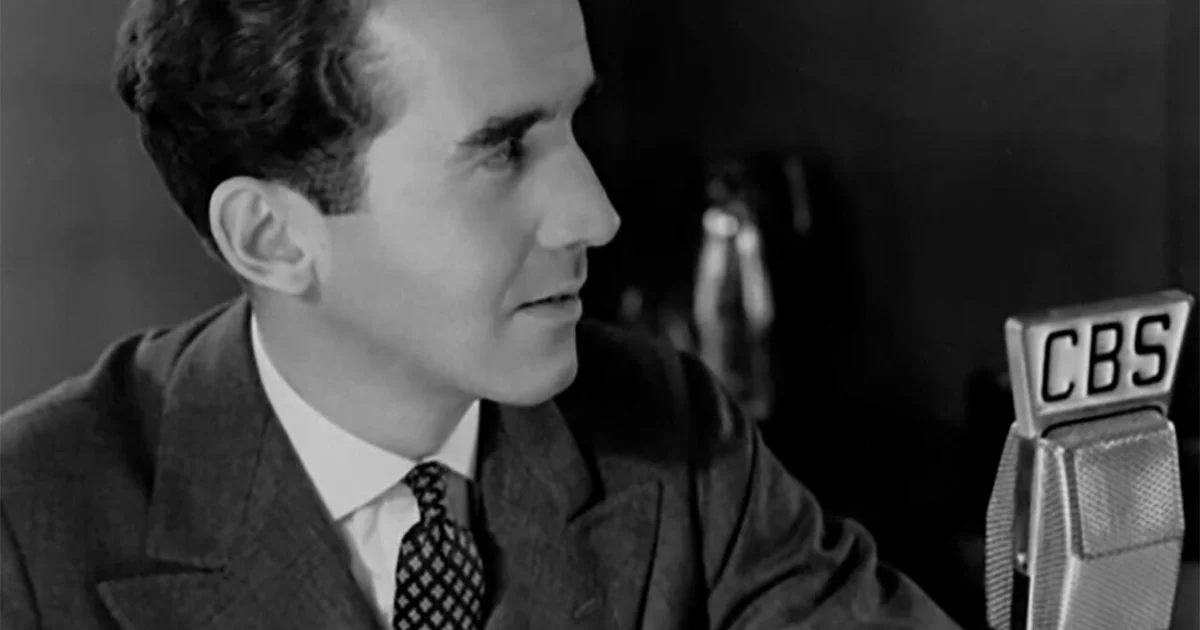
At the time, a young Edward R. Murrow, then 29, was in Europe on assignment from CBS chief William S. Paley to scout talent for the radio. Recognizing the escalating threat posed by Hitler, Murrow and CBS executives orchestrated a revolutionary live news program.
This broadcast featured remote reports from five European cities, a remarkable technical feat for its era. Trout anchored from New York, while Murrow reported directly from Vienna, marking his first public broadcast.
Read more: A Mother's Day Breakfast with Martha Stewart
Murrow’s report from Vienna began: “This is Edward Murrow speaking from Vienna. It’s now nearly 2:30 in the morning, and Herr Hitler has not yet arrived. No one seems to know just when he will get here. But most people expect him sometime after 10 o’clock tomorrow morning.”
This 1938 broadcast captivated listeners and is credited with launching the “CBS World News Roundup,” which went on to become America’s longest-running news program. It brought the realities of war and its aftermath directly to American homes.
Murrow’s reporting from the Buchenwald concentration camp on April 15, 1945, after the German retreat, remains a harrowing testament to his journalistic integrity. He described the unspeakable horrors he witnessed:
“Permit me to tell you what you would have seen and heard had you been with me on Thursday … It will not be pleasant listening. … At another part of the camp, they showed me the children, hundreds of them. Some were only six. One rolled up his sleeves, showed me his number. It was tattooed on his arm. An elderly man standing beside me said, ‘The children – enemies of the state.'”
The legacy of Murrow’s wartime broadcasts can be revisited through archived recordings, offering a powerful reminder of radio’s role in documenting history.
Former anchor Dan Rather shared his childhood experiences listening to CBS News Radio in Texas. He recalled how his parents used radio as a “magic carpet” to understand global events, particularly the situation in Germany.
Confined to bed due to rheumatic fever as a child, Rather found solace and companionship in the radio, staying intently focused on the broadcasts.
Rather, who later became the anchor and managing editor of “The CBS Evening News,” began his career in radio. He reported on the assassination of President John F. Kennedy, conveying the profound shock that gripped Dallas.
His report stated: “The mood in Dallas is still one of very deep shock. There are many people in Dallas who sincerely and literally still have a very difficult time believing what happened here today.”
Although Murrow had departed CBS the year before Rather joined, the high standards set by him and his colleagues, known as “Murrow’s Boys,” continued to influence the news division. Rather emphasized their exceptional writing skills, noting that poor writing could hinder a correspondent’s career at CBS.
He recalled thinking, “Dan, you’ve got to make yourself a better writer and you better do it in a hurry or you’re not going to be around here,” reflecting on the demanding standards.
Martha Teichner, a correspondent for “Sunday Morning,” spoke about how she learned the craft of reporting and broadcasting through CBS News Radio. She started at WJEF, a country-western station affiliated with CBS Radio in Grand Rapids, Michigan.
Teichner would transcribe broadcasts and then practice reading them aloud, mimicking the styles of prominent CBS figures like Eric Sevareid, Walter Cronkite, and Douglas Edwards. She described this as a form of “karaoke,” learning from the best in the business.
She acknowledged that these voices were her earliest mentors, noting the absence of women in those prominent roles at the time. “All male. There weren’t any women,” she stated.
Charles Osgood, who joined CBS Radio in 1967, brought a unique artistic flair to his reporting on his daily “Osgood File” broadcasts. He famously turned news into poetry, including his playful take on the term POSSLQ (Person of the Opposite Sex Sharing Living Quarters), coined by the U.S. Census Bureau.
Osgood’s rendition included the lines: “There’s nothing that I wouldn’t doIf you would be my POSSLQ.You live with me, and I with youand you would be my POSSLQ…”
Dustin Gervais, a CBS Radio News manager, offered a glimpse into the New York headquarters where global reporting was coordinated for over four decades. The offices, which once facilitated coverage from cities like Rio de Janeiro, London, Paris, Beijing, Seoul, and Sydney, are now being packed up.
“We covered the whole world,” Gervais remarked.
When asked about the enduring legacy of CBS News Radio, Dan Rather stated that it should be remembered as a national institution. He argued that for many years, it played a crucial role in holding the country together.
The closing of CBS News Radio serves as a moment to reflect on Edward R. Murrow’s iconic sign-off: “Good night, and good luck.”
For more information:
- CBS News Radio
- Dan Rather on X/Twitter
- CBS News: Martha Teichner
- CBS News: Allison Keyes
- Steve Kathan on X/Twitter
Story produced by Jay Kernis. Editor: Jason Schmidt.