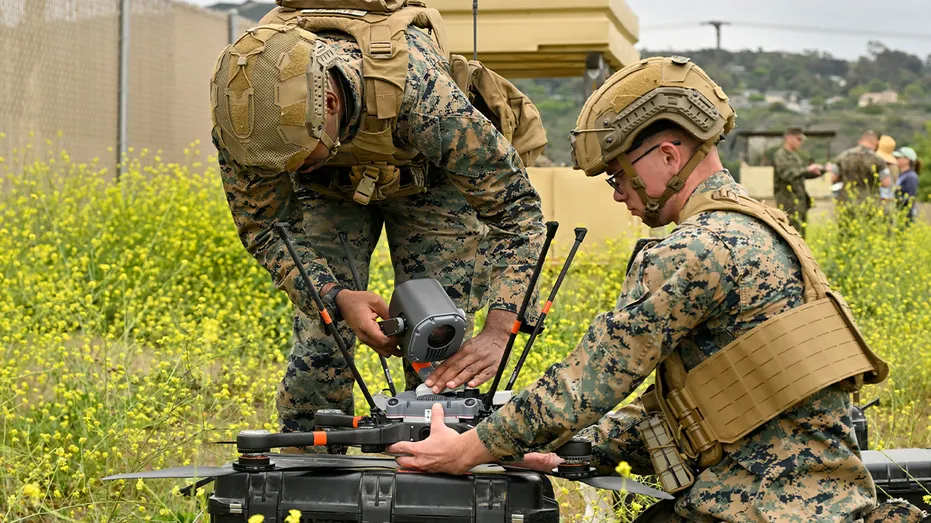
SouthernWorldwide.com – Modern battlefields are consuming drones at an unprecedented rate, mirroring the massive use of artillery shells in 20th-century conflicts. Ukraine alone produced 5 million drones last year, while Russia deployed 805 in a single night against Ukrainian cities. In this new era of warfare, victory hinges not on the most sophisticated weaponry, but on a defense industrial base capable of sustained, large-scale manufacturing. The foundational component for this production, particularly for drone warfare, is the permanent magnet, present in the motor of every drone operating today.
The United States has recognized this critical need. President Donald Trump’s executive order on drone dominance, issued on June 6, 2025, mandates a shift towards American-made platforms and aims to galvanize the industrial base with clear demand signals. Traditional acquisition timelines have been drastically shortened, moving from years to mere months, with vendors now competing through rapid field evaluations that directly lead to production contracts. The Pentagon’s Drone Dominance Program has allocated $1 billion to acquire over 200,000 drones by 2027, with an ambitious projection of 340,000 systems by 2028.
However, translating this ambition into robust production capacity requires a deep dive into the supply chain, specifically below the motor level. The U.S. consumes approximately 50,000 tons of permanent magnets annually, with a staggering majority of these imports originating from China. These magnets, while not sophisticated components themselves, are indispensable for generating the magnetic fields that power lift and torque. Their absence directly halts drone production and scaling efforts.
T.S. Allen, who previously led the Pentagon’s rapid drone fielding program before departing the Defense Innovation Unit last year, highlighted the challenge of scaling drone production to meet battlefield demands. He emphasized the need to secure critical components like batteries and other essential elements for mass production. The core issue, Allen noted, is that “almost the only processing for most critical minerals is occurring in China and Malaysia.”
CHINA WEAPONIZED SCIENCE AGAINST THE US. WE’VE FIGURED OUT A KEY ELEMENT THEY MISSED
China’s dominance in rare-earth elements was meticulously built over decades through state subsidies and predatory pricing strategies that led to the bankruptcy of Western competitors. This established leverage allows China to manipulate prices and implement export restrictions with ease. The prices of rare earth elements have experienced dramatic triple-digit swings within a single year. In contrast, iron and nitrogen, the primary inputs for iron nitride permanent magnets, are domestically abundant and low-cost. These are globally traded commodities without government controls as strategic exports, offering predictable scaling costs unlike rare-earth inputs.
In April 2025, China implemented export licensing requirements for seven rare earth elements and the permanent magnets derived from them, specifically targeting materials crucial for defense and industrial motor supply chains. The impact was immediate, with fewer than a quarter of export license applications being approved within weeks.
Consequently, shipments of Chinese rare earth magnets saw a significant decline of approximately 75% year-over-year in May, before a partial recovery. Motor-G, Europe’s largest drone motor producer, which manufactures nearly 100,000 units monthly, still relies entirely on Chinese rare earth supplies for its magnets. Ukraine encountered a similar obstacle when attempting to localize its motor production; despite possessing mineral reserves, it lacked the magnet-manufacturing infrastructure necessary for scaled production of finished products. The development of Western rare-earth capacity is not the sole solution for securing permanent magnets.
Allen estimated that meeting the full demands of battlefield attrition would necessitate production levels approximately ten times greater than what the Replicator program aimed for, which itself targeted thousands of drones. At such a scale, every component in the drone supply chain is subjected to extreme stress, far beyond what smaller programs typically encounter. While a fleet of hundreds might tolerate a magnet shortage, a fleet of hundreds of thousands cannot. In wartime, the loss of access to a single critical material can halt production across an entire class of drones.
Iron nitride magnets are already being adopted across various commercial sectors. Neither iron nor nitrogen, the key inputs, are subject to export license risks or can be embargoed. These magnets offer competitive performance at elevated temperatures and reduced weight, characteristics that are highly valued in drone motor design.
The foundational science behind iron nitride magnets originated from American university research, and American manufacturers are now scaling up production to meet the burgeoning demand. Integrating iron nitride into the drone motor supply chain extends a proven commercial technology into a sector where the stakes are already immense and continue to grow.
Attrition warfare is fundamentally a contest of production. The side that can maintain its manufacturing output emerges victorious. Supply chains are vulnerable to disruptions, diplomatic crises, and unexpected export controls. Every critical input in the drone motor supply chain requires a secure source that no adversary can disrupt. Currently, the permanent magnet is the component that lacks such a safeguard.