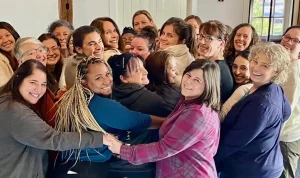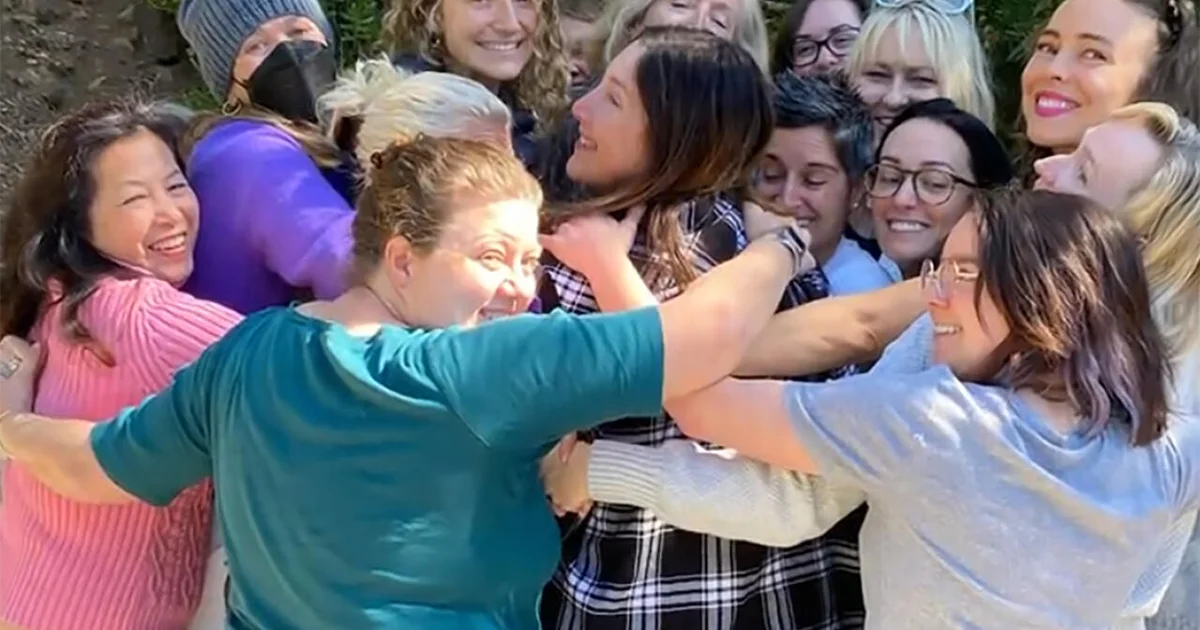
SouthernWorldwide.com – On a mountain in Northern California, a group of women, who identify as “motherless daughters,” gathered for the first time. These women lost their mothers before the age of 21, many due to illnesses like cancer, while others experienced sudden losses. Their lives are often marked by a distinct “before” and “after” their mothers’ passing.
Hope Edelman is the visionary behind the Motherless Daughters retreats. Since the inaugural gathering in 2016, over 500 women have participated in these events held across the United States. Edelman highlights the profound connection formed at these retreats.
“We say at every retreat, there may be 20 women who came to the retreat, but there’s 40 women in the room,” Edelman explained. “And it’s a way to reaffirm that these aren’t just women who died; they’re also women who lived, and many of them lived joyously.”
The retreats, such as the one held at Mount Madonna, incorporate deep conversations, yoga sessions, shared meals, and emotional release through tears. One participant expressed the poignant feeling of losing memories, saying, “I don’t remember her voice.”
Despite the inherent sadness, these gatherings are also filled with laughter. A woman shared a humorous anecdote about her mother’s playful nature. “She would steal people’s stuff at work and, like, leave them ransom notes to find it!” she recalled.
Edelman emphasizes that the women attending these retreats feel truly seen. “Our mother was usually the person who saw us,” she stated. “So, many of us have not felt seen for a long time.”
The author, Faith Salie, also identifies as a motherless daughter and reflects on her own experience. She is now older than her mother was when she passed, leading to a deeper appreciation for the time they shared. “I’m now years older than my mom ever lived to be. The older I get, the more I’m just grateful I had my mom – that I had her for the time I had her,” Salie shared.
Edelman’s mother died in 1981 at the age of 42, leaving a 17-year-old Hope as the emotional center of the family. In the years that followed, Edelman sought out stories that could help her navigate her grief, which eventually inspired her to write a book.
“When I started doing interviews and research and found other women and saw how similar our stories were, I knew there was going to be a book there,” Edelman said, referring to her seminal work.
Her book, “Motherless Daughters: The Legacy of Loss,” published in 1994, became an immediate bestseller. The book evolved into a global support network and community spearheaded by Edelman, who has received countless letters over the decades.
She observed that when motherless daughters connect, “There’s an immediate sense of connection. One woman said years ago she felt like the alien finding the mothership.”
Jennie Zhao, who was often told she resembled her mother, had never met anyone who lost their mother to suicide as a child until she found this community. She is now attending her third retreat.
“The women in the Motherless Daughters community, they mirror back my own heart, my own goodness, my own compassion,” Zhao expressed, finding solace and validation in the group.
Women often seek this sisterhood during significant life transitions, such as a health crisis, becoming a mother, marriage, or reaching the age their mother was when she died.
Shaina was 14 when her mother passed away at 47. Now, at 47 herself and a mother of teenagers and young adults, she finds herself in uncharted emotional territory. “Deep down inside, that little girl is just there saying I just want to hug my mom. I just want my mom to tell me it’s going to be okay,” she confided.
The experience of losing a mother at different ages carries distinct griefs. While losing an older mother might involve missing what was had, losing a younger mother often means mourning what was never experienced. Shaina articulates a deep longing: “To be able to call your mom, to be able to ask her, How do I do this? What is happening to my body? What is happening in my heart, in my mind?“
Motherhood brought Shaina a profound realization: “I realized what she lost when she died. I do not want to miss anything with my kids. They have hard times, they have good times. I want to be there for all of them.”
Angela Schellenberg, a fellow motherless daughter and a therapist, co-facilitates the retreats. She explains the trauma associated with losing a mother at a young age. “It’s an attachment trauma. It’s a break in attachment, and that’s traumatic, because your brain is constantly looking for your mother, and she’s not there,” Schellenberg stated.
Schellenberg emphasizes the healing power of these gatherings, noting their ability to induce a physiological shift. “There’s something called co-regulation, where our nervous systems feel each other. I know that sounds a little woo. It does! But there’s something just about sitting in community, and that settles the nervous system.”
The retreats attract a wide age range, from women in their 20s to those in their 80s. One participant shared, “I didn’t talk about my mom for at least 40 years.”
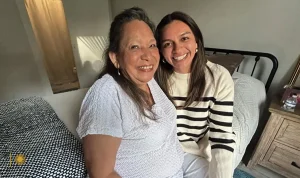
Marcia Nowak, an 81-year-old attendee, finds the intergenerational aspect particularly meaningful. “It’s beautiful, to have me and you as elders, and the young that can share their life experiences and be able to talk about it,” she said.
Shaina spent 30 years without encountering other women who shared her experience of growing up without a mother. She found that these women, who shared her sorrow, also embodied the best qualities of their mothers. “Being able to see all of those moms together, and then I would look at their living daughters and what they’ve all accomplished and who they are, and I connected them, and it was powerful,” she reflected.
Hope Edelman offers a comforting perspective, suggesting that the joy mothers would wish for their daughters can coexist with grief. “There will always be a tinge of sadness that pops up from time to time, because we wish our mom were there to witness our achievements, to help us through hard times,” she said. “But we can celebrate her life in addition to grieving her absence. Both of those things can be true.”
For more information:
- “Motherless Daughters: The Legacy of Loss (20th Anniversary Edition)” by Hope Edelman (Da Capo Press), available in paperback, eBook, and audio formats.
- Hope Edelman: Motherless Daughters Retreats
- Hope Edelman (Official site)
- Therapist and grief educator Angela Schellenberg
- Mount Madonna, Watsonville, Calif.
Story produced by Aria Shavelson. Editor: Carol Ross.
If you or someone you know is in emotional distress or a suicidal crisis, you can reach the 988 Suicide & Crisis Lifeline by calling or texting 988. You can also chat with the 988 Suicide & Crisis Lifeline here.
For more information about mental health care resources and support, The National Alliance on Mental Illness HelpLine can be reached Monday through Friday, 10 a.m.–10 p.m. ET, at 1-800-950-NAMI (6264) or email [email protected].
Read more: How will L.A. rebuild?
See more:
- Michelle Zauner’s recipe for consoling grief: A taste of home (“Sunday Morning”)
- Nancy Giles: Mother’s Day without a mother (“Sunday Morning”)
- Tens of thousands of children cope with “pandemic grief” after losing parent or caregiver (“CBS Evening News”)
- With deepest sympathy: The complications of coping with grief (“Sunday Morning”)
- Katie Couric on how children mourn (“Sunday Morning”)