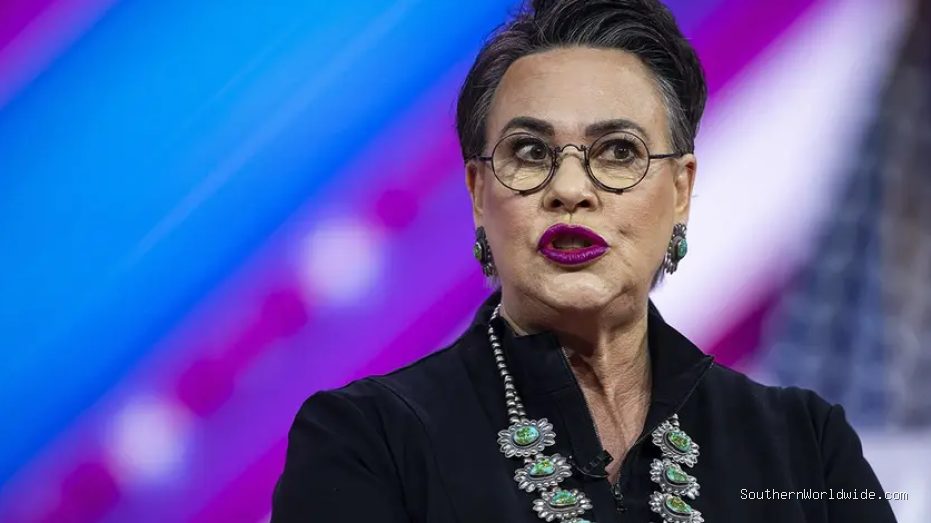
SouthernWorldwide.com – Representative Harriet Hageman, a Republican from Wyoming, has expressed significant concern regarding recent poll results indicating a historically low level of patriotism among Americans.
These findings, which suggest a decline in national pride, have prompted Hageman to issue a strong statement urging a reassessment of the nation’s cultural identity and a renewed appreciation for its heritage.
“In Gallup’s 25-year patriotism survey, just 17 percent, or less than 1 in 5 American adults, reported that they were ‘very proud’ of being an American,” Hageman stated during a recent floor speech.
She further elaborated on the sentiment behind this decline, suggesting that a critical self-examination and a perception of moral failing have contributed to this erosion of national pride.
“Our excitement for America has been dimmed by accusations of an unacceptable morality, our self-image tarnished by a novel self-flagellation,” she added, highlighting a sense of internal critique within society.
Hageman’s remarks are part of a broader argument that the United States possesses a unique cultural identity that is worthy of preservation and celebration, especially as the nation approaches its 250th anniversary of independence.
She emphasized the importance of recognizing and cherishing this distinct cultural heritage, urging a rekindling of appreciation for what makes America unique.
“We must stop pretending that America is just an idea, or that we have no shared culture worth fighting for,” Hageman asserted in her prepared speech.
Her perspective emphasizes that embracing American traditions does not preclude inclusivity. She noted America’s historical role as a welcoming nation for immigrants from around the world.
“This does not mean that we reject other cultures or traditions. America has, in fact, been one of the most gracious countries in history to welcome people from across the globe to our shores,” she explained.
However, Hageman clarified that welcoming newcomers does not necessitate the abandonment of American history and culture. Instead, she believes immigrants are invited to participate in and thrive within the existing American way of life.
“By inviting those who seek to make our country home, however, we are not obligated to subjugate our American history, culture and traditions for theirs. We instead welcome them here to partake in and succeed in the American way of life.”
The Gallup survey revealed significant partisan divides in national pride. Only 36% of Democrats reported being “very proud” of the U.S. in 2025, a substantial decrease from 62% the previous year.
In stark contrast, Republicans showed much higher levels of national pride, with 92% of respondents expressing they were “very proud” of their country.
Independents also experienced a decline, with only 53% expressing a high degree of pride, marking a seven-point drop from the year prior.
Hageman attributed these findings to the influence of the Democratic Party and its approach to reinterpreting the nation’s origins. She specifically criticized the focus on historical injustices as a primary lens through which the country’s narrative is told.
“My friends on the other side of the aisle have worked mightily to weaponize our history with slavery to indict our nation as irredeemable,” Hageman stated, pointing to a perceived attempt to frame the nation as inherently flawed.
She identified the year 1619, when the first enslaved Africans arrived in America, as a focal point for what she described as a new generation of “cultural revolutionaries” aiming to destabilize society.
“Today, the left reveres 1619 as the year of America’s true founding. The year the first slaves were imported to America has become the defining moment for a new generation of cultural revolutionaries hellbent to tear our society apart.”
Despite her critical assessment, Hageman expressed optimism that this trend of declining patriotism is reversible. She believes that a renewed emphasis on the nation’s founding principles and history can help restore a sense of national pride.
“I hope that by focusing on America’s 250th anniversary – and looking back over that history with honesty and accuracy — we will reverse these declines,” Hageman proposed.
She suggested that the ongoing festivities and preparations for the anniversary could serve as a catalyst for a renewed sense of national identity and purpose. Hageman concluded with a hopeful outlook on the nation’s ability to foster pride once again.
“I am, in fact, optimistic that those festivities we’ve already enjoyed are currently inspiring a new sense of purpose in our national identity. And I believe we are on the right track to making America proud again.”