SouthernWorldwide.com – President Trump has launched a series of initiatives aimed at curbing the pharmaceutical industry’s pricing practices. These efforts come as a significant portion of the American public expresses deep concern over the affordability of prescription drugs.
A recent KFF poll revealed that approximately 60% of U.S. adults worry about affording medications for themselves and their families. The majority deem prescription drug prices “unreasonable” and support increased regulation to lower costs. This sentiment is underscored by the fact that Americans pay considerably more for the same medications compared to individuals in other developed nations.
In response, President Trump initiated a multi-pronged approach. Last July, he sent letters to 17 drug manufacturers, urging them to voluntarily reduce drug prices. This was followed by a series of one-on-one meetings at the White House with more than a dozen pharmaceutical executives, during which the president claimed to have secured agreements.
In December, an announcement was made regarding the implementation of “most favored nation” pricing for Medicaid, the government program for low-income Americans. This policy aims to ensure that prices paid by Medicaid do not exceed the lowest prices paid by other developed countries.
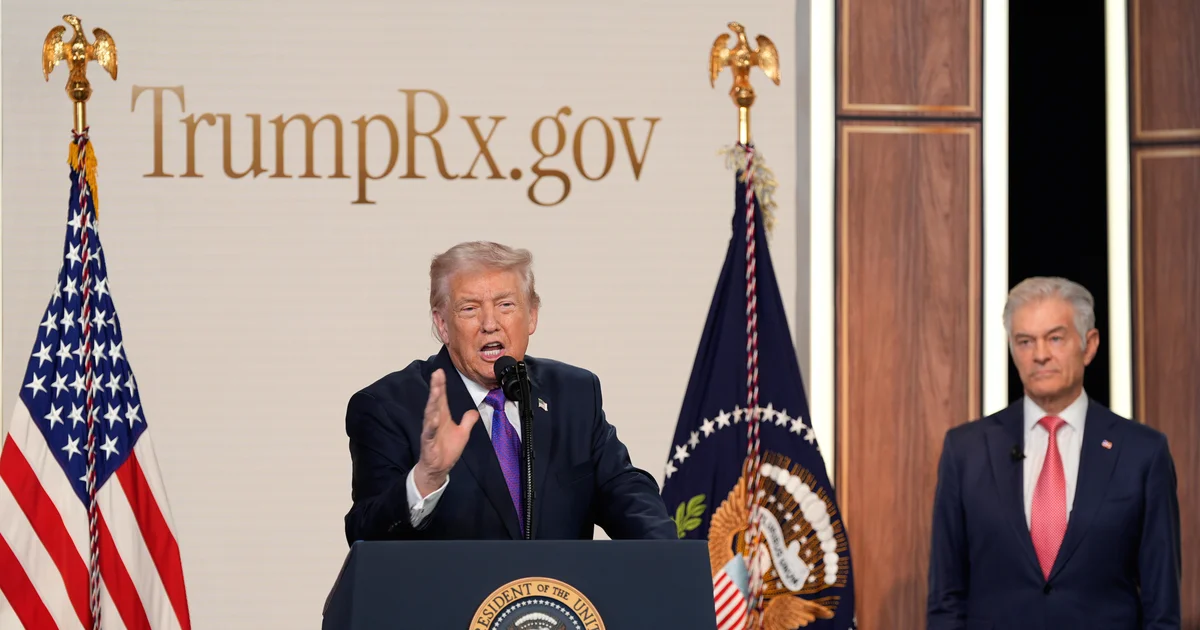
Further initiatives included the launch of TrumpRx, a website designed to offer discounted medicines to cash-paying patients. Additionally, promises were made to expedite the approval of biosimilar products, which are generic versions of high-priced specialty drugs, by streamlining FDA regulations.
However, the actual impact and scope of these promises remain somewhat unclear. Many details regarding the negotiations, including the specific drugs covered, are not fully disclosed, leading to a degree of uncertainty about the extent of their benefits.
When questioned about TrumpRx, White House spokesperson Kush Desai did not provide specific details.
It’s worth noting that Medicaid already procures drugs at substantial discounts. Furthermore, many patients may already have access to more comprehensive drug discount programs through commercial options or their insurance plans, which often include manufacturer copayment cards.
Consequently, the number of Americans who will directly benefit from these new initiatives may be limited, even though some individuals might see cost reductions.
“If it makes a difference to any patient, it’s a win,” stated Mark Cuban, an entrepreneur actively involved in efforts to lower drug prices. He highlighted the discounted pricing available on TrumpRx for certain fertility and weight loss drugs for individuals without insurance or whose plans do not offer coverage.
Cuban’s own venture, the Mark Cuban Cost Plus Drug Co. (Cost Plus Drugs), established in 2022, aims to reduce drug costs by eliminating intermediaries and selling directly to consumers. The majority of drugs offered by Cost Plus Drugs are generics.
Aaron Kesselheim, a Harvard Medical School professor specializing in drug pricing research, described the Trump administration’s announcements as “one-off agreements made for publicity purposes. They don’t change anything about the way drugs are priced.”
He further commented on the agreements, stating, “The agreements are opaque and unenforceable.”
The specifics of the “most favored nation” pricing, including which drugs were included and how the pricing was determined, were not fully clarified. It is evident that not all drugs were subject to this pricing model.
Doing the Math
Analysis by 46brooklyn, a consulting firm that tracks brand-name drug prices, indicated that nearly 1,000 brand drugs experienced price increases in January 2026. Moreover, 2025 saw the highest number of list price increases on record. “This is not a material change, it’s business as usual,” commented Antonio Ciaccia, the company’s co-founder.
In the first week of 2026, Pfizer reportedly increased the list prices of 71 drugs by an average of 5%, while reducing the price of only one drug by 9.8%, according to the data project’s findings.
Perhaps the most significant benefit for patients has been the continuation of a program initiated by the Biden administration: Medicare drug price negotiation for expensive medications. The negotiated discounts on the initial 10 drugs, which include blood thinners, insulins, and treatments for inflammatory conditions, became effective on January 1st.
With price reductions exceeding 50% on some products, the estimated $6 billion in annual savings has enabled the program to cap Medicare patients’ out-of-pocket spending on Part D prescription drugs at $2,000 for 2025 and subsequent years.
An additional 15 high-priced drugs, including popular weight loss and cancer medications, were slated for negotiation in 2025, with discounted Medicare prices to take effect next year. Furthermore, 15 more high-priced drugs are scheduled for negotiation this year. Collectively, these 40 negotiated drug prices are projected to save Medicare over $20 billion annually.
Despite these discounts, pharmaceutical industry lobbyists have actively worked to mitigate their impact, achieving some success. For instance, the One Big Beautiful Bill Act reportedly exempts drugs for rare diseases from negotiations.
Nevertheless, Kesselheim noted, “this is historic because it’s the first time the United States has negotiated prices, like every other developed country. And guess what? Innovation didn’t stop.”
It is important to note that these discounts are exclusively available to Medicare enrollees. While the newer Trump administration initiatives offer some benefits to other patients, they are limited in scope and require users to be aware of how to access them.
Trump’s One-on-Ones
The televised meetings between the president and the heads of major drug companies resulted in agreements, but their direct impact on patients appears to be minimal. For example, following a meeting with Pfizer CEO Albert Bourla, the company announced discounts on over 30 drugs.
Bourla described the deal as “a win for American patients, a win for American leadership, and a win for Pfizer.”
These discounts are primarily offered through TrumpRx, which in turn provides coupons co-branded on GoodRx.com, a platform that already offers discount coupons for a wide array of medications.
Pfizer highlighted the agreement as part of its broader “most favored nation” (MFN) agreement with the U.S. government, intended to lower prescription medicine prices for patients while reinforcing America’s leadership in biopharmaceutical innovation.
Pfizer spokesperson Steven Danehy referenced a September press release, stating that the TrumpRx.gov site offers savings “as high as 85%.”
A significant portion of the discounted drugs are brand-name medications, which often have much cheaper generic alternatives. For instance, the cholesterol-lowering drug Colestid is listed on TrumpRx at a 50% discount, priced at $127.91. In contrast, generic versions are available for approximately $17 on the Cost Plus website.
This suggests that branded companies are not making substantial sacrifices by offering these drugs at lower prices through TrumpRx, as these discounts might represent sales that would not have occurred otherwise, according to Sean Tu, a patent law expert at the University of Alabama.
Some of the discounted drugs are older medications, such as Cortef (hydrocortisone). The 5-milligram branded Pfizer version is listed on TrumpRx for $45, half its list price of $91.80. However, it is available for significantly less on Cuban’s Cost Plus site.
Other medications, like the HIV treatment Viracept, priced at $607.20, are only effective when used in combination with other drugs that are not discounted.
Recently, TrumpRx added Amgen’s Humira, formerly the world’s best-selling drug, at $950 per dose, a reduction from its list price of nearly $7,000. However, Humira lost its patent protection in 2023, and biosimilar versions have since entered the market. Notably, two of these biosimilars are listed on TrumpRx for as little as $207.60 per dose.
Since most TrumpRx products are exclusively available to uninsured individuals paying cash, the price reduction for the arthritis drug Xeljanz from $2,277 to $1,518 per month would still render it unaffordable for many.
A Few Notable Deals
The TrumpRx website, launched on February 6th, primarily features 30 of Pfizer’s drugs (out of approximately 85), along with a select number of discounts intended to attract media attention.
These include three fertility drugs from EMD Serono, a subsidiary of Merck KGaA. The most expensive, Gonal-F, has a list price of $966 but is available for $168 per IVF cycle using a TrumpRx coupon.
These discounts could save women thousands of dollars. However, the overall cost of fertility treatments, of which medications are only a part, will likely remain out of reach for many.
Sean Tipton, spokesperson for the American Society for Reproductive Medicine, estimates that TrumpRx discounts could reduce the $15,000 to $25,000 cost of a single fertility treatment cycle by about 10%. In some European countries, each cycle costs approximately $3,000.
In exchange for lowering these prices, EMD Serono benefited from the lifting of tariffs on its predominantly overseas-produced medications. The company also secured expedited FDA approval for a fertility drug it has been actively marketing in Europe.
Another notable offering on the site is Novo Nordisk’s Wegovy, a GLP-1 drug for weight loss and diabetes. The price has been reduced to as low as $199 per month for the pen. Many insurance plans cover such drugs only for diabetes, leaving individuals seeking weight loss to pay out-of-pocket.
Zepbound, a competing drug from Lilly & Co., is also listed at $299 per month.
There has been increasing pressure on Novo and Lilly to reduce the U.S. prices of their GLP-1 drugs. These compounds have lost patent protection in India, and pressure from consumers purchasing overseas is expected to intensify when generic Wegovy becomes available in Canada for as low as $73 per month, potentially this year.
In the United States, numerous patents are expected to prevent generic Wegovy from reaching the market until 2039, according to Professor Robin Feldman, a patent expert at the University of California Law-San Francisco.
A recent report from the research group I-Mak detailed various methods used by patent manipulation to keep generics off the U.S. market long after they are available in other countries.
While the Trump administration has pledged to accelerate the approval of biosimilars to foster competition and lower prices, this may not have a substantial impact. The primary obstacle to bringing generics and biosimilars to market is often not FDA approval, but rather the extensive patent thickets that U.S. law permits manufacturers to utilize to protect their intellectual property.
For example, although the FDA approved a generic version of Otezla, a popular drug for psoriatic arthritis, in 2021, it is not expected to reach the market until 2028. Its entry would necessitate drugmakers paying rebates to Medicare if they charged the program more than other developed countries for “single source” drugs and biologics.
This mechanism would allow Medicare to benefit from price negotiations conducted in other countries for some of the most expensive medicines. These programs are still in the rulemaking process and would primarily benefit those covered by Medicare, and only indirectly.
The average patient, if willing to pay cash, might find some bargains. However, securing the best deal could involve considerable effort in comparing prices and options, requiring consumers to become discerning shoppers for essential medications, much like they would for everyday groceries.
Data reporter Maia Rosenfeld contributed to this article.
Read more : Hidden Costs of Pharmacy Discounts
KFF Health News, formerly known as Kaiser Health News (KHN), is a national newsroom that produces in-depth journalism about health issues and is one of the core operating programs at KFF—the independent source for health policy research, polling, and journalism.