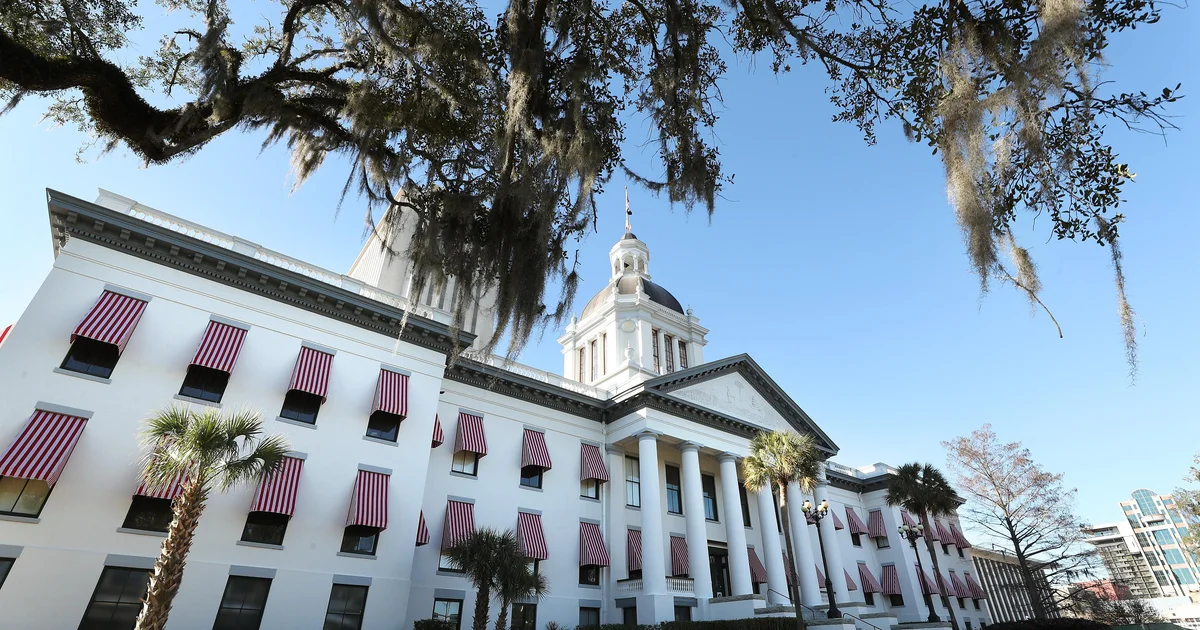
SouthernWorldwide.com – Florida is emerging as a key battleground for Republicans looking to strategically redraw congressional district lines to their advantage, with plans potentially targeting three to five Democratic-held House seats before the 2026 midterm elections.
The state already operates under a congressional map enacted in 2022, heavily influenced by Florida Governor Ron DeSantis, which resulted in a delegation comprising 20 Republicans and 8 Democrats. This aggressive gerrymandering in Florida adds another layer to the ongoing political contest over redistricting, following similar moves in Republican-controlled Texas and Democratic-controlled California.
Currently, Democrats would need to secure victories in just three Republican-held seats in the House of Representatives to regain control of the chamber. This makes Florida a significant state for both parties in the upcoming electoral landscape.
President Trump has been a vocal proponent of redistricting efforts in several Republican-controlled states, including Indiana, Missouri, and Florida. He has actively encouraged these states to redraw their congressional maps to better align with his party’s objectives.
“With California moving forward with their maps, there’ll be even more pressure to do that,” stated a Florida GOP operative who wished to remain anonymous to discuss internal legislative strategies. “I do think Washington’s going to look at Florida and be like, ‘All right guys, you gotta fix this.'”
In early August, Florida House Speaker Daniel Perez initiated a preliminary step by establishing a select committee dedicated to congressional redistricting. Perez indicated that this move was prompted by a Florida Supreme Court decision in July, which upheld the existing gerrymandered map and dismissed a legal challenge concerning the elimination of a majority-Black district in North Florida.
Critics had argued that the 2022 district lines contravened Florida’s constitutional “Fair Districts” amendments, adopted in 2010, which were designed to prevent partisan and racial gerrymandering. Perez, however, asserts that the committee’s formation is timely to examine the interplay between the Fair Districts provisions and the state’s redistricting initiatives.
“[T]here are national conversations ongoing in other states related to midterm redistricting,” Perez communicated in a memo. “Exploring these questions now, at the mid-decade point, would potentially allow us to seek legal guidance from our Supreme Court without the uncertainty associated with deferring those questions until after the next decennial census and reapportionment.”
The select committee is scheduled to commence its initial meetings around the week of October 6. The prevailing expectation among Florida lawmakers and Republican operatives is that further discussions and the potential approval of a new congressional map will be incorporated into the agenda for the Florida legislative session commencing in January 2026. However, they acknowledge the evolving nature of the situation and are closely monitoring the activities of the redistricting select committee.
Read more: Missouri Lawmakers Approve GOP Redistricting Map Supported by Trump
According to two Florida GOP operatives with knowledge of legislative discussions, up to five Democratic U.S. Representatives in Florida could have their districts targeted in a potential redraw.
The districts represented by Democratic U.S. Representatives Debbie Wasserman Schultz, Lois Frankel, Jared Moskowitz, Frederica Wilson, and Darren Soto in Orlando could be made more competitive by incorporating Republican-leaning areas. Alternatively, these districts might be redrawn to create situations where multiple incumbents would face each other in an intraparty primary election.
Florida Senator Shevrin Jones, a Democrat from South Florida, characterized the potential redraw as “a straight-up power grab, politicians picking their voters, instead of voters picking their representatives.”
“The Republicans drew the damn maps, and now they want to come back and cut out Black Democrats and even Democrats who have worked across the aisle for their district,” Jones stated.
Kevin Wagner, a political science professor at Florida Atlantic University, highlighted the potential risks for the GOP in targeting Democratic seats, which could involve diluting reliably Republican voter bases from strong GOP districts.
“It depends how much of a risk they wanna take. Because if you were in a +20 district towards your party, are you okay making it go +5 or +6? People get worried and they don’t want to be in a non-safe district. It’s a little more horse trading than people think,” Wagner explained.
“The assumptions from redrawing the maps is that voters are going to vote in the same magnitude and pattern that has existed previously. Sometimes that turns out to be true and sometimes it does not,” he added.
Calling for Mid-Decade Census
Florida Governor Ron DeSantis has expressed support for a mid-decade redraw in his state and has gone a step further by echoing President Trump’s call for an early “redo” of the decennial Census count. The objective is to exclude undocumented immigrants from the count, with DeSantis asserting that Florida’s population has grown sufficiently to warrant an additional congressional seat.
DeSantis claimed that Florida’s population was undercounted by approximately 700,000 individuals, and that the state needed just 100,000 more residents in its final population count to secure an additional U.S. House seat.
The Census Bureau reported in 2022 that Florida experienced an undercount of 3.48%, representing over 756,000 people.
DeSantis announced that Florida’s Attorney General, James Uthmeier, will also advocate to the Commerce Department, which oversees the Census Bureau, for a new mid-decade census. Uthmeier sent a letter in July to Commerce Secretary Howard Lutnick, requesting “a corrected census to give Floridians the representation they deserve in Congress.”
“It’s not unusual that states complain that they’ve not got sufficient representation of their population. There are legitimate arguments about how we count, whether that is an accurate representation of the population,” Wagner commented.
The Census Bureau has not announced any modifications or plans for a corrected census to be completed in time for the 2026 midterm elections. The U.S. Constitution mandates that the enumeration, or census count, be conducted every ten years. A Census Bureau employee, speaking anonymously to discuss internal matters, deemed it logistically “impossible” to conduct a census and reallocate congressional seats before the 2026 midterms.
CBS News has reached out to the Commerce Department for comment regarding any potential changes to the census timeline. As of now, no official announcements have been made.
Generally, DeSantis believes there is sufficient political will in Tallahassee to proceed with redrawing the state’s congressional lines.
“Even if they don’t do a new census, even if they don’t revise the current Census, I still think it is appropriate to [redraw the lines],” DeSantis stated during a press conference in Florida on August 11.
“I’ve spoken with some folks in the Florida Legislature, and I think that there’s broad acknowledgement that this is something that is going to happen,” he concluded.