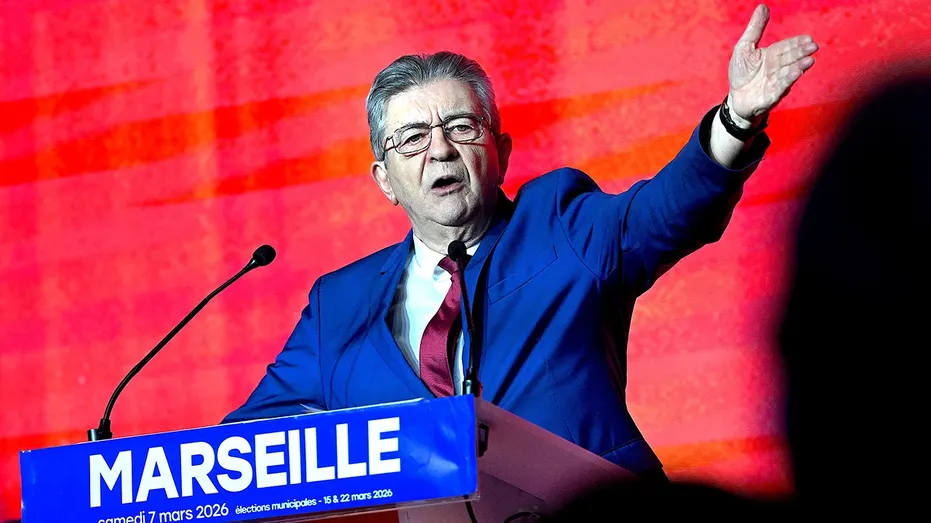
SouthernWorldwide.com – Israel’s ambassador to France, Joshua Zarka, has drawn a stark comparison between the rhetoric of far-left leader Jean-Luc Mélenchon and that of Adolf Hitler, citing a disturbing surge in antisemitism that is forcing French Jews to conceal their identities.
Ambassador Zarka expressed his deep concern over the growing antisemitic incidents in France, a country that hosts Europe’s largest Muslim and Jewish communities. He pointed to foreign influences as a significant factor exacerbating the issue.
Zarka stated that the volume of antisemitic acts reported daily in France is exceptionally high. He attributed this not to a lack of effort by the French government in combating it, but to a growing undercurrent of antisemitism fueled by external actors.
He identified Iran, Russia, Turkey, and Qatar as nations he believes are instrumental in promoting antisemitism from abroad. Zarka also noted that certain French political figures exploit antisemitic sentiments to garner votes.
Among these figures, Zarka singled out the far-left party La France Insoumise (LFI) and its leader, Jean-Luc Mélenchon. He found Mélenchon’s public addresses to be disturbingly reminiscent of Hitler’s speeches.
“The way [LFI leader] Jean-Luc Mélenchon speaks in front of a crowd reminds me of Hitler,” Zarka declared. He elaborated that Mélenchon’s tactic of uniting people against a common enemy by speaking about Israel mirrors Hitler’s historical rhetoric against Jewish people.
In February, the Human Rights League had already criticized Mélenchon for mocking the pronunciation of Jewish names, including that of Member of the European Parliament Raphaël Glucksmann.
Mélenchon had previously written on his blog that antisemitism in France was “residual.” This statement drew sharp criticism, with many arguing it downplayed the significant rise in anti-Jewish sentiment following the Hamas attack on Israel on October 7.
Zarka also observed a notable shift in the French Jewish community’s perception of the far-right over the past three years. Many no longer view the National Rally, formerly led by Marine Le Pen, as a primary threat.
He highlighted that National Rally President Jordan Bardella visited Yad Vashem and made a formal commitment to fight antisemitism from both the left and the right. Zarka believes this action has resonated within the Jewish community.
Read more : National K-12 Group's DEI Agenda Impacting Local Schools, Report Finds
Recent antisemitic incidents underscore the escalating problem. On January 12, a tree planted in memory of Ilan Halimi, a victim of a brutal 2006 antisemitic attack, was partially cut down in Lyon.
On February 9, a young boy wearing a kippah was attacked by five individuals, one of whom allegedly held a knife to his throat. Just ten days later, acid was sprayed in two dining areas of a kosher restaurant in Paris.
Graffiti with racist and antisemitic messages targeted three high schools in the Montpellier metropolitan area on April 15.
In March, authorities arrested two brothers in connection with a “deadly and antisemitic” plot. Police found a semi-automatic weapon, hydrochloric acid, and an ISIS flag in their vehicle.
Rabbi Elie Lemmel was the target of two antisemitic assaults. In June, he was punched in the stomach in Deauville. Days later, while sitting at a café in Neuilly-sur-Seine, he was struck with a chair by an individual from Gaza.
“You have to be vigilant,” Rabbi Lemmel stated. He acknowledged that some people are bothered by the sight of a kippah and that those with harmful intentions will always find a pretext.
“If we start hiding, it is the beginning of the end,” he added. “I have always worn a kippah, and that is why I continue to wear it.”
Yonathan Arfi, president of the Representative Council of Jewish Institutions of France (CRIF), reported that some Jewish families are now choosing to display mezuzahs discreetly or use different names on mobile applications to avoid identification.
“We must not offer antisemitic terrorists and those driven by hatred our fear and withdrawal as a trophy,” Arfi urged. He emphasized that Jewish life must continue openly and proudly wherever possible.
Arfi also noted that Jewish immigration to Israel serves as a warning sign, indicating that some Jews no longer perceive a secure future in France.
Historically, French immigration to Israel averaged between 1,500 and 2,000 people annually after the Six-Day War. This figure surged to approximately 8,000 annually between 2012 and 2015, then dropped to around 1,000 in 2023.
However, immigration increased to over 2,000 in 2024 and is projected to reach 3,500 in 2025. The Jewish Agency for Israel estimates that approximately 4,000 immigrants from France will arrive in 2026.
The Israeli ambassador acknowledged that French authorities are actively working to combat antisemitism, making France a “relatively safe place.” Nevertheless, he advised Israelis to exercise caution when traveling to other European countries like Spain, Belgium, and even the Netherlands, where antisemitism is described as flourishing.
In February, French President Emmanuel Macron denounced the “antisemitic hydra” that had permeated French society. He made these remarks during a ceremony commemorating Ilan Halimi, who was tortured and killed in 2006.
“In 20 years, and despite the resolute efforts of our police officers, gendarmes, judges, teachers and elected officials, the antisemitic hydra has kept advancing,” Macron stated, as reported by Le Monde.
He further explained that the hydra constantly assumes new forms, insinuating itself into the heart of society, often accompanied by silence and a refusal to acknowledge the problem.
Macron also condemned “Islamist antisemitism,” which he linked to the Oct. 7 Hamas-led attacks, and “far-left antisemitism,” which he stated rivals that of the far right.
He observed that antisemitism increasingly uses the guise of anti-Zionism to advance subtly.
Despite these concerns, diplomatic relations between France and Israel have faced challenges. Zarka disclosed that the Macron administration denied permission for U.S. military overflights carrying weapons to Israel during the conflict with Iran.
“The French made the decision not to provide us with an aerial bridge for American weapon shipments to fly over during the war against Iran,” he stated.
This marked the second time France had denied such a request, with the first instance occurring during the 1973 Yom Kippur War, according to the envoy.