SouthernWorldwide.com – As the midterm elections approach, Republicans are shifting their focus from border security, a key issue in 2024, to tackling fraud. This strategic pivot comes as the nation faces economic uncertainties, a prolonged conflict in Iran, and rising gas prices, while President Trump’s signature legislative agenda has yet to gain significant traction.
With the border issue no longer dominating the political landscape as it did in previous elections, the GOP is actively seeking new themes to resonate with voters. Fraud has emerged as a prominent contender, allowing Republicans to revisit a familiar talking point.
House Republican Conference Chairwoman Lisa McClain, R-Mich., highlighted concerns over government spending during a recent press conference. She cited instances such as $20 million allocated for Sesame Street in the Middle East and $8 million for programs related to transgender mice, questioning the administration’s priorities.
McClain also criticized the Biden administration for providing “free housing and cars for illegals” and for what she described as taxpayer dollars being distributed by federal agencies with insufficient oversight, control, and accountability.
Republicans are reportedly struggling to formulate an economic package that can appeal to voters. Consequently, their current strategy involves emphasizing the issue of fraud.
“It’s absurd to suggest that fraudsters should be protected or that the hard-earned tax dollars of the American people should be given to criminals who are stealing their money. That’s simply not logical,” McClain stated, underscoring the perceived irrationality of supporting fraudulent activities.
House Republicans had scheduled debates on three bills aimed at curbing fraud in government programs. One bill proposed to strengthen oversight of childcare block grants, while another sought to prevent individuals from exploiting programs designed to assist the most vulnerable members of society.
A third measure was intended to address “ghost students” and combat fraud within student aid programs. Representative Austin Scott, R-Ga., emphasized the importance of program integrity, arguing that taxpayers would not support programs riddled with fraud.
“The integrity of these programs is paramount because taxpayers will not continue to support them if they are rife with fraud. This applies to all programs, whether it’s child care or SNAP. The American citizens want to see fraud eliminated from the system,” Scott asserted.
Some Democrats expressed skepticism regarding the Republican focus on fraud. Senator Peter Welch, D-Vt., suggested that the GOP was not addressing the core issue of affordability, which he stated was a primary concern for voters. He also noted that no politician would openly endorse fraud.
“They are not addressing affordability. The President has stated he is not concerned. Secondly, all of us are against fraud. I have yet to meet any politician who, when asked ‘Are you for fraud?’ says ‘Yes.’ We’re all against it,” Welch commented.
Another Democratic senator suggested that Republicans should instead investigate fraud and corruption within the Trump administration and the Trump family, pointing to ongoing reports of Trump’s children benefiting from government contracts.
On Wednesday, Republicans initiated a hearing to investigate alleged Medicaid fraud in Ohio, following their discovery of various fraudulent activities in Minnesota. Representative Brandon Gill, R-Texas, claimed that individuals from the Somali community were involved in fraudulent schemes in both states.
“You have the largest Somali population in the United States located in Minnesota, and the second largest in Ohio. While it may not be politically correct to say, the reality is that this fraud predominantly originates from that community,” Gill stated during the hearing.
During the hearing, Gill alleged that Somalis were migrating between Ohio and Minnesota, suggesting a connection between their movements and the fraudulent activities. He also claimed that a significant portion of Somali immigrants were reliant on welfare programs.
Gill engaged in a heated exchange with Ohio State Senator Nickie Antonio, who questioned the premise of his statements. Antonio expressed dismay at the “hateful rhetoric” based on what she described as false information.
“Seventy percent of Somali immigrants are on welfare,” Gill asserted. Antonio retorted, “The rate and level of hateful rhetoric based on false information is shocking to me.”
Gill pressed further, stating, “They are defrauding your state at an astounding rate. Most Ohioans have a problem with that.” Antonio countered by pointing out that Republicans have held significant positions of power in Ohio for the past 15 years, suggesting that any fraud would have occurred under their watch.
“They hold the House, the Senate, the governor’s office, and four statewide offices. If there is fraud in Medicaid, it has happened on the Republican majority’s watch. Perhaps it’s time to clean Ohio’s house,” Antonio responded.
A recent Fox poll indicated that over 70 percent of respondents believe fraud is “very common” in government welfare programs. With the elections approaching, Republicans aimed to pressure Democrats by forcing them to vote on anti-fraud measures.
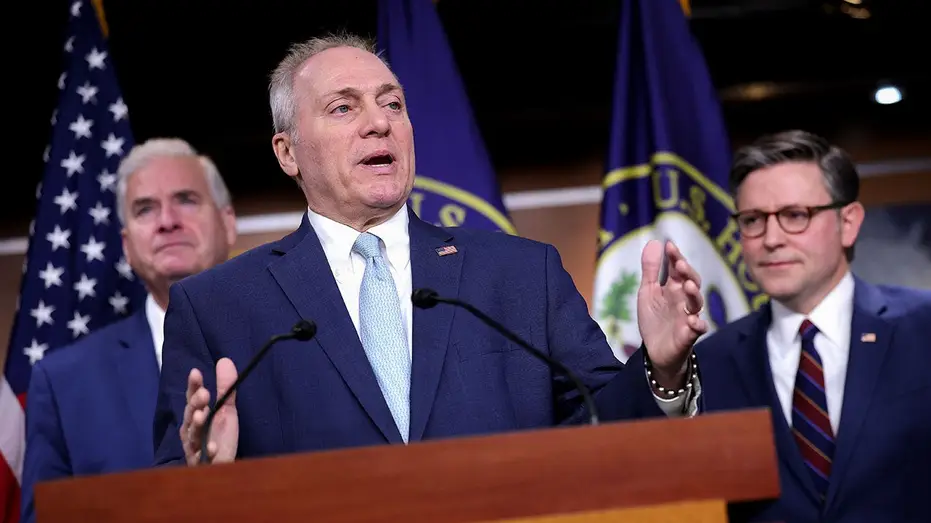
When asked if Democrats opposing these bills would be targeted, House Majority Leader Steve Scalise, R-La., suggested that voters would question such decisions. “I think their own voters are going to be questioning that,” Scalise replied. “If Democrats vote no on that, it’s going to be a hard vote to explain.”
House Minority Leader Hakeem Jeffries, D-N.Y., while opposing the GOP’s anti-fraud initiatives, gave Democrats in battleground districts the latitude to make their own decisions.
“Democrats are going to make a decision based on what is the right thing to do for the district that they represent. And I trust every single Democrat, particularly those who are in swing districts, to do the right thing for the people that they are privileged to represent,” Jeffries stated.
The House passed the childcare fraud bill on Wednesday afternoon, with only four Democrats voting in favor. However, Republicans withdrew a bill concerning fraud in the Temporary Assistance for Needy Families (TANF) program, citing a lack of sufficient votes and the need for further refinement.
The “ghost student” bill did not proceed to a vote, as the House adjourned earlier than scheduled. These three fraud-related measures are considered “messaging” bills, unlikely to become law but intended to convey a message to voters and highlight potential Democratic opposition.
Despite the emphasis on fraud, House Republicans managed to pass only one of their three proposed bills. This success rate, while comparable to some Hall of Fame baseball players, is not considered a strong performance in the political arena.
Republicans plan to introduce additional anti-fraud measures next week. However, if they fail to achieve greater success with these upcoming bills, voters may choose to “ghost” them at the polls, mirroring the fate of the legislative proposals that did not advance.