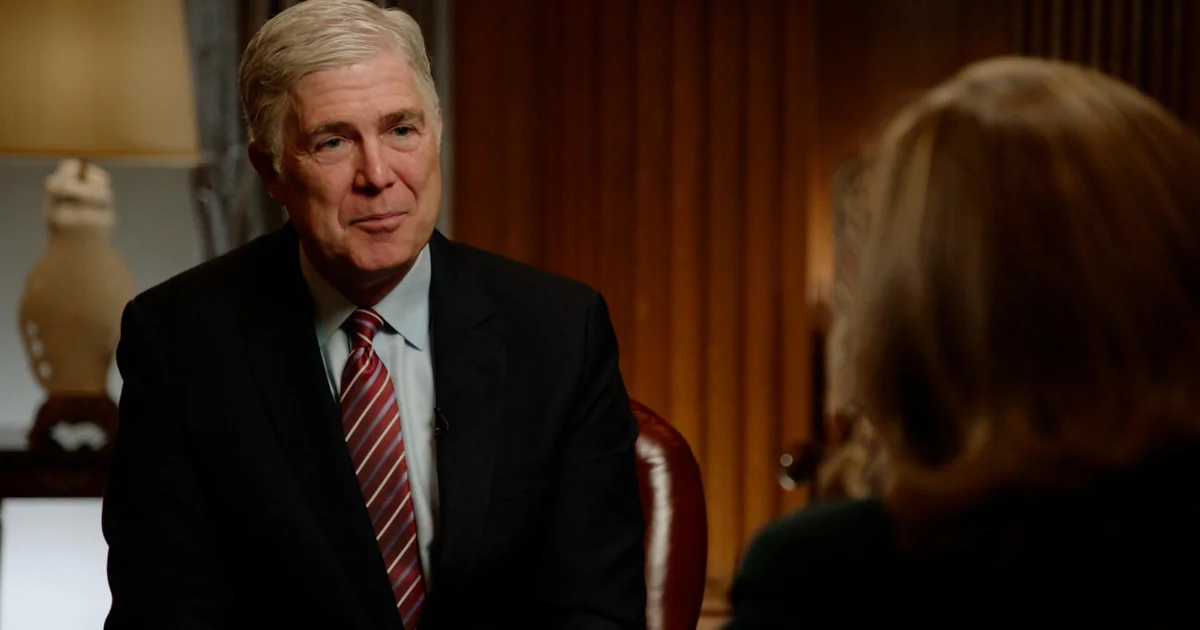
SouthernWorldwide.com – Supreme Court Justice Neil Gorsuch has directly addressed former President Donald Trump’s criticisms, emphasizing his unwavering commitment to the Constitution. Gorsuch stated that his loyalty lies with the Constitution and the laws of the United States, not with any president who appointed him.
This statement comes in response to repeated attacks from former President Trump following the Supreme Court’s 6-3 ruling in February that invalidated significant tariffs imposed by his administration. Justices Gorsuch and Amy Coney Barrett, both appointed by Trump, were part of the majority in this decision.
Trump had previously voiced his disapproval on Truth Social, suggesting that justices appointed by Democratic presidents exhibit strong loyalty to their appointing party and ideology. He contrasted this with some Republican appointees, whom he accused of being overly concerned with popularity or political correctness, thereby demonstrating insufficient loyalty to him or their original ideology.
In a candid interview with CBS News chief legal correspondent Jan Crawford, Justice Gorsuch articulated his perspective. He firmly asserted that a justice’s duty is not to the president who nominated them, but to the foundational documents of the nation.
“My loyalty is to the Constitution, the laws of the United States,” Gorsuch explained. “That’s the oath I took. It’s really just that simple.”
Gorsuch, who joined the Supreme Court in 2017 at the age of 49, highlighted the significance of life tenure granted to federal judges. He believes this provision is crucial for allowing them to perform their duties impartially.
“Think about it,” he remarked to Crawford. “You’ve given nine old people life tenure. But you give them life tenure if you believe their job is only to apply the law fairly without regard to anybody or anything else or politics or any of the noise.”
He expressed confidence in the federal judiciary’s structure as designed by the Constitution. Gorsuch also indicated that external opinions do not sway his judicial approach.
“Do I care what people say left, right, center about me? Nah,” he stated.
Justice Gorsuch has also authored a new children’s book titled “Heroes of 1776: The Story of the Declaration of Independence,” co-written with Janie Nitze, which was released this week.
Beyond the tariff ruling, former President Trump has also expressed his belief that the Supreme Court might overturn his executive order aimed at ending birthright citizenship. He attended the oral arguments for this case and publicly speculated that based on the questioning from Republican-nominated justices, the administration might lose.
However, the Supreme Court has also faced criticism from Democrats. Most recently, a decision last week that weakened a key provision of the Voting Rights Act drew strong reactions. House Democratic Leader Hakeem Jeffries labeled the court “illegitimate” and its conservative justices “extremists.”
These rulings, including the 2022 decision overturning Roe v. Wade and the 2024 decision on presidential immunity, have intensified calls for reforms to the Supreme Court. Congressman Johnny Olszewski of Maryland recently proposed a constitutional amendment to establish 18-year term limits for justices. Similar proposals, such as expanding the court’s size, have been put forth by Democrats in recent years but have not gained significant traction in Congress, particularly in the Senate.
The number of Supreme Court justices was set at nine in 1869. Justice Gorsuch remarked that this composition has “worked reasonably well,” echoing a sentiment previously shared by the late Justice Ruth Bader Ginsburg in 2019.
He also advised those advocating for reforms to thoroughly understand the institution’s history and carefully consider the potential consequences of implementing changes.
Read more: Two hikers hurt in Yellowstone bear encounter
“You may have some great ideas about reforming things and they might be right,” Gorsuch cautioned. “Make sure you know what you’re reforming before you tinker with it. Once you start tinkering, you expect other people to tinker. And then where does it end?”