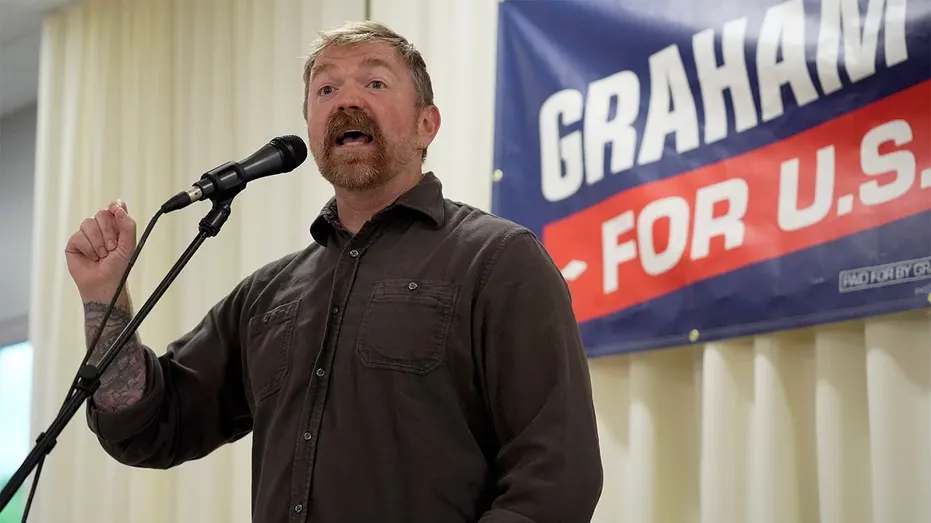
SouthernWorldwide.com – It’s a critical day for Graham Platner, the Democratic Senate candidate in the progressive state of Maine, as he aims to unseat long-serving Republican Senator Susan Collins. This race is one of a few that will significantly influence whether the GOP maintains its narrow majority in the Senate following the midterm elections.
Platner, an oyster farmer and decorated combat veteran, has garnered support from prominent progressives like Senator Bernie Sanders. However, he is currently embroiled in a series of controversies that could make his anticipated Democratic primary victory more challenging than initially expected.
Concurrently, in South Carolina, the influence of former President Donald Trump is being tested once again. This comes just a week after his endorsement streak in high-profile Republican primaries was broken, highlighting another crucial electoral battle for the GOP gubernatorial nomination.
These two key electoral contests are set to dominate national headlines as Maine and South Carolina, along with Nevada and North Dakota, hold their primary elections on Tuesday.
PLATNER TO SUPPORTERS: ‘MAINE, YOU HAVE MY BACK’
Platner has spent the past month addressing a growing number of controversies. These include inflammatory online comments made on Reddit, a tattoo on his chest that bore a resemblance to a Nazi symbol which has since been covered, recent reports of exchanging sexually explicit messages with multiple women while married, and new allegations from former girlfriends detailing a history of rape fantasies, heavy drinking, and violent episodes. Platner has vehemently denied the most recent allegations of violence.
The negative press has led some Democrats in Washington to question Platner’s viability as a candidate. However, Platner expressed gratitude to Maine voters for their continued support over the weekend.
“When hurtful things I said on the internet a decade ago came out into the public, as I shared my personal journey through PTSD and darkness of recovery and accountability and growth, Maine had my back,” Platner stated at a rally near his hometown in Down East, Maine.
“Now, as every single piece of that past and journey gets dug up, litigated, and weaponized, you have my back. And when politically motivated, serious and false accusations are made against me. Maine, you have my back.”
SEE IT: MAINE VOTERS SOUND OFF ON PLATNER CONTROVERSIES
Platner, who has openly discussed his struggles with Post-Traumatic Stress Disorder (PTSD) stemming from his military service in Iraq and Afghanistan, apologized for his controversial Reddit posts last fall shortly after launching his Senate campaign.
Regarding the tattoo, Platner explained that he got it in 2007 while drinking with fellow Marines in Croatia. He stated he covered it after learning it resembled a Nazi symbol. However, new accounts from an ex-girlfriend have raised questions about his timeline of awareness regarding the tattoo’s appearance.
“I’m more concerned about making it clear that we’re opposed to misogyny, those relationships were toxic and volatile, there’s no excuse for that,” said Khanna, referring to Platner’s past relationships. “I talked to Graham and he says he was at a very dark period, he had come back from two tours of duty in Iraq as an infantry man seeing violence and death. That doesn’t excuse it.”
SEE IT: DEM SENATORS DODGE ON BACKING PLATNER AS MAINE CANDIDATE’S SCANDAL CLOUDS FINAL DAYS BEFORE PRIMARY
Khanna added that Platner expressed that he “really grew as a person when he came back to Maine and he was an oyster farmer and he found peace and he is ashamed of that period. To me, that suggests someone taking accountability and improving their lives, and we need that redemption in this country. And I agree with a lot of his economic policies, that we should be taxing the billionaires, we should be focusing on the working class.”
Platner was widely considered the likely Democratic nominee after Governor Janet Mills, who had the backing of Senate Democratic Leader Chuck Schumer and the party establishment, withdrew from the race earlier this spring. Mills had been significantly trailing Platner in fundraising and polling.
Senator Collins, upon returning to Maine on Friday after a week on Capitol Hill where she marked a milestone by casting her 10,000th consecutive vote, was questioned by reporters about the latest allegations against Platner.
“The allegations in the latest story are troubling,” Collins stated. “And I believe that Graham Platner has a lot of questions to answer.”
THE TEN RACES THAT WILL DETERMINE THE SENATE’S MAJORITY
Platner is facing considerable opposition from Republican groups. A super PAC affiliated with Collins has been running advertisements highlighting Platner’s controversies.
The National Republican Senatorial Committee (NRSC) has labeled Platner a “fraud.”
“He’s preaching about living a small but decent life growing up in Maine. The truth? Graham Platner is an elitist whose parents sent him to boarding school in Connecticut and bought him a house,” the NRSC asserted.
The Republican National Committee (RNC) has also criticized Platner.
“Graham Platner says his violent and erratic past is being ‘weaponized’ against him. Platner said he would rape someone to show his dominance and ‘rape was about power,’ the RNC research team wrote on X, referencing the latest allegations.
Despite the allegations and the Republican attacks, no Democratic politicians who have endorsed Platner have withdrawn their support.
Platner has attracted large crowds and built a substantial fundraising base. Democrats view Maine as a key opportunity for a pickup in their effort to regain the Senate majority.
However, defeating Collins, a moderate senator seeking her sixth term who has a history of voting against President Trump’s agenda, will be a formidable task. Six years ago, polls suggested she was headed for defeat, but Collins defied expectations, winning re-election by nine points over then-Democratic state House Speaker Sara Gideon.
In the race to succeed the term-limited Governor Mills, Maine has a crowded and competitive field of Democrats vying for their party’s gubernatorial nomination. On the Republican side, former federal investigator Bobby Charles is leading eight other candidates, including Jonathan Bush, nephew of the late President George H.W. Bush.
Also drawing attention is the Democratic primary in Maine’s 2nd Congressional District, where Democrats are competing to replace moderate Democratic Representative Jared Golden, who announced last year he would not seek re-election due to political polarization.
Republicans, who are aiming to retain their slim House majority, consider this largely rural district, which Trump carried in the 2016, 2020, and 2024 presidential elections, a prime pickup opportunity. Former two-term Republican Governor Paul LePage is unopposed for the GOP nomination.
In South Carolina, Trump’s endorsement is once again a focal point.
About a week and a half ago, the former president gave his last-minute support to Lieutenant Governor Pamela Evette, who is seeking to succeed term-limited Republican Governor Henry McMaster, a close Trump ally.
Evette is competing in the GOP primary against several other prominent candidates, including long-serving South Carolina Attorney General Alan Wilson, nationally recognized Representative Nancy Mace, Representative Ralph Norman, and businessman Rom Reddy.
As no candidate is expected to secure over 50% of the primary vote, the top two finishers will advance to a runoff election on June 23.
The significant impact of Trump’s endorsement power has been evident in recent GOP primaries. His favored candidates have successfully ousted incumbents he targeted in key races in Indiana, Louisiana, Kentucky, and Texas, which garnered considerable national attention.
However, his eleventh-hour endorsement of Republican Representative Randy Feenstra of Iowa, given on the same day he also backed Evette, in the race to succeed retiring GOP Governor Kim Reynolds, was not enough to secure victory for the three-term congressman.
Feenstra was narrowly defeated by Zach Lahn, a businessman, farmer, and former political strategist. Lahn was supported by political factions aligned with the Make America Healthy Again movement, associated with former Trump Health Secretary Robert F. Kennedy Jr., and Turning Point USA, a prominent conservative organization co-founded by the late Charlie Kirk.
In the South Carolina GOP gubernatorial primary, the main contenders had been emphasizing their support for Trump and his policies in hopes of securing his endorsement.
Trump, after remaining neutral for months, endorsed Evette, describing her as an “America First Patriot” and a “WINNER” in his announcement.
Following Trump’s endorsement of Evette, Mace suggested that her strong advocacy last year for the Justice Department to release files related to its investigation into convicted sex offender Jeffrey Epstein may have influenced the president’s decision to back her rival.
“I know I put the likelihood of an endorsement on the line when I demanded transparency on the Epstein files,” Mace stated. “I demanded it because you deserved the truth — ALL OF IT,” she emphasized in a post on X.
Trump, in a social media post endorsing Evette, also indicated his expectation that Evette would select Henry McMaster Jr., the governor’s son, as her running mate for lieutenant governor.
This comment from the former president sparked controversy within South Carolina political circles and led to speculation that Governor McMaster, who succeeded Nikki Haley and is in his tenth year as governor, was attempting to promote his son’s political career.
However, McMaster denied any agreement or pressure, and Evette stated that she would not name a running mate until after the primary election.
On Friday, the younger McMaster withdrew his name from consideration, calling it “incredibly humbling” to be considered for lieutenant governor but stating that “now is simply not the right time.”
The winner of the Republican gubernatorial nomination is expected to be the clear favorite in the November general election in South Carolina.
State Representative Jermaine Johnson, trial attorney and 2010 gubernatorial candidate William Mullins McLeod Jr., and businessman Billy Webster, who served as chief of staff to former Democratic Governor Richard Riley, are competing for their party’s nomination.
Long-serving Republican Senator Lindsey Graham is the strong favorite in the Republican Senate primary, but is facing a more challenging-than-expected contest from South Carolina businessman Mark Lynch, with the race marked by escalating personal attacks.
In Nevada, incumbent Republican Governor Joe Lombardo is expected to overcome a few primary challengers as he seeks re-election. On the Democratic side, Nevada Attorney General Aaron Ford is the clear frontrunner against Washoe County Commissioner Alexis Hill.
And in the solidly Republican state of North Dakota, a competitive GOP House primary is underway for the state’s at-large congressional district.