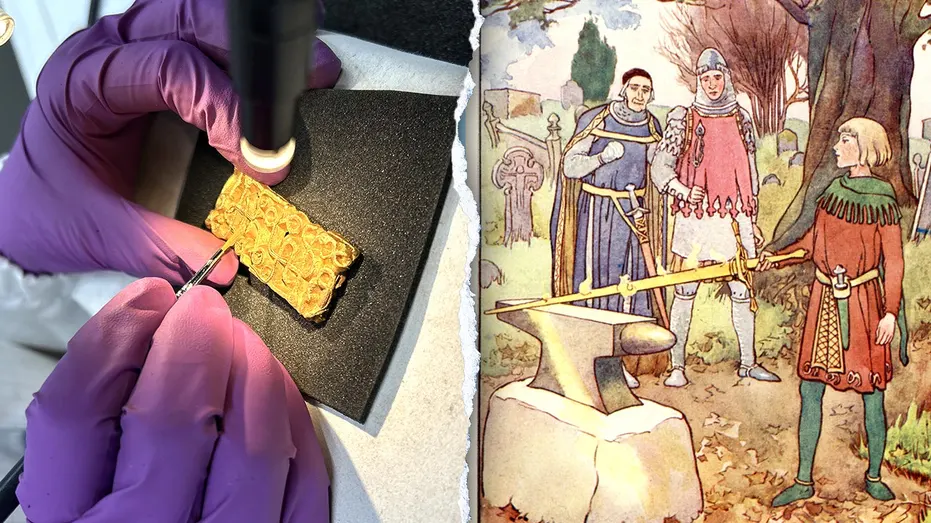
SouthernWorldwide.com – A discovery reminiscent of King Arthur’s legend has recently been made in Norway, where a hiker stumbled upon a 1,500-year-old gold sword fitting hidden beneath a tree.
The University of Stavanger, a public university in Norway, announced the news on May 5.
This significant artifact was found in the Austrått district of Sandnes, a city located in southwestern Norway. It dates back to the sixth century, a period known as Norway’s Migration Period, which was a tumultuous era of upheaval following the collapse of the Roman Empire.
The anonymous hiker, a resident of Austrått, expressed his passion for exploring and familiarizing himself with the local area.
After noticing a tree that had been felled by a storm, the man, who is a father of two, began to investigate the ground beneath it.
He recounted that he saw a slight mound of soil under the tree and poked at it with a stick. Suddenly, he noticed something gleaming and initially didn’t fully comprehend the nature of his discovery.
Unlike the legendary Excalibur of King Arthur, this find was a small gold sword fitting, measuring approximately six centimeters in width.
Read more : Mississippi Governor Drops Election Pledge, Hurting Trump's Midterm Plan
Despite its size, officials have underscored the importance of this artifact.
They indicated that the sword fitting likely belonged to a chieftain who held power in the region of Hove.
The fitting is described as being richly decorated and would have adorned a scabbard worn on a belt, from which the sword itself would hang.
This marks the first time such a discovery has been made in Rogaland, and only 17 similar items have been found in Northern Europe to date.
Håkon Reiersen, an archaeologist and university professor, described the find as “spectacular.”
He explained that discoveries of this nature are completely unexpected, and the chances of finding something so rare are minimal.
The professor suggested that the sword’s owner was probably the leader in this area during the first half of the sixth century, supported by a retinue of loyal warriors.
Reiersen further noted that gold scabbard fittings usually show little evidence of wear, but this particular one is worn and well-used, implying that the chieftain utilized it extensively, thereby emphasizing his status and authority.
Regarding the reason for its concealment, archaeologists theorize that the sword fragment was deliberately buried in a rock crevice as an offering to the gods.
During that era, the region experienced crop failures and crises, leading people to deposit valuable objects as offerings in the hope of better times.
The artifact is now scheduled to be exhibited at the Museum of Archaeology at the University of Stavanger.
Kristin Armstrong-Oma, the museum’s director and a professor, extended her sincere gratitude to the very observant hiker.
She stated that the hiker has provided them with a new piece of the puzzle concerning the power center at Hove during the Migration Period.
Armstrong-Oma added that the museum houses some of the world’s leading researchers on such artifacts, which will enable them to continue studying the find, its ornamentation, and to uncover new insights about the elite who governed the area at that time.
She concluded by saying that this find will be made accessible to the public, allowing people to view it and share in the excitement of this historical discovery.