SouthernWorldwide.com – In a daring and cost-effective mission, a specialized company, in collaboration with NASA and Northrop Grumman, has launched an experimental space tug. The primary objective is to intercept and secure a descending space telescope that is on a trajectory to re-enter Earth’s atmosphere and burn up by the end of the year.
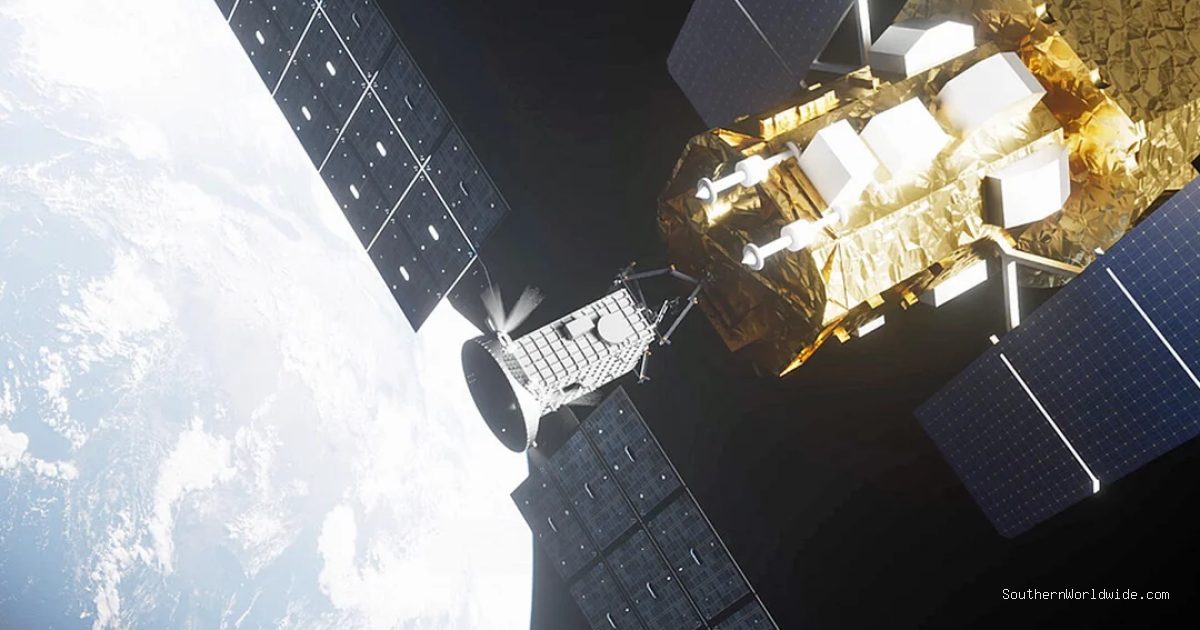
The mission aims to use robotic arms to attach to the $250 million Neil Gehrels Swift Observatory. Once secured, the tug will attempt to propel the satellite to a higher, safer orbit. This would extend the observatory’s operational life, allowing it to continue its crucial work of detecting the universe’s most energetic explosions and serve as a vital “first responder” for other telescopes.
However, the success of this ambitious endeavor hinges on the outcome of this high-risk operation.
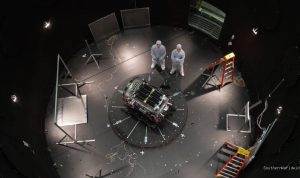
Katalyst Space designed, manufactured, and tested the LINK satellite in an accelerated timeframe of just eight months. This was achieved under a $30 million contract with NASA, which also covered the costs of its air-launched Northrop Grumman Pegasus XL booster and the carrier jet. This represents a remarkably low price for such a complex mission.
The launch, which was delayed by three days due to adverse weather conditions and a software issue, saw the LINK satellite and its booster released from Northrop Grumman’s L-1011 jet at 4:36 a.m. ET. The payload dropped from an altitude of 40,000 feet over the Marshall Islands in the South Pacific Ocean.
NASA confirmed that the booster’s three solid-fuel stages ignited as planned, successfully placing the satellite into orbit. Mission controllers are now commencing detailed system checks, pending confirmation of the LINK’s solar arrays deploying correctly.
If all systems function as expected, mission controllers will dedicate several weeks to thoroughly testing the spacecraft’s capabilities. Following these checks, the actual rendezvous with the Swift observatory will commence. Should the operation proceed smoothly, the LINK spacecraft will utilize its three robotic arms to engage a flange that was used for ground transport during its assembly.
Following the capture, low-power but efficient ion thrusters will begin firing. These thrusters will gradually elevate the telescope to an altitude of approximately 370 miles, potentially extending its mission by another decade. The entire reboost operation is anticipated to take between 10 to 12 weeks to complete.
“The accomplishments of the Katalyst team in merely eight months are truly extraordinary,” stated Ghonhee Lee, CEO of Katalyst Space, on the company’s website. “The team successfully designed, built, tested, and integrated a robotic spacecraft capable of executing one of the most ambitious commercial servicing missions ever attempted.”
The question arises: what necessitated such a compressed timeline for this mission?
“If we do not intervene, the Swift satellite will de-orbit by the end of this calendar year,” Shawn Domagal-Goldman, director of astrophysics at NASA Headquarters, explained to CBS News. “The clock is ticking, and time is of the essence.”
Furthermore, what is the compelling reason to invest significant effort in extending the operational life of a satellite that has already far surpassed its initial two-decade design expectancy?
Launched in 2004, Swift was engineered to survey deep space, specifically searching for the high-energy radiation emitted by gamma-ray bursts. These are recognized as the most powerful explosions in the universe since the Big Bang over 14 billion years ago.
Gamma-ray bursts are theorized to originate from the collapse of massive stars during supernova events, potentially leading to the formation of black holes. They can also occur when two dense neutron stars collide, generating immense energies capable of forging heavy elements that even the Big Bang could not produce.
“Swift was specifically designed to study gamma-ray bursts, which are brief flashes of high-energy light that release more energy in mere seconds than the sun will in its entire lifespan,” explained Brad Cenko, Swift’s principal investigator.
“Since its launch in 2004, it has achieved remarkable success in this area, detecting over two thousand of these sources extending to the very edge of the observable universe. This has been instrumental in confirming that most of the heaviest elements in the periodic table, including the gold and platinum found in our jewelry, are synthesized in these cosmic events.”
Although designed for a two-year mission, Swift has been gradually descending to lower altitudes over the past two decades. This orbital decay is attributed to interactions with residual particles in the extreme upper atmosphere, which extend into the realm of low-Earth orbit.
Solar storms have the effect of heating the atmosphere, causing it to periodically expand. This expansion increases the atmospheric drag on the spacecraft, and Swift is not equipped with the necessary thrusters to counteract this persistent downward pull.
The observatory is currently losing approximately five miles in altitude each month. This descent rate is expected to accelerate as it ventures into denser regions of the upper atmosphere. Projections indicate that the satellite will reach an altitude of 186 miles by October.
“At present, we believe there are several months during which Swift will maintain a sufficiently high altitude to provide the Katalyst team with a strong opportunity to capture and boost it,” Cenko stated.
Katalyst Space was already engaged in the development of robotic satellite rescue and servicing systems. NASA identified the Swift reboost mission as an ideal opportunity to test this emerging technology while simultaneously potentially restoring a valuable scientific satellite to active service.
The outcome of this initiative is the LINK spacecraft, weighing 940 pounds. It is equipped with three xenon-fueled ion engines, solar panels capable of generating 4 kilowatts of power, three robotic arms, 16 orientation control thrusters, and a sophisticated array of sensors and systems specifically designed for rendezvous and the close-proximity operations required for capturing Swift.
“Initially, many doubted the feasibility of this mission,” admitted Domagal-Goldman. “Few believed we would reach this stage. To be candid, there are still significant risks ahead. Nevertheless, I am profoundly grateful and as optimistic as possible that we will successfully overcome these challenges.”
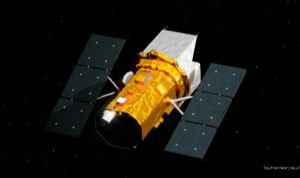
The Swift space telescope is outfitted with three instruments that collaborate to observe GRBs, detecting gamma rays, X-rays, and ultraviolet emissions.
The spacecraft was aptly named “Swift” due to its capability to swiftly detect and re-orient itself to lock onto a GRB. It can then transmit precise location data to other observatories for coordinated observations before these transient celestial events fade from view.
“While the Hubble Space Telescope offers greater sensitivity and captures more detailed images than Swift,” Cenko commented, “Hubble requires at least one to two days, in the best-case scenario, to reposition itself to a target of interest. In contrast, Swift can routinely follow up on phenomena detected in the night sky within minutes.”
“It truly functions as NASA’s ‘first responder.’ By working together in this complementary fashion, NASA’s astrophysics portfolio can address scientific questions that would be insurmountable for any single facility to answer independently.”
Katalyst Space harbors ambitious aspirations for the Swift reboost mission. The company envisions developing a range of robotic spacecraft that could, in the future, be utilized not only for reboosting aging satellites but also for refueling and even repairing high-value civilian and military spacecraft that might otherwise become inoperable or lost.
A scaled-up version of this same technology could potentially be employed at some point to boost the slowly descending Hubble telescope back to a safe altitude. The world’s most renowned space telescope, now in its 36th year of a historic mission, is projected to re-enter Earth’s atmosphere in the 2030s if no intervention is undertaken.
“Katalyst’s objective is to signify the end of the ‘disposable’ model and usher in a new era,” stated Robert Lamontagne, Katalyst’s vice president of strategic partnerships. “The expectation should be that satellites can be refueled, repositioned, repurposed, repaired, and even upgraded, regardless of whether they were initially designed for such interventions.”