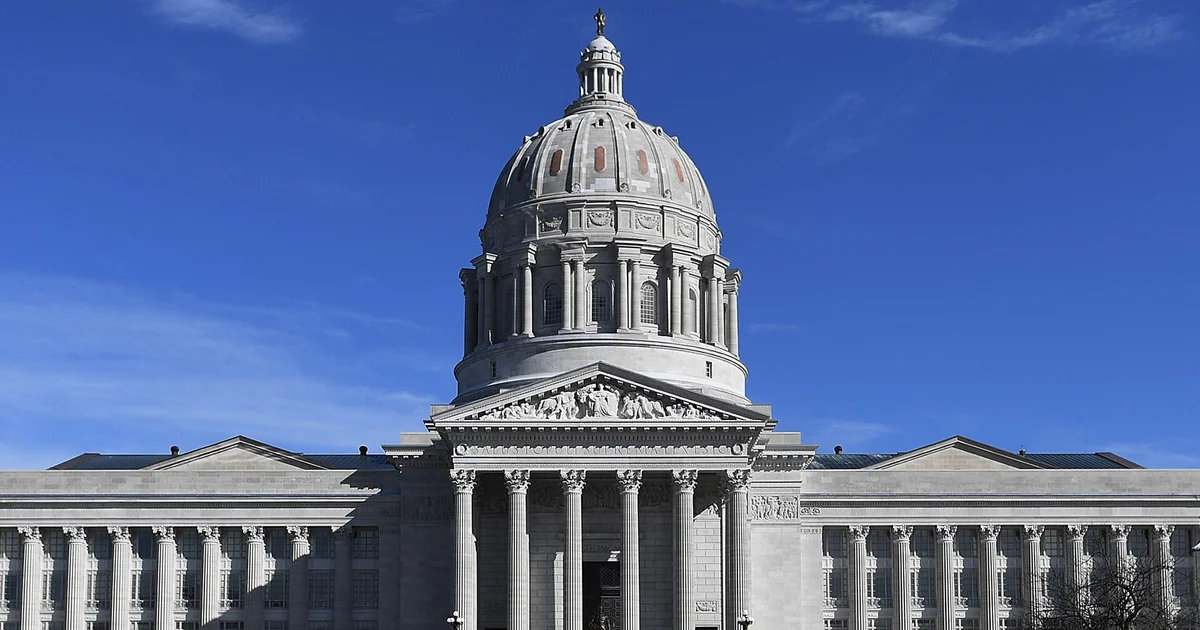
SouthernWorldwide.com – Missouri lawmakers have approved a Republican-backed redistricting plan that could lead to an additional GOP-leaning seat in the U.S. House of Representatives. This move aligns with a nationwide trend of redistricting efforts supported by former President Donald Trump.
The state Senate passed the redistricting proposal on Friday, sending it to the desk of Republican Governor Mike Kehoe. Governor Kehoe has publicly stated his intention to sign the bill into law. The state House of Representatives had previously passed the plan on Tuesday. Governor Kehoe had convened a special legislative session last month specifically to address the redrawing of congressional districts.
The newly approved map is expected to alter the political landscape by dividing the Kansas City area. This division is anticipated to make the district represented by longtime Democratic Representative Emanuel Cleaver more conservative. If enacted, Missouri would have seven Republican-leaning House districts and one Democratic-leaning seat. This represents a shift from the current composition of the state’s House delegation, which consists of six Republicans and two Democrats.
This redistricting initiative in Missouri follows similar mid-decade adjustments made in California and Texas. The broader strategy to reshape congressional maps is seen as a Republican effort to secure their narrow majority in the House of Representatives in the upcoming midterm elections.
Under the influence of former President Trump, Texas officials passed a redistricting plan last month that aims to create five new Republican-leaning districts. In response, California lawmakers swiftly advanced a map designed to shift five Republican-held seats towards the Democrats. However, the California plan still requires voter approval in a special election scheduled for this fall.
Former President Trump publicly praised the Missouri lawmakers for moving forward with the new map. In a post on Truth Social, he expressed his hope that the plan “will, hopefully, give us an additional Seat in Congress” and “will help send an additional MAGA Republican to Congress.” He further described the approved map as “much fairer, and much improved.”
Read more: North Carolina lawmakers approve new congressional district boundaries
House Minority Leader Hakeem Jeffries, a Democrat from New York, criticized the new maps, referring to them as “rigged” in a statement released on Friday. He accused “corrupt Missouri Republicans” of advancing their “mid-decade gerrymandering scheme” to influence the midterm elections and bolster the Republican House majority, acting upon the demands of Donald Trump.
Prior to the passage of the new maps, Professor Peverill Squire of the University of Missouri informed CBS News that Republicans had considered splitting Representative Cleaver’s district for some time. However, he cautioned that such actions come with potential risks. Squire noted that the redrawn maps are based on data that is several years old and may no longer accurately reflect current demographics. He also indicated that legal challenges are a distinct possibility.
“There’s a lot of risk for the Republicans, and the only thing at the moment that they stand to gain is maybe one more House seat,” Squire stated, highlighting the potential benefits versus the inherent risks involved in the redistricting process.
Within hours of the state Senate passing the redistricting plan, opponents initiated a legal challenge in state court. The lawsuit contends that the new map is “unconstitutional in a host of ways” and asserts that the process was conducted in a “slapdash and rushed” manner. The legal action, brought forth by the ACLU of Missouri and the Campaign Legal Center, argues that the Missouri Constitution permits only one redistricting per decade, following the release of new census figures. It also mandates that House districts should be as geographically compact as possible.
The lawsuit further alleges that the primary objective of the new maps is “to transform what has long been a seat anchored in the Democratic-leaning Kansas City metropolitan area into a district dominated by rural, Republican-leaning counties, an outcome accomplished by splitting Kansas City’s Black and white residents along stark racial lines.” This suggests that the redistricting is intended to dilute the voting power of minority communities within the Kansas City area.
This report was contributed to by Nikole Killion and Caroline Linton.